

Car Seat Gap Fillers: Fit, Compatibility and What to Avoid
The gap between your seat and the center console swallows phones, cards, coins and crumbs — and the fix is cheap, but only if it fits. A filler that is too wide presses on the seat, one that is too narrow slides to the floor, and a rigid organizer in a gap that changes width will bind every time you slide the seat. Measure the gap first, at both ends of the seat’s travel. Then check the seat belt buckle, the seat rails and anything wired under the seat. If any of those checks fails, do not use the filler — no gap is worth a blocked buckle.

Quick Decision
Decide the job first: close the gap only (soft blocker), close it and store a phone or cards (pocket organizer), or add a cup holder (full caddy). Measure the gap, not the seat — width at its widest, seat fully forward, then fully rearward, on both sides. If the width changes by more than about a quarter inch across the travel, choose a compressible blocker, not a rigid box. Check the buckle: the filler must sit beside it, never over or under it, and the belt must latch, release and retract freely. Check the rails and wiring: nothing may be wedged under the seat or forced past a harness. Ventilated seats: go thin and soft, and put storage in the console instead. Stop conditions: buckle covered, seat will not slide, wiring or vents blocked, or the filler must be forced — remove it.
How this guide was put together. LanPicks does not test seat gap fillers hands-on. The measurement steps, type comparison and safety checks here come from published fitment guides, checked on 14 November 2026. Gap-width ranges and the quarter-inch rule of thumb come from those guides, not from measurements of any car, and no prices, model names or ratings appear here, because none of the sources verified them as measurements. The hero image is AI-generated; the diagram is an original conceptual drawing, not a measurement. See our Editorial Policy.
On this page
Filler vs Storage Organizer
“Car seat gap filler” and “car seat gap organizer” are used as if they meant the same thing. They cover three distinct products that solve different problems, and buying the wrong type is the most common mistake in this category.
A pure blocker is a foam or neoprene wedge that compresses into the gap and moves with the seat. It stores nothing. Its entire purpose is to make sure nothing ever falls through again — phones, coins, keys, fries. Because it squashes, it is the most forgiving type on fitment, and it is the right choice when your only complaint is losing things.
A gap organizer is the hybrid: a hard or semi-rigid lip that hooks over the seat edge, a blocking panel, and a pocket or two facing up. It gives you storage — a phone slot, card slots, sometimes a cable pass-through — but it needs the gap to sit inside a specific width range, and the added height can foul the seat belt buckle stalk. A slim pocket organizer is the middle step: a flat pouch that holds a few small items and asks less of the gap than a full box.
A console organizer is a different product entirely: trays, dividers and inserts that live inside the center console bin or armrest. It does not touch the seat gap at all. If your actual complaint is a console bin full of loose change, cables and receipts, this is the category you want — and the good ones are molded for a specific vehicle platform. Plenty of people need two of the three: a blocker for the gap and a console insert for the bin coexist happily.
Swipe to compare all columns →
| Type | What it does | Best for | Watch out for |
|---|---|---|---|
| Pure blocker (soft wedge or strip) | Closes the gap; stores nothing | Stopping things falling; variable-width gaps; power seats | Too narrow slides down; too wide presses on the seat |
| Slim pocket organizer | Closes the gap; holds a few small items | A phone and cards, with a slim profile | Bulk near your leg or the gear selector |
| Full organizer / caddy | Closes the gap; phone, cards, sometimes a cup holder | Wide gaps with a tall, straight console | Fit, buckle clearance, seat movement, vent blocking |
| Console insert | Organizes the console bin; does not touch the gap | A messy console bin | Must match your exact console; does nothing for the gap |
If your only goal is to stop things falling, start with a filler. If you want somewhere to put things, consider a pocket or a full organizer — and accept that storage makes the fit harder, not easier. A pocket that collects crumbs and is awkward to clean, or an open slot that puts a phone on display, may be worse than the gap it replaced.
Measure the Gap
“Universal fit” is a marketing phrase, not a measurement. Cars differ, and even the two sides of one car can differ — the driver’s gap is often different from the passenger’s, because the seats sit on different rails and in different positions. Measure the gap, not the seat.
Slide the seat fully forward, then measure the horizontal gap between the outer edge of the seat cushion and the console wall at the widest point — usually around the seat belt catch. Then repeat with the seat fully rearward, and repeat both measurements on the passenger side. Most sedans and crossovers land somewhere between roughly half an inch and an inch and a half, according to one fitment guide; full-size trucks and body-on-frame SUVs can run considerably wider. Write down all four numbers: forward and rearward, driver and passenger.
The second measurement matters more than the first. Some vehicles with power seat tracks have a gap that changes width dramatically through the seat’s travel, and a rigid organizer sized to the gap at the rear of the track can bind, pop up or scrape trim when you slide forward. One guide’s rule of thumb is that if the gap width varies by more than about a quarter inch across the travel, a compressible blocker will serve you better than a rigid caddy — soft wedges do not care about the change, rigid boxes do. Also note how deep the gap goes, and whether the console wall is vertical or sloped: a box-style organizer often relies on the console being taller than the seat edge to hold it steady, and if the console is low or tapers sharply, a rigid organizer may lean or sag, while a soft filler copes better with odd shapes.
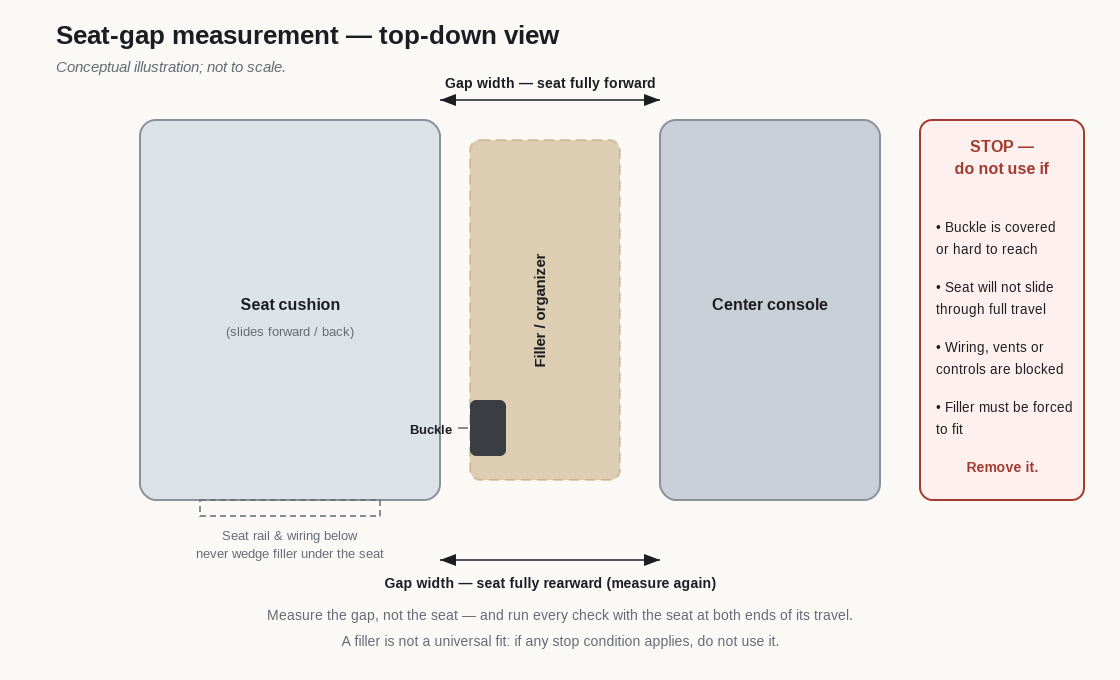
The diagram above shows the gap in top-down view: the seat cushion on one side, the center console on the other, the filler between them, and the two width measurements — seat fully forward and seat fully rearward. The buckle block sits beside the filler, never under it. The red panel lists the stop conditions: buckle covered or hard to reach, seat will not slide through its full travel, wiring, vents or controls blocked, or the filler must be forced to fit. The diagram carries no dimensions — fill in your own measurements from the worksheet at the end of this guide.
Compare your numbers with the width range stated on the listing. If the listing does not state a range, treat that as a warning sign — a seller who will not state the fit has not measured it either. And check whether the price is for one piece or a pair: most cars have a gap on both front seats, and many listings sell a single piece.
Check Seat Movement and Buckles
Fit is not a single measurement; it is a set of clearances that have to hold while the seat moves and the belt is used. Run these checks after fitting, before you drive.
First, the seat belt buckle — the most important check in this guide. Whatever you install should sit beside the buckle, never over or under it. Latch and release the seat belt several times: the button must stay visible and easy to press. Pull the belt out and let it retract fully, and check that nothing catches it. Then slide and recline the seat and confirm nothing pinches, folds into the seat rails or pulls on the upholstery. If anything interferes with the belt, the seat or the controls, remove the filler. The few dollars saved are not worth a buckle you have to fish for.
Second, the seat’s full travel. Run the seat from fully forward to fully rearward with the filler in place. If the filler lifts, binds, pops up or rubs trim at either extreme, it is the wrong size or the wrong type. For organizers, test buckling and unbuckling while seated normally — a product that makes you fish for the buckle has made your car worse, not better.
Third, look underneath. Seat rails, wiring looms for heated or powered seats, occupancy sensors and seat belt pretensioner hardware all live in that zone. An organizer that bottoms out on a rail will never seat properly, and an aggressive push can chafe a wiring harness — a genuinely expensive mistake on cars where a damaged seat-side airbag or occupancy sensor circuit triggers a warning light. Slide the filler in from the front of the seat rearward, keeping it on top of any wiring, not under it, and work around the seat belt stalk rather than forcing the filler past it. Seat-mounted side airbags deploy from the outboard bolster, away from the console, so a filler in the inboard gap is generally clear of the deployment path — but still check your owner’s manual and do not block the area the airbags are designed to deploy through.
Finally, the controls around the gap. A tall caddy can crowd your elbow, the gear selector or the seat controls, and a filler that presses against a seat-adjustment switch can move the seat when you do not mean it to. Sit in the car, belted, and reach everything you normally reach. If the filler is in the way of any of it, it does not fit — whatever the listing said.
Follow Vehicle and Product Instructions
Two documents decide whether a filler belongs in your car: your vehicle’s owner’s manual and the product’s own instructions. Read both before you buy, not after the filler is already wedged in.
The owner’s manual is the authority on what must stay clear. It shows where the side airbags deploy, where the seat wiring and sensors run, and whether your seats are ventilated — and ventilated seats change the choice. Their air is pulled or pushed through ducting that often vents at the seat base edges, and packing a thick foam wedge or a hard plastic box tight against that area can reduce airflow and make cooled seats feel weaker. The guides’ workaround is a thin, soft blocker pushed only as far as it needs to go to close the gap, not jammed under the cushion — and if you want real storage with vented seats, put the storage inside the console instead and keep the gap hardware minimal.
The product’s instructions state its width range, its material and its limits. Check the stated range against your own measurements, and check the material against your interior: a wipeable outer surface such as coated fabric, neoprene or silicone is easier to live with than open foam, which can soak up spills and hold odors. PU leather with a high-density sponge interior conforms to irregular gaps; neoprene is springy and recovers its shape; rigid TPE holds its shape precisely but will not compress to fill a tapered gap. Check the product images for rough edges or stiff plastic corners that could scrape your upholstery, and for an exposed zipper seam — on leather seats, exposed metal zipper teeth can scuff. Do not cut a filler to fit unless the maker explicitly says it is safe: cutting some designs can compromise their structure or void the warranty.
And consider whether the gap is even the right problem to solve. If your phone is the thing that keeps falling into the gap, a filler is only one fix — a mount keeps the phone out of the gap entirely. Our guide on how to choose a car phone mount covers the same kind of compatibility check: mount type, placement and what must stay unobstructed. Whichever fix you choose, the rule is the same — measure first, and do not cover anything the car needs to move, sense or deploy.
When Not to Use One
A seat gap filler is a small accessory with a short list of hard limits. If any of these apply, do not use one — there is no version of the product that makes the condition safe.
Do not use one if it covers or crowds the seat belt buckle, the belt will not retract fully, or you have to hunt for the release button. Do not use one if the seat will not slide through its full travel, recline freely, or if the filler lifts, binds or scrapes trim at either end of the travel. Do not use one if it must be forced into the gap, wedged under the seat cushion, or pressed against wiring, sensors or pretensioner hardware. Do not use a thick foam wedge or a tall rigid caddy against ventilated-seat vents. Do not use one if your car has no gap to fill — some vehicles have a wide, flat center console that meets the seat, and there is nothing to close.
There are softer limits too. Do not overfill a storage box with hard coins and keys: it becomes a rattle, and in a crash it becomes a projectile. Do not leave a filler in place for a year without looking under it — pull blockers out every few months and vacuum beneath them, because fabric-covered foam in a gap collects crumbs and, in a warm cabin, can start to smell. And do not assume a filler that fit the driver’s side fits the passenger’s side: measure both, because the gaps can differ.
Fit Checklist
Vacuum the gap first with a narrow nozzle — every filler sits on top of whatever is down there, and a filler fitted over a coin rolls. Then work through the worksheet, with the seat at both ends of its travel, before you drive anywhere.
Swipe to see all columns →
| Check | Your measurement or result | Pass? |
|---|---|---|
| Gap width, seat fully forward | Your measurement | Inside the product’s stated range |
| Gap width, seat fully rearward | Your measurement | Inside the product’s stated range |
| Width change across travel | Forward minus rearward | About a quarter inch or less, or a compressible blocker chosen |
| Passenger-side gap | Your measurement | Measured separately; not assumed from the driver’s side |
| Seat belt buckle | Latch, release, retract test | Button visible, belt retracts fully, nothing catches |
| Seat full travel | Slide forward and back, recline | No lifting, binding, popping or trim rubbing |
| Rails, wiring, vents, controls | Visual check under and beside the gap | Nothing wedged under the seat; vents and controls clear |
| Console height and shape | Console vs seat edge | Rigid organizer has support; soft filler chosen if the console tapers |
The rows above are placeholders, not dimensions — fill in your own measurements. If every row passes, the filler fits your car. If any row fails, the answer is not a different brand of the same type — it is a different type, or no filler at all. Re-check after a week of driving: a filler that has crept forward, compressed unevenly or started to rub trim is telling you the fit was marginal, and it will not improve on its own.
FAQ
Will a seat gap filler fit my car?
No one can tell from a car model name alone. Measure your gap — width at its widest, seat fully forward and fully rearward, on both sides — and compare it with the width range stated on the listing. If the listing states no range, treat that as a warning sign.
Are seat gap fillers safe with side airbags?
They can be if installed correctly. Seat-mounted side airbags deploy from the outboard bolster, away from the console, so a filler in the inboard gap is generally clear of the deployment path. The real risk is physical: forcing a rigid product against wiring, sensors or pretensioner hardware under the seat. Keep fillers on top of the rails, never wedged under them, and check your owner’s manual for your car’s airbag layout.
Do gap fillers work with ventilated or cooled seats?
Thin, soft blockers usually do. Thick foam or tall plastic caddies can restrict airflow around the seat-base vents and make cooled seats feel weaker. If you have vented seats, go minimal at the gap and put your storage inside the console instead.
Should I buy a filler or an organizer?
A filler is simpler and slimmer if you only want to stop things falling. An organizer adds storage but needs a suitable gap and console — a consistent, moderate gap and a console tall enough to support it. If your gap changes width as the seat slides, choose a compressible filler over a rigid organizer.
Can I use one on both seats?
Usually, but gaps can differ between sides, so measure both and check whether the listing is for one piece or a pair. Do not assume the price shown covers both seats.
Conclusion
Measure the gap, not the seat — at both ends of the travel, on both sides. Choose the type that matches those numbers: a soft blocker for a changing gap, a pocket organizer for a steady one, a full caddy only where the gap is wide and the console can support it. Then run the buckle, rail and seat-travel checks, and respect the stop conditions. A filler that passes all of them is a small, invisible fix; one that fails any of them is a problem you paid for.
Sources
- GarageProof — Car Seat Gap Filler Organizer 2026: Fit It First, Buy It Second (three product types, measuring forward and rearward, quarter-inch rule, rails and wiring, ventilated seats, install order; accessed 14 November 2026)
- CarGearFinder — Car Seat Gap Organizers: How to Choose One That Fits (filler vs organizer, “universal fit” as marketing, buckle checks, console shape, desk research not testing; accessed 14 November 2026)
- HomeToSight — 5 Best Car Seat Gap Fillers | Lost Phone Retrieval Ends Here (retention design, materials, zipper and trim risks; accessed 14 November 2026)
- SideMyney — Best Car Seat Gap Filler and Organizer Malaysia 2026 (fitting checks, vacuum first, do not overfill; accessed 14 November 2026)
Related Posts

This guide is about one specific listing: a 4K dash cam listed with parking monitoring, night vision, smart voice control and 24-hour automatic DVR, described as mini and easy to install. LanPicks has not tested this dash cam, and this guide reports no test results and no prices. What it does is separate what the […]

A dash cam records the road while you drive — and, with the right setup, while you are parked. The choice is not which model wins a roundup. It is which setup fits your car and your risk: front-only or front and rear, what resolution, and whether you need parking mode. This guide explains each […]
This guide looks at one AliExpress listing: “Magnetic Car Phone Holder Universal Air Vent Car Phone Mounts.” It is a magnetic holder that mounts on a car air vent, and the listing describes it as universal. This page explains what that wording does and does not promise, and the two checks that decide the fit. […]

Quick Decision If your car has sturdy, flat vent blades, start with a vent mount: it installs in seconds, moves between cars, and leaves nothing behind — but it blocks airflow and can sag under a heavy phone on weak blades. If your vents are round, recessed, or flimsy, a dashboard mount is the steadier […]

A trunk organizer only works if it fits — through the opening, on the floor, and around the things you already carry. Measure the usable cargo area first: width, depth, height to the lid or parcel shelf, and the width of the trunk opening itself. Then list what you actually carry every week and match […]