

Men’s Travel Grooming Kit: What to Pack and What to Skip
A travel grooming kit is not a smaller bathroom — it is your normal routine, cut down to what you actually use, sized to the trip, and packed so it clears security and does not leak. Pack by trip length, not by habit: the core stays the same on every trip, and only the additions grow as the trip gets longer. On US flights, every liquid in your carry-on must be in a container of 3.4 ounces (100 ml) or less, inside one quart-size bag — and that rule, not the size of your bag, decides what goes in the liquids pouch.

Quick Decision
Start with the core: toothbrush and toothpaste, floss, deodorant, cleanser, moisturizer with SPF, a comb — that set covers every trip, from one night to two weeks. Size by trip length: overnight, trim before you leave and add nothing; weekend, add a razor or trimmer and travel-size shampoo; a week, add conditioner, extra deodorant and nail clippers; longer, plan a refill or buy at the destination. Follow the 3-1-1 rule on US flights: each liquid container 3.4 oz (100 ml) or less, all in one quart-size bag — the container size counts, not how much is left in it. Move what you can to solids — bar soap, solid deodorant, toothpaste tablets — because solids skip the liquids bag entirely. Prevent leaks: do not overfill, close lids firmly, test refillable bottles at home, and double-bag liquids. Check the rules for your route before you fly: TSA rules govern US airports, other countries set their own limits, and the final decision rests with the officer at the checkpoint.
How this guide was put together. LanPicks does not test travel kits hands-on. The packing logic and trip-length guidance here come from published travel grooming guides, and the baggage rules come from the US Transportation Security Administration’s own pages, all checked on 14 November 2026. Baggage rules change and differ by country and airline, so this guide tells you which official source to check rather than presenting one country’s rule as universal. No prices, no product rankings and no brand recommendations appear here. The hero image is AI-generated; the diagram is an original conceptual drawing, not a measurement. See our Editorial Policy.
On this page
Plan by Trip Length
The key is to pack for your routine, your destination, and the length of your trip. A man with a close-cropped haircut and a beard needs a different setup from someone who shaves daily and uses a styling product; a beach vacation calls for more sun protection than a short conference trip, while a week of workouts means extra deodorant and shampoo. The categories do not change with trip length — the quantities and the extras do.
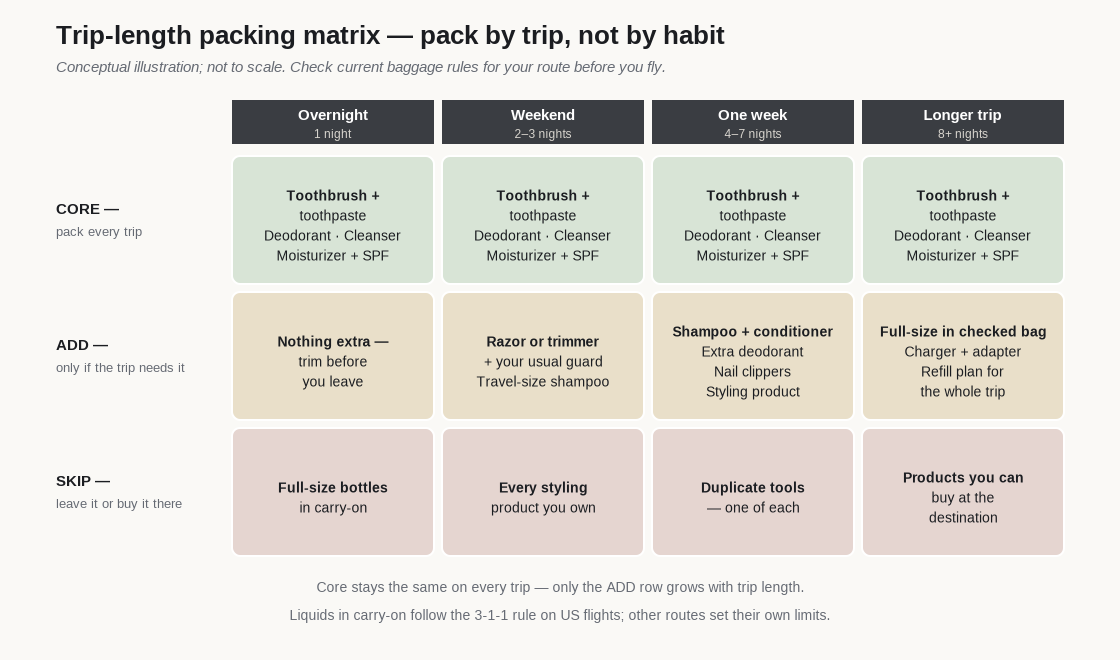
Text equivalent: the matrix has four columns — Overnight (1 night), Weekend (2–3 nights), One week (4–7 nights), Longer trip (8+ nights) — against three rows. The CORE row is the same in every column: toothbrush and toothpaste, deodorant, cleanser, moisturizer with SPF. The ADD row grows with the trip: overnight, nothing extra — trim before you leave; weekend, a razor or trimmer with your usual guard plus travel-size shampoo; one week, shampoo and conditioner, extra deodorant, nail clippers and styling product; longer trip, full-size bottles in the checked bag, a charger and adapter, and a refill plan for the whole trip. The SKIP row is what to leave behind or buy at the destination: full-size bottles in carry-on, every styling product you own, duplicate tools, and products you can buy where you are going.
A two- or three-day trip is the best chance to keep the kit especially simple. If you groom before leaving, you may be able to skip tools you would need on a longer journey — for a short weekend you may not need to pack a beard trimmer at all: trim and shape your beard before leaving, then maintain it with a small comb if needed. For a casual trip, you might skip cologne and styling products; for a wedding or business event, a small amount of your usual hair product and fragrance may be worth the extra space. The goal is to pack for the activities you actually have planned: a weekend of hiking and swimming needs more sunscreen and body wash than a short city break, even though the number of days is the same.
For a week or longer, the question changes from what to pack to how much. Before a trip, pay attention to how much shampoo, cleanser and moisturizer you use in a normal week — that gives a more reliable estimate than filling every travel bottle to the top. For products that are difficult to replace, including specialized skin care or prescribed items, bring enough for the trip plus a reasonable cushion for delays. For everyday items such as toothpaste or body wash, buying a replacement at the destination may be simple if you run out. Sunscreen is the exception to bringing the smallest possible amount: outdoor activities can require regular, generous application, so plan for your actual exposure and allow room for reapplication — a small tube can run out quickly on an outdoor vacation, so pack enough in checked luggage or plan to buy more after arrival.
Keep the Core Routine
Travel is where routines fall apart. You forget your razor, use random hotel soap on your face, skip sunscreen, borrow toothpaste, and spend the whole trip feeling slightly off. Fix it with one packed grooming bag built around the routine you already follow at home — not a new routine invented for the trip.
The core is small: oral care, deodorant, cleansing, moisturizer, sun protection. A toothbrush and fluoride toothpaste belong in every kit; a compact toothbrush with a protective cover is easy to pack, and a small toothpaste tube is usually enough for a short trip. Add floss — it takes up very little room — and any retainer or dental appliance you normally use, with its case. Pack the deodorant or antiperspirant that works for you; a smaller stick suits a weekend, but a longer trip or a warm destination may call for more. A gentle facial cleanser removes sweat, oil, sunscreen and dirt at the end of the day; a moisturizer keeps skin comfortable after washing or shaving; and sunscreen belongs in the morning routine, not just on beach days.
For skin care, the guidance is to keep your travel routine similar to your routine at home. The American Academy of Dermatology recommends keeping your travel skin care routine similar to your routine at home to help reduce the chance of a reaction to unfamiliar products, and travel guides repeat the practical version: do not try many new products at once while travelling, and test a new product before you leave — especially sunscreen, facial cleansers, shaving products and hair care formulas. If several new products go on at the same time and your skin reacts, you cannot tell which one caused it. Use the products you already know, in smaller containers.
The same keep-only-what-you-use test works at home as on the road. Our guide to everyday carry essentials for men applies it to the things you carry every day — keys, wallet, phone — with a simple rule: if you have not used an item in two weeks, it does not belong in the daily carry. A travel kit deserves the same test: if you would not use it at home this week, it does not earn space in a bag you have to carry through an airport.
Hair and shaving follow the same rule. If you wash your hair during the trip, bring a small amount of shampoo that works for your scalp — hotel shampoo can be convenient, but it may not suit a dry, sensitive or easily irritated scalp, and a medicated shampoo may be harder to replace at your destination. Conditioner is optional for some men and essential for others; a two-in-one shampoo and conditioner can save space if it works well for your hair, but try it before your trip rather than assuming it will replace your usual products. A small comb is one of the easiest additions to the kit: it takes up little space, works without a charger, and keeps short or medium-length hair looking tidy.
Choose Multi-Use Tools Carefully
Multi-use products earn their space when they genuinely replace two things you would otherwise pack. A gentle cleanser that works for both face and body can replace a separate body wash — but not every body wash is comfortable on the face, so if it leaves your skin feeling tight or irritated, pack your usual facial cleanser separately. A moisturizer with sunscreen can cover two morning steps, and a suitable facial moisturizer can double for small dry areas such as your hands. A 2-in-1 shampoo and conditioner works only if your hair tolerates it. The test is always the same: does the combined product do both jobs as well as the separate ones, for your skin and hair? If not, the space saved is not worth the compromise — avoid replacing a product that your skin or hair depends on simply to save space.
Tools follow the same logic. A compact trimmer with the guard you use most often can replace a razor and a separate detail tool on a longer trip — charge it before you leave, pack its charger if you will need it, and check the manufacturer’s voltage guidance before using it abroad. A plug adapter changes the shape of the plug; it does not necessarily change the electrical voltage, so check the device’s label and instructions before using it abroad. An electric razor can be a good travel choice if you prefer a quick dry shave or want to limit the number of liquids you pack, because it needs no shaving cream. A compact cartridge or disposable razor is convenient if you shave regularly — keep the head covered to protect the blades and prevent accidental cuts when reaching into your bag.
Solids are the simplest multi-use swap of all, because they remove a category of problem rather than adding a product. Bar soap replaces liquid body wash and skips the liquids bag entirely; a solid deodorant does the same for gel or aerosol deodorant; solid shampoo and conditioner bars eliminate liquid restrictions and spill risk; toothpaste tablets replace a tube; a solid cologne stick or a small refillable atomizer replaces a full-size fragrance bottle. One guide suggests a 5 ml or 8 ml atomizer holds enough for a two-week trip. Every item you can move from liquid to solid frees space in the quart-size bag and removes a leak risk — but only swap to a solid you have already tried at home. A new bar that dries your skin out is a worse trade than a small compliant bottle of the product you know.
Small tools are worth their space because they solve practical problems without taking up much room. A compact pair of nail clippers can be useful on longer trips or whenever a broken nail needs attention — pack them in a small pouch so they do not get lost among bottles and cables. If tweezers are part of your regular routine, a small pair may be worth bringing; keep the tips protected. A few tissues or a clean, quick-drying cloth can come in handy for wiping up spills, drying a razor, or freshening up after a long journey. Lip balm is easy to carry in a pocket or day bag, and for time outdoors a lip product with SPF is worth considering. None of these needs a travel version — your regular ones fit in the bag, and a separate travel version is an extra purchase for no benefit.
Prevent Leaks
The more containers you pack, the more opportunities there are for spills. Choosing fewer products and sealing them carefully is the best leak prevention there is — but a few habits cover the rest.
Start with the containers. If you transfer products into smaller bottles or jars, select containers that close tightly and are suitable for the product, and label each one clearly so you can identify it at your destination. Do not overfill containers: leave a little room at the top, close the lids firmly, and place liquids in a separate sealed bag. Before your trip, test refillable containers at home by turning them upside down over a sink or towel — a bottle that weeps at home will leak in a pressurised cabin. For sunscreen and other products where label information matters, keeping the original labelled travel-size container can make the directions and protection rating easy to check.
Double-bag liquids inside the dopp kit. Pack liquids in a small, sealed plastic pouch within their compartment, so that even if a cap loosens or a bottle cracks under altitude changes or jostling, the spill stays inside the pouch and off your clothes. Keep the pouch separate from clothing whenever possible, and keep the liquids bag where you can reach it easily if security officers ask you to remove it. A wipeable lining makes small spills easier to clean up, and a separate compartment for a toothbrush or razor keeps those items away from the rest of your supplies.
Keep the kit clean between trips. After each trip, empty the kit, wipe down the inside, clean your tools, and allow everything to dry before storing the bag — a damp bag stored closed develops stale odours quickly. Replace low supplies before storing the bag, and keep travel-size versions ready instead of packing from scratch every time: that is how you forget the one thing you actually need. A five-minute reset makes packing for your next trip much easier, and a dedicated kit that lives packed removes the nightly repacking entirely.
Verify Route-Specific Baggage Rules
TSA rules govern US airports. Other countries set their own limits, and airlines can add their own restrictions on top — so the rule to follow is the one for your route, checked shortly before you fly, not the rule you remember from your last trip.
For flights departing from US airports, the TSA’s 3-1-1 rule is the one that decides what goes in your carry-on liquids bag: each liquid, gel or aerosol must be in a container of 3.4 ounces (100 ml) or less, all containers must fit in one clear, quart-size resealable bag, and each passenger is allowed one bag. The container size matters, not how much is left in it — a half-empty 6-ounce bottle will not pass. The rule covers liquids, aerosols, gels, creams and pastes, including toothpaste, shampoo, conditioner, mouthwash and lotion. Medically necessary liquids may be allowed in larger quantities, subject to screening.
Swipe to compare all columns →
| Item (US flights, TSA) | Carry-on | Checked bag |
|---|---|---|
| Liquids, gels, creams, pastes (shampoo, toothpaste, lotion, sunscreen) | Yes — each container 3.4 oz / 100 ml or less, in one quart-size bag | Yes — full-size allowed |
| Disposable razor | Yes | Yes |
| Cartridge razor | Yes | Yes |
| Electric razor / beard trimmer | Yes | Yes |
| Safety-razor blades (loose) | No — checked baggage only | Yes |
| Straight razor | No — checked baggage only | Yes |
| Nail clippers, tweezers | Pack and check the current TSA list for sharp tools | Yes |
The table above reflects TSA’s published “What Can I Bring?” list as checked on 14 November 2026: the disposable-razor entry states carry-on Yes and checked Yes. The safety-razor-blade row matches TSA’s “Safety Razor With Blades” entry, and the straight-razor row is an inference from TSA’s “Razor-Type Blades” rule, which prohibits razor blades not in a cartridge in carry-on — TSA does not list straight razors as a separate item, so carry-on No and checked Yes here are that general rule applied to a straight razor’s open blade. Both rows were re-checked against TSA’s live list on 16 November 2026; if you use a safety razor, remove the blade before going through security — the handle is fine in your carry-on, but the blade must go in your checked bag or be purchased at your destination. TSA’s own pages add the same caveat to every item: the final decision rests with the TSA officer on whether an item is allowed through the checkpoint.
Outside the US, do not assume the 3-1-1 rule. The UK, the EU and other regions publish their own liquid limits and their own lists of permitted items, and the limits can differ in both container size and bag size. Check the airport and airline on your route before departure, and check again if your trip crosses more than one security regime — a kit that clears your departure airport may not clear a connection. When in doubt, the safe default is to put anything questionable in checked baggage and buy a travel-size version at the destination.
Packing Checklist
Build the kit once, keep it stocked, and pack from the list rather than from memory. The checklist below is the core plus the trip-length additions from the matrix above — tick the rows that apply to your trip and leave the rest.
Swipe to see all columns →
| Item | Every trip | Notes |
|---|---|---|
| Toothbrush + toothpaste | Yes | Small tube for short trips; larger supply or buy at destination for long trips |
| Floss or floss picks | Yes | Almost no space; add retainer or dental appliance if you use one |
| Deodorant | Yes | Solid stick skips the liquids bag; pack extra for hot weather or workouts |
| Facial cleanser | Yes | Your usual product, travel-size; do not switch formulas for a trip |
| Moisturizer + SPF | Yes | SPF 30 or higher, broad-spectrum; reapply outdoors |
| Comb | Yes | Small comb; works without a charger |
| Shampoo | Weekend and longer | Travel-size or solid bar; hotel shampoo only if it suits your scalp |
| Razor or trimmer + guard | Weekend and longer | Trim before an overnight trip instead; charge trimmer before leaving |
| Shaving cream or gel | Only if you shave wet | Small tube; counts against the liquids bag |
| Nail clippers | Week and longer | Small pouch; check current rules for sharp tools |
| Styling product | Only if you use it daily | One product, small amount; test a 2-in-1 before the trip, not during it |
| Fragrance | Optional | Travel atomizer or solid stick; keep it light in shared spaces |
| Lip balm | Yes | With SPF for time outdoors |
| Charger + adapter | Longer trips / abroad | Adapter changes plug shape, not voltage — check the device label |
Before you zip the bag, run the final check: every liquid in a container of 3.4 oz (100 ml) or less and inside the one quart-size bag; solids separated from liquids; lids closed firmly and bottles not overfilled; the liquids bag at the top of the carry-on where you can reach it; the trimmer charged and its guard on; and any prescribed or hard-to-replace product packed with a cushion for delays. If something does not fit, the answer is usually to leave it out or buy it there — not to force a bigger bag.
FAQ
What should a man have in his travel grooming kit?
Most men need a toothbrush, toothpaste, floss, deodorant, body cleanser, facial cleanser, moisturizer and sunscreen. Add shampoo, a comb, shaving supplies, a beard trimmer or styling products based on your routine and trip length. Start with the core and add only what your schedule, destination and routine require.
Can I bring a razor in my carry-on?
It depends on the type. On US flights, TSA allows disposable razors, cartridge razors and electric razors in carry-on luggage. Loose safety-razor blades and straight razors must go in checked baggage. The final decision rests with the TSA officer at the checkpoint, so check the current TSA “What Can I Bring?” list for your item before you fly.
What is the TSA 3-1-1 liquids rule?
Each liquid, gel, aerosol, cream or paste in your carry-on must be in a container of 3.4 ounces (100 ml) or less, all containers must fit in one clear quart-size bag, and each passenger is allowed one bag. The container size counts, not how much is left inside it. Medically necessary liquids may be allowed in larger quantities, subject to screening.
How do I keep my grooming kit small?
Choose travel-size containers, pack only products you use regularly, and select a compact bag. Consider whether one gentle product can serve more than one purpose, but avoid replacing a product your skin or hair depends on simply to save space. Moving liquids to solids — bar soap, solid deodorant, toothpaste tablets — frees space in the liquids bag and removes leak risks.
How do I prevent toiletries from leaking in my suitcase?
Use secure containers, close lids firmly, avoid overfilling, and place liquids in a sealed bag. Test refillable bottles before your trip by turning them upside down over a sink, and keep them separate from clothing whenever possible. Double-bagging liquids inside the dopp kit contains a spill even if a cap loosens in the air.
Should I bring shampoo if my hotel provides it?
Bring your own if you prefer a particular formula, have a sensitive scalp, or use a specialized shampoo. If hotel shampoo works well for you and your stay is short, using it can save space.
Conclusion
Pack the routine you already follow, sized to the trip, and nothing else. The core — oral care, deodorant, cleanser, moisturizer with SPF — never changes; only the additions grow with trip length, and the skips are the products you can buy where you are going. Check the baggage rules for your route before you fly, keep liquids in 3.4 oz containers inside one quart-size bag on US flights, and keep the kit stocked between trips so packing takes minutes, not a last-minute scramble. A kit that is easy to pack is a kit you will actually use.
Sources
- Transportation Security Administration — Liquids, Aerosols, and Gels Rule (3-1-1 rule, 3.4 oz / 100 ml limit, one quart-size bag; accessed 14 November 2026)
- Transportation Security Administration — Travel Tips: 3-1-1 liquids rule (quart-sized bag, 3.4 oz limit per item; accessed 14 November 2026)
- Transportation Security Administration — What Can I Bring? Disposable Razor (carry-on Yes, checked Yes; final decision rests with the TSA officer; accessed 14 November 2026)
- Transportation Security Administration — What Can I Bring? Razor-Type Blades (razor blades not in a cartridge are prohibited in carry-on — the rule covering a straight razor’s open blade; carry-on No, checked Yes; accessed 16 November 2026)
- Transportation Security Administration — What Can I Bring? Sharp Objects (disposable razor carry-on Yes; fetched portion covers A–K entries only; accessed 14 November 2026)
- MensFitClub — Minimalist Travel Grooming Kit for Men: What to Pack (packing list, trip-length variants, leak prevention, AAD sunscreen and routine guidance; accessed 14 November 2026)
- Grizzly — Travel Grooming Essentials: The TSA-Friendly Kit For Men (solids vs liquids, dopp kit that lives packed, fragrance atomizer; accessed 14 November 2026)
- HandsomeFix — Men’s Grooming Essentials Checklist PDF: Build a Simple Routine That Works (core routine, travel checklist; accessed 14 November 2026)
- Shaving School — How Beard Trimmers Work: Guards & Motors (electric trimmer allowed in carry-on and checked baggage; opened 14 November 2026 for M8)
Related Posts

This guide is about one specific listing: a wireless 4D electric razor, USB rechargeable and waterproof, with a charging base. LanPicks has not tested this shaver, and this guide reports no test results and no prices. What it does is separate what the listing actually states from what you still need to check — using […]
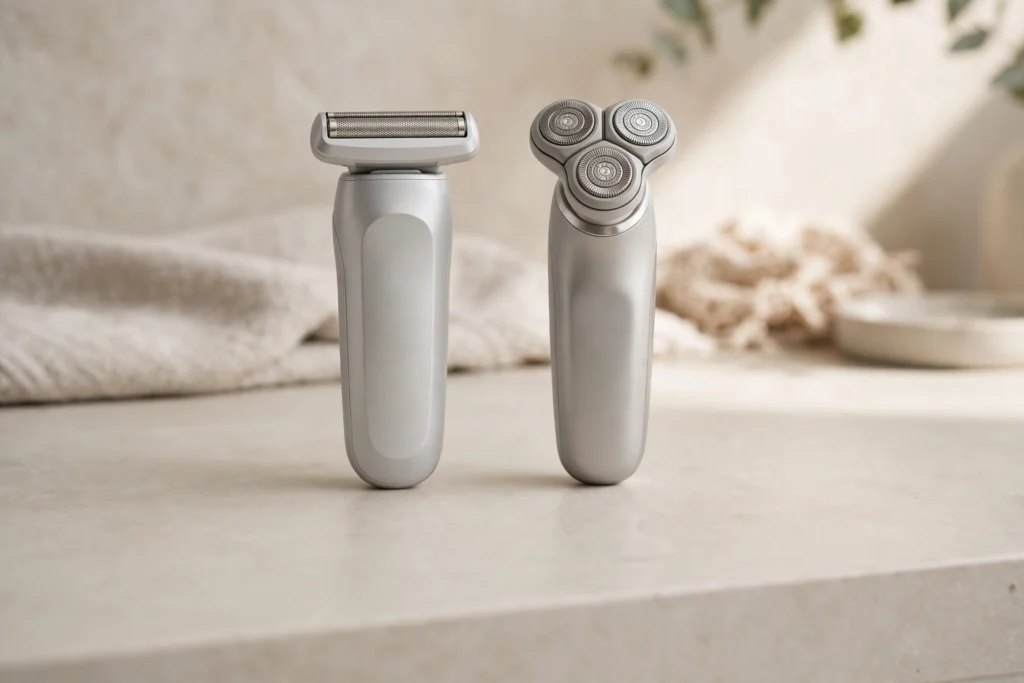
A foil shaver cuts with straight blades moving back and forth under a thin perforated foil. A rotary shaver cuts with three round heads that move in small circles. Neither type is better for everyone. The right one depends on your face shape, which way your hair grows, how thick it is, and how often […]
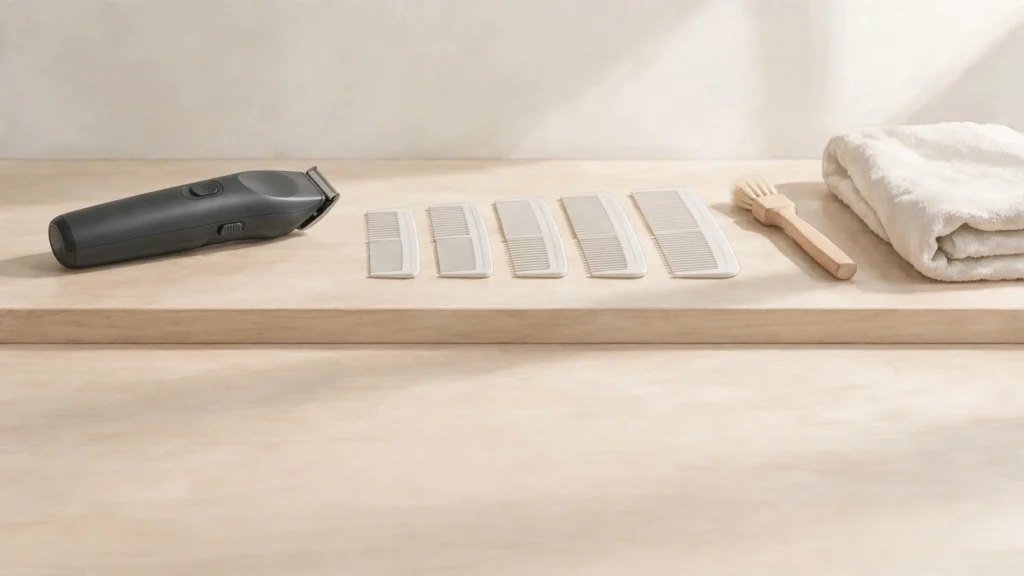
A beard trimmer is three things: a blade set, a motor and a guard — and only those three change the result. Buy by length first. Pick the style you wear most often, check that the trimmer covers that length in fine steps, then look at the guard system, the blade and how the tool […]