

Foil vs Rotary Shaver: Which One Fits Your Face?
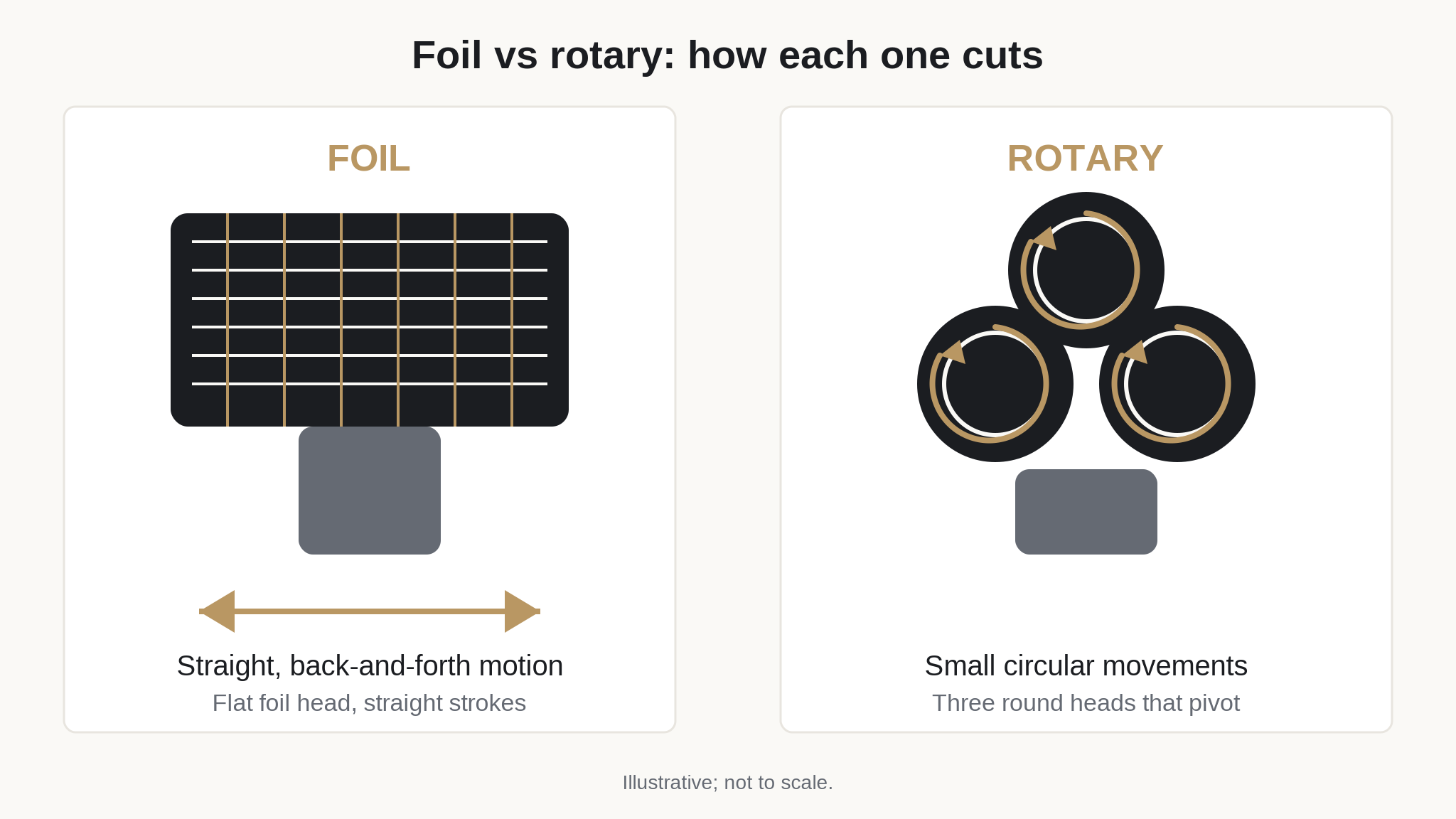
A foil shaver cuts with straight blades moving back and forth under a thin perforated foil. A rotary shaver cuts with three round heads that move in small circles. Neither type is better for everyone. The right one depends on your face shape, which way your hair grows, how thick it is, and how often you shave. This guide explains both mechanisms from the makers’ own pages, then helps you choose by those four factors. It recommends no model and reports no testing.
Quick Decision
Start with how often you shave and which way your hair grows. If you shave every day, have fine or straight-growing hair, and want clean straight edges, a foil shaver is the natural starting point — that is the foil side of Remington’s own who-benefits list. If you shave every few days, your hair grows in several directions, or your jaw and neck are heavily curved, a rotary shaver is the natural starting point — that is the rotary side of the same list. For dense, coarse stubble the makers disagree: Panasonic says a well-powered multi-blade foil shaver often has a practical advantage, while Remington puts thick or coarse hair on the rotary side, so treat that as an open question, not a rule.
How this guide was put together. LanPicks worked from the manufacturers’ own pages — Braun, Philips, Panasonic and Remington — checked on 17 November 2026. LanPicks did not test, own, or measure any shaver, and recommends no model. No price appears here. Where the makers disagree, this guide says so instead of picking a side.
How a foil shaver works
A foil shaver uses rapidly moving blades beneath a thin, perforated metal surface. Hair enters the openings in the foil and is cut by the blades moving underneath. The foil separates the blades from the skin and creates a straight, controlled shaving surface. That description is Panasonic’s, from its own guide to the two types. Braun describes the same design more plainly: straight heads with cutting blades underneath a thin layer of foil with a distinctive mesh appearance, and the foil’s purpose is capturing beard hairs and getting a close shave.
The head is a flat rectangle, so the shaver works in straight lines. Panasonic says foil shavers generally work best with short, straight, overlapping strokes rather than circular motion, and that premium foil systems may combine several cutting elements, each designed to engage different hair lengths or growth patterns during the same pass.
Remington’s own guide puts four kinds of shaver on the foil side: men who shave every day, who have fine hair, who have straight hair growth, and who are looking for more precision. The precision point is the practical one: a flat foil head gives a straight edge, so it is the easier tool for defining sideburns and the lines around a beard. Those are Remington’s categories, not an independent test result — but they match how the mechanism works. A foil head is at its best on short hair, shaved often, on a face without deep curves.
How a rotary shaver works
A rotary shaver uses circular cutting units beneath protective guards. The rounded heads are designed to move across the face in circular patterns and can be helpful around curved areas of the jaw, chin and neck. That is Panasonic’s description. Remington adds the shape: these shavers typically have three rotating circular blades in a triangular pattern, designed to follow the contours of the face, and the heads flex over the jawline, cheekbones and chin.
Philips, the maker most associated with the rotary design, says the same thing in its own support guide: choose a rotary shaver if you want a close and comfortable shave that follows the contours of your face, because the circular shaving heads are designed to catch hairs growing in different directions, including in areas such as the chin, jawline and neck, where beard growth can be less uniform. The technique follows the shape: Philips says rotary shavers are used with small circular movements, helping the heads follow the curves of the face and capture hairs from different directions.
Remington’s own guide puts three kinds of shaver on the rotary side: men who shave infrequently, who have thick or coarse hair, and whose hair grows in different directions. The logic follows the mechanism. A round head that pivots can stay in contact with a curved jaw or a neck where hair swirls, and a rotary head is designed to pick up longer hair that a foil would struggle to feed through its perforations. Philips closes its own comparison with a line worth repeating: the best choice depends on your beard growth, shaving technique and personal preference.
Foil vs rotary at a glance
The two designs differ in five ways, summarized from the makers’ own descriptions:
Swipe to compare all columns →
| Foil | Rotary | |
|---|---|---|
| Mechanism | Straight blades moving back and forth under a thin perforated foil | Three circular heads rotating under rounded guards |
| Cutting motion | Straight, oscillating action beneath a foil | Circular action beneath rounded guards |
| Typical technique | Short, straight, overlapping strokes | Small circular movements |
| Precision | Well suited to controlled lines and targeted passes | Well suited to fluid movement around contours |
| Best match | Readers who want controlled, straight-line shaving and clean edges | Readers prioritizing contouring or multidirectional growth |
Read the table as a description of how the two designs behave, not as a score. A foil head is a straight edge: it is precise, and it is flat. A rotary head is a set of circles: it follows curves, and it is not made for drawing a straight line. Everything else in this guide — the decision checks and the upkeep — follows from that one difference. On coarse hair the table takes no position: Panasonic and Remington disagree there, as the decision checks below explain.
Choose by your face, hair and routine
Work through four checks in order. The first two matter most; the last two break ties.
Check 1: your face shape
Run a finger along your jawline and neck. If the line from ear to chin is mostly straight and your neck is fairly flat, a foil head can stay in contact across the whole pass. If your jaw curves sharply, your chin sticks out, or your neck dips and rises, a rotary head’s pivoting circles are made to follow those curves — that is the point Philips and Remington both make about the design. Neither head fixes a bad fit: a flat foil on a deeply curved neck leaves patches, and a rotary on a flat cheek wastes its advantage.
Check 2: which way your hair grows
Look at the hair on your neck and jaw in a mirror. If it mostly points one way — usually downwards — a foil head’s straight strokes run cleanly against it. If it swirls, grows sideways on the neck, or points in several directions on the chin, a rotary head’s circular motion is designed to catch hairs from different directions in the same pass. Philips names the chin, jawline and neck as exactly the places where growth is less uniform. This check alone pushes many men one way or the other.
Check 3: your hair type
Fine, straight hair is the foil’s home ground in Remington’s guide, and a foil is designed to feed short hair through its perforations. Thick or coarse hair appears on both sides of the makers’ guidance, so do not let it decide for you: Remington puts thick or coarse hair on the rotary side, while Panasonic says a well-powered multi-blade foil shaver often has a practical advantage for dense, coarse stubble. If coarse hair is your main concern, the honest answer is that the makers disagree — try the type that matches your other three checks.
Check 4: how often you shave
Daily shaving keeps hair short, which is what a foil head is built to cut; Remington lists daily shaving on the foil side. Shaving every few days leaves longer hair, which a rotary head is designed to pick up; Remington lists infrequent shaving on the rotary side. If your routine changes — daily during the week, every few days on holiday — pick the type that matches the routine you actually keep, not the one you aspire to.
If the four checks point the same way, the choice is made. If they split — say, a flat face with swirling neck hair — let Check 2 decide: growth direction is the one factor the mechanism itself answers, because a foil head cannot turn corners and a rotary head cannot draw a straight line.
Technique matters more than the type
A good shaver used badly shaves worse than a middling shaver used well, and the makers are unusually specific about the motion. For a foil shaver: short, straight, overlapping strokes, per Panasonic. For a rotary shaver: small circular movements, per Philips, letting the heads follow the curves of the face.
The common mistake is to use one motion for both. Straight strokes with a rotary head fight the design; circular scrubbing with a foil head fights it the other way. If you switch types, expect the first few shaves to feel unfamiliar — that is a change of habit, not a verdict on the shaver. Philips’ own closing line is the right frame for the whole decision: the best choice depends on your beard growth, shaving technique and personal preference.
Upkeep: what wears out
Both types have parts that wear out — the foil and cutter on a foil shaver, the heads on a rotary shaver. How often to replace them depends on the exact model, so follow your own shaver’s manual rather than any general interval.
No manufacturer page read for this guide makes a comparative cleaning claim between foil and rotary, so this guide makes none either. Check the manual for how your model is cleaned — some are fully washable, some use a cleaning station — and do not assume one type is easier to keep clean than the other.
Trimmer or shaver?
Before you choose between foil and rotary, make sure a shaver is the tool you want at all. A trimmer leaves length; a shaver cuts close. LanPicks’ Beard Trimmer Buying Guide explains the difference in full: if you keep a short beard or stubble and want to shape it, a trimmer does that job, and a shaver is the wrong tool for it. If you want a clean-shaven finish, a shaver — foil or rotary — is the tool. Some men keep both: the trimmer shapes the beard and the shaver finishes the edges. That is a routine choice, not a rule — but it is worth deciding before you spend anything, because no shaver, foil or rotary, will do a trimmer’s job.
Taking a shaver travelling
A shaver’s type matters less on the road than its size, battery and charging. LanPicks’ Men’s Travel Grooming Kit notes that an electric razor can be a good travel choice if you prefer a quick dry shave or want to limit the number of liquids you pack, because it needs no shaving cream. Before a trip, check two things on your own model: whether it has a travel lock so it cannot switch on in a bag, and how it charges — a USB-charged shaver is one less cable to pack. Neither point favours foil or rotary; both types travel the same way.
Conclusion
A foil shaver is a straight edge: flat, precise, and at its best on short hair shaved daily on a fairly straight face. A rotary shaver is a set of pivoting circles: made for curves, swirling growth and longer gaps between shaves. Check your face shape, your growth direction, your hair type and your frequency — in that order — and let the checks decide. Where the makers disagree, on coarse hair, this guide has said so rather than inventing a winner. Pick the type that matches your face and your routine, learn its motion — straight strokes for foil, small circles for rotary — and judge it after you have used it properly, not on the first shave.
FAQ
Which type is better if I shave every day?
A foil shaver is the usual starting point. Remington lists daily shaving on the foil side, and a foil head is designed to cut short hair fed through its perforations. A rotary shaver is designed more for longer growth between shaves, so a daily shaver gets less of its advantage. If you shave daily and your hair grows in several directions on the neck, growth direction may still point you to rotary — work through the four checks in the guide.
Can a rotary shaver handle hair that grows in different directions?
Yes — that is the design’s main strength. Philips says the circular heads are designed to catch hairs growing in different directions, including on the chin, jawline and neck, and Remington describes three rotating heads in a triangular pattern that follow the contours of the face. Use small circular movements so the heads can meet the hair from different angles.
How often do I need to replace the foil or the heads?
Follow your shaver’s manual — there is no universal interval. The foil and cutter on a foil shaver and the heads on a rotary shaver all wear out over time, and how often to replace them depends on the exact model. Replace parts when the manual says to, or when they show signs of wear.
Do I need a trimmer as well as a shaver?
It depends on whether you keep any length. A trimmer leaves length; a shaver cuts close. If you keep a short beard or stubble, you need a trimmer to shape it — LanPicks’ Beard Trimmer Buying Guide covers that choice. If you want a clean-shaven finish, a shaver is the tool. Some men keep both, using the trimmer for shaping and the shaver for the close edges.
Sources
- Braun — Tips to choose the best electric shaver for men: foil shaver definition — straight heads, thin foil with a distinctive mesh appearance, the foil’s purpose is capturing beard hairs and getting a close shave.
- Panasonic — Foil vs. Rotary Shaver for Thick Stubble: foil and rotary mechanisms, comparison table, technique, thick-stubble position.
- Philips — Philips rotary vs foil shavers: which is better for my shave?: rotary heads and contours, small circular movements, choice depending on growth, technique and preference.
- Remington — Ultimate Series Shavers: foil and rotary who-benefits lists, three-head rotary pattern, flexing heads.
Related Posts

This guide is about one specific listing: a wireless 4D electric razor, USB rechargeable and waterproof, with a charging base. LanPicks has not tested this shaver, and this guide reports no test results and no prices. What it does is separate what the listing actually states from what you still need to check — using […]

A travel grooming kit is not a smaller bathroom — it is your normal routine, cut down to what you actually use, sized to the trip, and packed so it clears security and does not leak. Pack by trip length, not by habit: the core stays the same on every trip, and only the additions […]

A beard trimmer is three things: a blade set, a motor and a guard — and only those three change the result. Buy by length first. Pick the style you wear most often, check that the trimmer covers that length in fine steps, then look at the guard system, the blade and how the tool […]