

Vent vs Dashboard vs Windshield Phone Mounts: Key Differences
Quick Decision
If your car has sturdy, flat vent blades, start with a vent mount: it installs in seconds, moves between cars, and leaves nothing behind — but it blocks airflow and can sag under a heavy phone on weak blades. If your vents are round, recessed, or flimsy, a dashboard mount is the steadier choice, provided you have a flat, smooth spot and accept that an adhesive base is a commit-once install. A windshield mount puts the phone highest and closest to your line of sight, but it is the only one of the three whose legality varies by state, and its suction cup is the first to let go in summer heat. The location decides the mount — check your vents, your dash surface, and your local rules before you buy. If you have not narrowed down the mount type yet, our car phone mount guide walks through checking your car, phone, and case first.
How this guide was researched. We checked the search results for “vent vs dashboard phone mount” on 13 November 2026: the dominant intent is a location comparison, led by MaviGadget, GiftedPicks, eatsip365, and the Safety Behind the Wheel Foundation’s placement guide. Attachment and removal details come from the makers’ own instructions — iOttie’s vent-mount manual, Scosche’s MagicMount instructions, and Quad Lock’s suction-mount manual — and placement and state rules come from the foundation’s guide and LegalClarity’s state-by-state summary. We did not test any mount hands-on, and the blade ranges and cradle widths below are each maker’s stated limits for a named model, not universal fits. No prices are given, and no mount is called the safest for every car.
Contents
Quick Location Comparison
The three locations solve the same problem — holding the phone where you can see it without holding it — with three different attachments. A vent mount hangs the phone from a vent blade. A dashboard mount sticks it to the dash top. A windshield mount suctions it to the glass. Everything that follows is a consequence of that attachment: what surface it needs, how it fails, and how hard it is to remove.
Swipe to compare all columns →
| Location | How it attaches | Where the phone sits | Removal | Main risk |
|---|---|---|---|---|
| Vent | Clip or hook on a vent blade | Low–mid dash, in the airflow | Pulls off in seconds, no residue | Blocks airflow; sags on weak blades |
| Dashboard | Adhesive base or suction cup | Dash top, near the center | Adhesive is semi-permanent; suction peels off | Residue or marks; needs a flat, smooth spot |
| Windshield | Suction cup on the glass | High, near your line of sight | Peels off; the cup can be washed and reused | Fails in heat; legality varies by state |
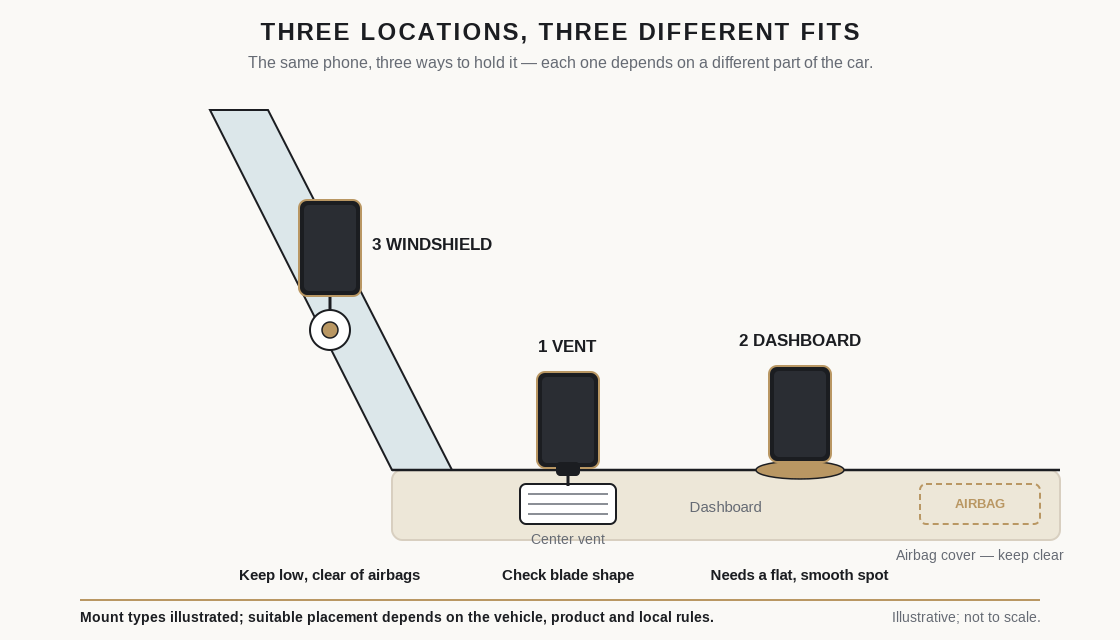
Diagram text equivalent. Side view of a car cabin: the windshield slopes down to the dashboard. A phone sits low on the windshield on a suction cup (keep low, clear of airbags). A second phone clips to the center vent (check blade shape). A third phone stands on an adhesive base on the dashboard top (needs a flat, smooth spot). The passenger-side airbag cover is marked as a keep-clear zone.
Vent Geometry
A vent mount is the simplest of the three: a clip or hook closes on a vent blade, and the phone hangs from it. Most vent mounts fit both horizontal and vertical blades — iOttie’s Easy One Touch 5 uses a twist-lock clip for either orientation, and the iTap 3 manual tells you to rotate the hook sideways for a vertical vent. But the iTap 3 manual also states the limit plainly: the mount “is designed to be used only with FLAT air vent blades.”
That flat-blade condition is where most vent-mount failures start. Round, turbine-style vents — common in some European cars and sports cars — have no flat blade for a hook to close behind, and listings for several vent mounts exclude them outright. The LISEN Master states its vent range as blades 10–35 mm deep and under 4.2 mm thick, with round vents out; a Lamicall wider-clamp holder states a 10–29 mm hook extension, blades under 4.2 mm thick, and the same exclusion. Those are each model’s stated limits, not a universal rule — check the listing for the exact mount you are considering, and measure your own blades before ordering.
Blade strength matters as much as blade shape. A heavy phone in a thick case hangs its full weight from one thin slat, and flimsy or older blades bend, rattle, or let the phone droop over bumps. A support foot or brace that rests against the dash below the vent takes some of that load — the Easy One Touch 5 has an extendable foot for exactly this — but no brace fixes a vent that already wobbles. If your blades feel brittle, choose a different location. Measure the phone with its case on, too: the cradle holds by width, not screen size. iOttie’s Easy One Touch 5, for example, is listed for phones and cases 2.3–3.5 inches wide (5.9–8.8 cm); a phone wider than the cradle’s stated range will not sit securely, whatever its screen diagonal is.
Finally, the vent mount trades airflow for convenience. The phone sits directly in the airstream, which cools it while the air conditioning runs — a real advantage on a long navigation drive — and blocks that vent for everything else. In winter the same position works against you: hot air blowing straight onto the phone heats it, so close that vent or redirect it and let the other vents do the heating.
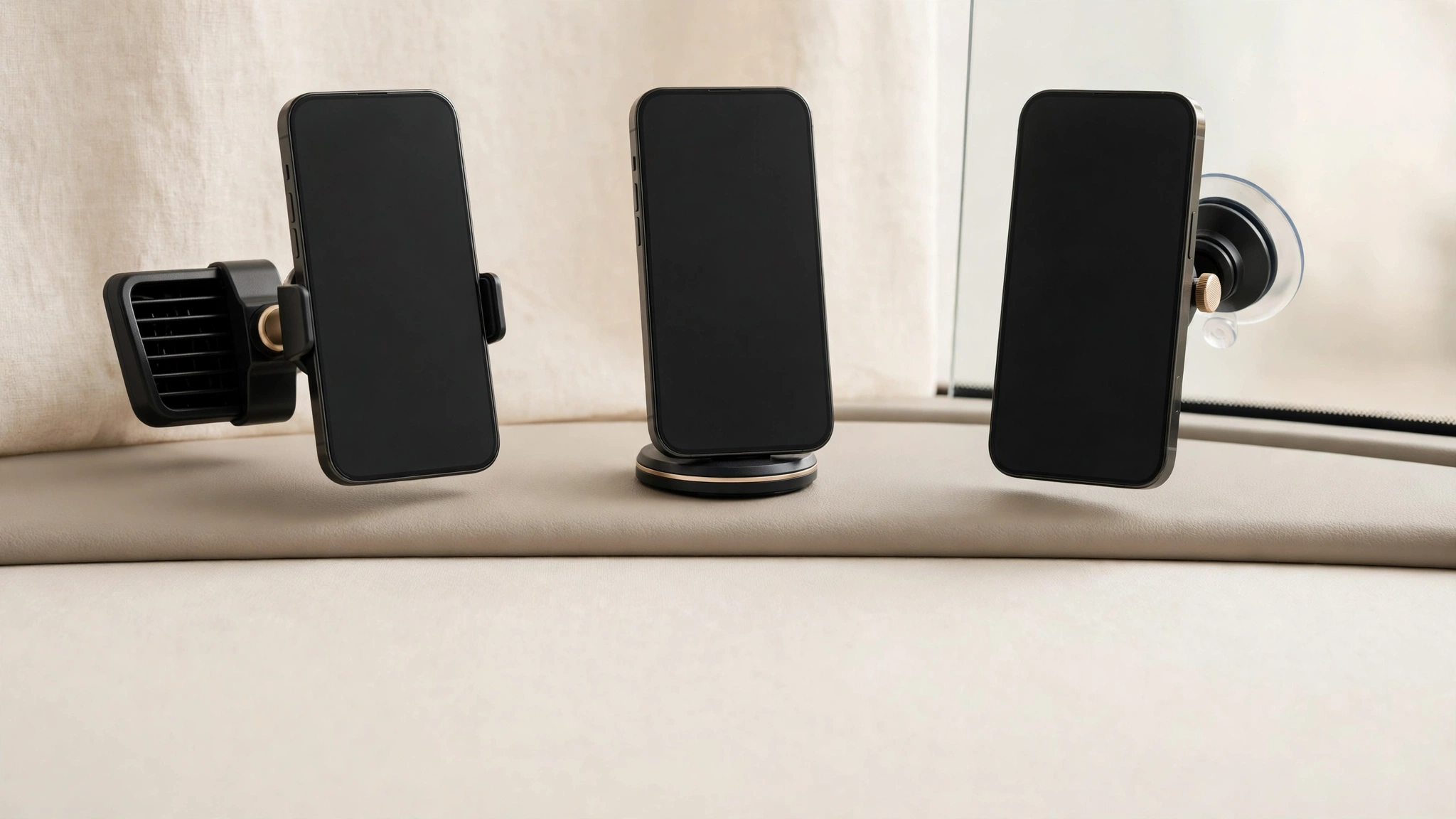
Dashboard Surfaces
A dashboard mount has two possible attachments, and they behave very differently. An adhesive base is the steadier hold: you clean the spot, press the base down, and it stays. A suction cup is the removable one: it peels off and can be repositioned, but it needs a surface it can seal against.
Suction is the pickier of the two. It needs a smooth, flat, non-porous surface, and most dashboards are none of those things. Textured plastic, leather, soft-touch vinyl, curved panels, and fabric all let air seep under the cup, and the mount lets go — sometimes hours later, sometimes while you are driving. Suction-mount listings exclude leather, coated faux leather, suede, and uneven surfaces for this reason. If your dash is textured, the usual workaround is the adhesive disc the mount ships with: a hard, smooth pad that sticks to the dash so the suction cup has something flat to grip.
Adhesive is steadier but it is a commitment. Scosche’s own instructions for removing a MagicMount Dash base describe the work: low heat from a hairdryer for one to two minutes, dental floss behind the base to slice through the adhesive, then adhesive remover for what is left — and any residue comes off with a non-abrasive cleaner. The same maker’s suction-cup instructions warn that the cup “may leave residue or discoloration on some surfaces” and “may also leave a ring of residue when mounted to the dash,” and that the supplied cleaning wipe “may cause discoloration of certain plastics, vinyls and painted surfaces” — test it in an inconspicuous area first. Pick the spot once, at navigation glance height, because moving an adhesive base means doing the removal twice.
One advantage the dashboard has over the other two locations is legal: because it does not touch the windshield, it sidesteps the windshield rules that vary by state, and LegalClarity calls it the most reliably legal option across all states. The one place it must not go is the passenger airbag cover, which sits in the dashboard — check your owner’s manual for its exact location, and keep the mount clear of it.
Windshield Placement Constraints
A windshield mount puts the phone highest of the three, closest to where you are already looking. It attaches with a suction cup, usually on an adjustable arm, and the glass is the one surface in the car that is always smooth and flat enough for suction. That is the whole case for it — the constraints below are the whole case against it.
The first constraint is the law, and it varies by state. California’s driver handbook lists the windshield, dashboard, and center console as places to mount a phone, as long as it does not block your view, and allows a single swipe or touch. Minnesota allows GPS or navigation units mounted near the bottom of the windshield. Florida bans items on the windshield except a GPS device used for navigation. Other states ban attaching any non-transparent object to the windshield entirely. California Vehicle Code 26708 narrows the windshield option further: a GPS device may only be mounted in a small area in the lower corner of the windshield. Rules change, and the handbook reading is not the statute — check your state’s current rules before you mount anything to the glass.
The second constraint is the view itself. The best spot is low and central — the base of the windshield or the top of the dash, just right of the steering wheel, clear of any airbag cover — because that keeps the phone below most of the road view. High on the windshield, near the mirror, the phone can hide traffic signals and signs, and newer cars keep cameras and sensors behind the glass there. The driver’s side corner shortens the glance but widens the blind area by the windshield pillar on left turns. Never install a suction cup on the passenger side: airbag deployment can turn the holder into a projectile.
Before you commit to a spot, test it from the driver’s seat: sit in your normal position, seat belt on, mirrors set. The phone must not cover the lane ahead, traffic signals, or sidewalk edges; you should read it by moving only your eyes, not your head; reach it without leaning; and all three mirrors, the gauges, and the climate and hazard controls must stay in view, with the steering wheel clearing the mount at full lock. Federal guidance aims for single glances of two seconds or less, and research cited by the Safety Behind the Wheel Foundation links handling a phone to a collision risk two to six times higher than undistracted driving — the mount removes the need to hold the phone, not the need to keep your eyes on the road.
Heat and Removal
Heat is the suction cup’s enemy, and it is the one failure the other two locations mostly avoid. Quad Lock’s suction-mount manual states it directly: the mount “falls off in extreme temperatures,” temperature fluctuations affect suction, and you should re-attach it when the car interior temperature is stable — and “consider using the dash pad for more permanent dashboard mounting in areas with significant temperature swings.” OQTIQ’s manual warns against exposing the cup to direct sunlight at high temperatures for extended periods, because it “may affect its long-term adhesion and material integrity.” Heat softens the suction gel and the adhesive pads, and a cup that lets go while warm rarely grips as well again.
A suction cup that has lost its grip is not always finished. Quad Lock’s manual gives the recovery step: “wash it with warm, soapy water and let it air dry” to restore the stickiness. Clean the glass too — a speck of dust under the rim is enough to break the seal — and press the cup firmly and fully engage the locking lever. If it keeps failing, the surface or the climate is the problem, not your technique: a textured dash will never hold suction, and a car parked in the sun all day will keep defeating it.
Removal is where the three locations part company for good. A vent mount pulls off in seconds and leaves nothing behind, which is why it is the natural choice for a rental or a shared car. A windshield suction cup peels off the same way, and the cup can be washed and reused. An adhesive dashboard base is the only one that fights back: heat, floss, and adhesive remover, per the maker’s instructions, and possibly a faint ring on the dash afterward. Choose the location with the removal in mind, not just the installation — the mount you can take off cleanly is the one you will actually move when the car changes.
Choose for Your Vehicle
Work through the matrix before you buy: each row is a feature of your car, each column a location, and a location that fails your car’s feature is out, whatever its other advantages are.
Swipe to compare all columns →
| Your vehicle | Vent | Dashboard | Windshield |
|---|---|---|---|
| Round (turbine) vents | Avoid — no blade to grip | Works | Works |
| Vertical vent blades | Check — needs a hook that rotates, and flat blades | Works | Works |
| Textured or leather dash | Works | Avoid for suction; check the mount’s instructions for adhesive | Works |
| Curved dash, no flat spot | Works | Avoid — suction needs a flat spot | Works |
| Hot climate, car parked in the sun | Works — no suction to fail | Check — heat softens adhesive | Avoid — suction fails in heat |
| Heavy phone with a thick case | Check — needs a support foot and sturdy blades | Works — adhesive base is the steadier hold | Check — keep the arm short |
| Rental or shared car | Works — moves between cars in seconds | Avoid — adhesive is a commit-once install | Works — suction peels off cleanly |
| Newer car with cameras behind the glass | Works | Works | Check — keep the mount clear of the sensor area |
Choose a vent mount if your vents are flat-bladed and sturdy, you move the mount between cars, and you want the fastest install and cleanest removal — and you can live with one blocked vent.
Choose a dashboard mount if your vents are round, recessed, or flimsy, you have a flat, smooth spot on the dash, and the mount will stay in one car — and you accept the adhesive removal if you ever take it off.
Choose a windshield mount if you want the phone highest and closest to your line of sight, your state’s rules allow it, and your climate is mild enough for suction to hold — and you keep it low, clear of the mirror sensors and the airbag zones.
There is no universal safest location: the right one depends on your vents, your dash surface, your climate, and your local rules. Once the location is settled, the holding mechanism is the next decision — our car phone mount guide covers the phone-side checks, including case fit and the clamp-versus-magnetic choice.
Conclusion
The best mount is the one that fits your car and local rules, not a winner for every driver. Choose a vent mount when your blades are flat and sturdy, a dashboard mount when you have a flat, smooth spot and accept that adhesive is a commitment, and a windshield mount when you want the phone highest, provided the spot does not block your view or break the law. Check your vents, dash surface and local rules before you buy, remember that heat is the suction cup’s enemy, and pick the location you can remove when you need to.
FAQ
Will a vent mount fit round air vents?
Usually not. Most vent clips need a flat blade to close on, and a round, turbine-style vent has none — listings for several vent mounts exclude round vents outright. If your car has only round vents, use a dashboard or windshield mount instead.
Is a windshield mount legal?
It depends on your state. Some states allow GPS or navigation devices on the windshield only in specific low areas; others ban attaching anything non-transparent to the glass. California’s handbook allows a phone on the windshield where it cannot block the view, while Florida bans windshield items except a GPS device. Check your state’s current rules before mounting.
Why does my suction cup keep falling off?
Almost always heat, dust, or texture. A car parked in the sun gets hot enough to soften the suction gel, dust under the rim breaks the seal, and a textured surface never holds suction at all. Wash the cup with warm, soapy water, let it air dry, clean the glass, and re-attach when the interior temperature is stable. If it keeps failing, the surface or the climate is the problem — try a vent mount instead.
Can a vent mount damage my car’s air vents?
It is possible, but unlikely with a well-designed mount on sturdy blades. Look for rubberized or padded clips, and use a mount with a support foot if your phone is heavy. The risk is with heavy phones on flimsy or older vents — if your blades feel brittle, choose a different location rather than forcing the clip.
Which mount is best for a rental car?
A vent mount or a windshield suction mount. Both come off in seconds and leave nothing behind, so you can move them between cars. Avoid an adhesive dashboard base in a rental — it is a commit-once install that you cannot cleanly remove.
Sources
- Safety Behind the Wheel Foundation — “Phone Mount Placement: Sight Lines, Air Bags and State Laws.” https://drivewithcare.org/phone-gps-mount-placement-windshield-laws/
- LegalClarity — “Legal Phone Holder in Car: Placement Rules and Laws.” https://legalclarity.org/where-is-it-legal-to-put-a-phone-holder-in-your-car/
- MaviGadget — “Best Car Phone Holder: Mount Types, Pros & Cons, Buying Guide.” https://mavigadget.com/blogs/auto/car-phone-holder-guide
- iOttie — iTap 3 Magnetic Air Vent Mount user manual (via Manuals+). https://manuals.plus/iottie/itap-3-magnetic-air-vent-mount-manual
- iOttie — Easy One Touch 5 Air Vent Mount product page (iOttie Poland). https://www.iottie.pl/en/products/iottie-mounts/iottie-easy-one-touch/iottie-easy-one-touch-5-air-vent-mount-holder-to-grille-83839
- Scosche — MagicMount Pro Dash/Window Mount instructions (via Manuals+). https://manuals.plus/m/1d6bfb5a41e351eb89927faeb8a0c2b74018b953d03cf619a80d7b02be21c6df.pdf
- Scosche — MagicMount Dash replacement base instructions (removal). https://cdn4.guidespdf.com/view/1985/1985021-magicmount_magdbase2pkbp0.pdf
- Quad Lock — Suction Windshield/Dashboard Car Phone Holder user manual (via Manuals+). https://manuals.plus/asin/B0BSTW1FVQ
- OQTIQ — S02 Replacement Suction Cup Mount instruction manual (via Manuals+). https://manuals.plus/asin/B07YHKDVPQ
- DreamTek — “Car Phone Holders in Sri Lanka: Which Type Actually Stays Put.” https://www.dreamtek.lk/advice/car-phone-holder-guide-sri-lanka/
- RoadHubs — “LISEN Master Magnetic Phone Mount Review: Vent & Dash.” https://roadhubs.com/lisen-master-car-mount-review/
- ROKFORM — “Top 4 Best Places to Mount a Car Phone Holder.” https://www.rokform.com/blogs/rokform-blog/top-4-best-places-to-mount-a-car-phone-holder
Related Posts

This guide is about one specific listing: a 4K dash cam listed with parking monitoring, night vision, smart voice control and 24-hour automatic DVR, described as mini and easy to install. LanPicks has not tested this dash cam, and this guide reports no test results and no prices. What it does is separate what the […]

A dash cam records the road while you drive — and, with the right setup, while you are parked. The choice is not which model wins a roundup. It is which setup fits your car and your risk: front-only or front and rear, what resolution, and whether you need parking mode. This guide explains each […]
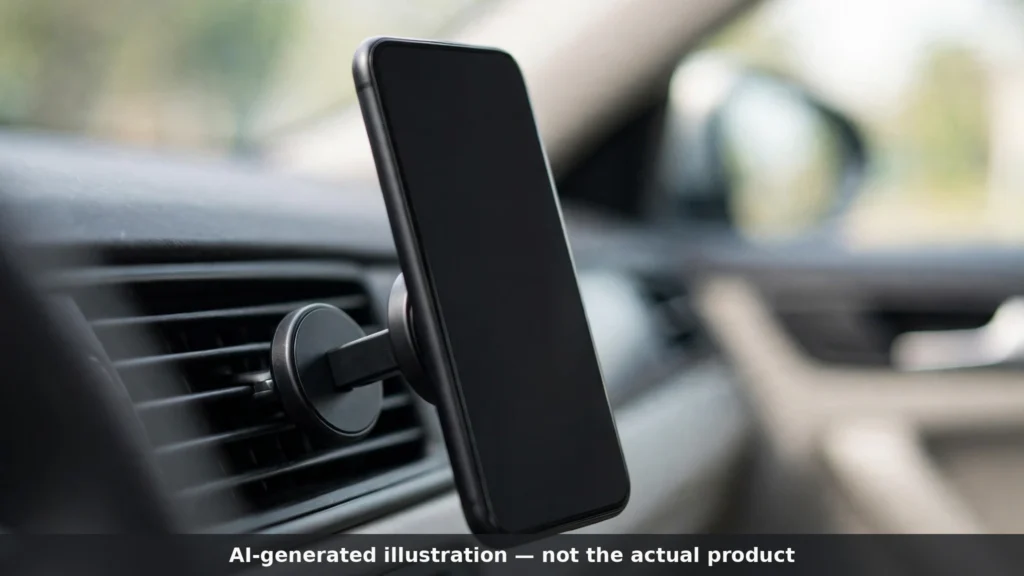
This guide looks at one AliExpress listing: “Magnetic Car Phone Holder Universal Air Vent Car Phone Mounts.” It is a magnetic holder that mounts on a car air vent, and the listing describes it as universal. This page explains what that wording does and does not promise, and the two checks that decide the fit. […]
The gap between your seat and the center console swallows phones, cards, coins and crumbs — and the fix is cheap, but only if it fits. A filler that is too wide presses on the seat, one that is too narrow slides to the floor, and a rigid organizer in a gap that changes width […]

A trunk organizer only works if it fits — through the opening, on the floor, and around the things you already carry. Measure the usable cargo area first: width, depth, height to the lid or parcel shelf, and the width of the trunk opening itself. Then list what you actually carry every week and match […]