

Why Your Car Phone Mount Keeps Falling Off—and What to Check
A phone mount that falls off once is annoying. A mount that falls off every week is telling you something: one part of the chain is not holding — the surface, the attachment, the arm, or the cradle. This guide works through the chain in order, so you find the weak part before you spend money on a replacement. Most failures are fixable with cleaning and a careful reinstall; a few mean the mount, or the mount type, does not suit your car.
Quick Decision
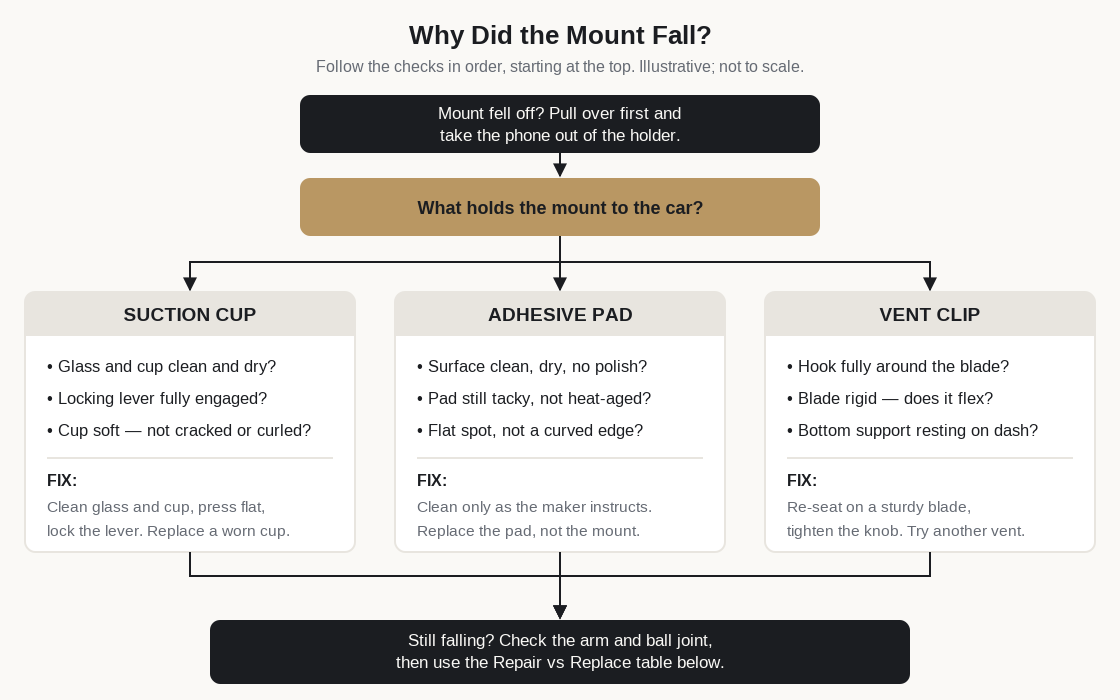
Pull over and take the phone out first. A mount that drops the phone while you drive is a distraction and a loose object in the cabin. Find what holds the mount to the car — a suction cup, an adhesive pad, or a vent clip — and run only that branch of the flowchart below. Suction: clean the glass and the cup, press the cup flat, and lock the lever fully; replace a cup that has gone stiff, cracked, or curled. Adhesive: clean only as the mount maker instructs, wait the cure time the maker states, and replace the pad rather than the whole mount when the pad has aged. Vent clip: seat the hook fully around a sturdy blade, rest the bottom support on the dash, and tighten the knob without over-tightening. If the base holds but the phone still droops, the arm or ball joint is the weak part.
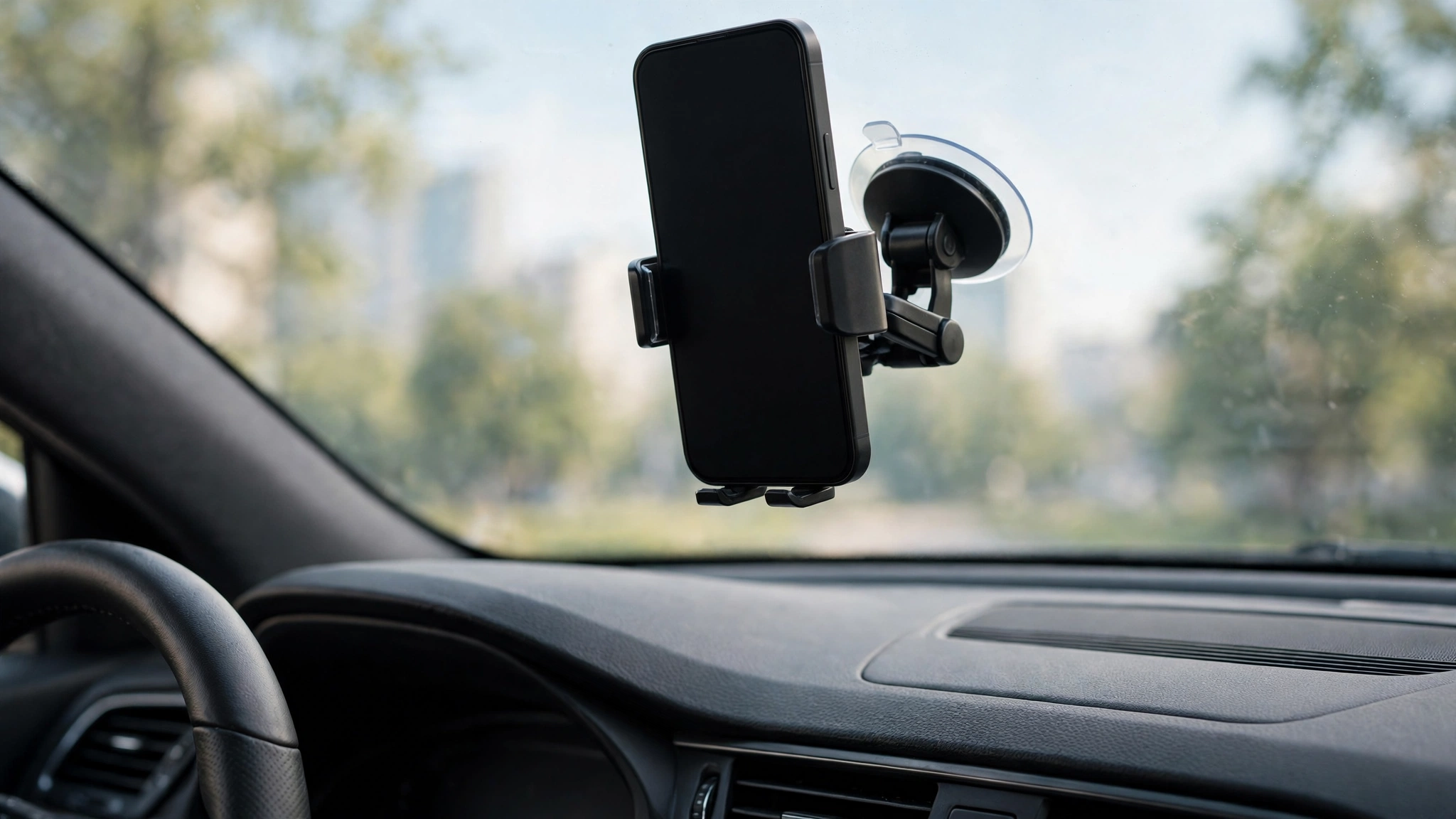
How this guide was put together. LanPicks does not test car mounts hands-on. The checks in this guide come from mount-maker instruction manuals (SCOSCHE, Lamicall, Miracase) and from specialist mount guides (MountGuys, Mighty Mount, NDTV Shopping), all checked on 13 November 2026. Where guides differ — for example, on whether to dampen a suction cup — this guide says so and follows the maker’s instructions for your specific mount. The hero image is an AI-generated editorial illustration; the diagnostic flowchart is an original conceptual drawing, not a measurement. See our Editorial Policy.
On this page
Stop Using an Unstable Mount
The first step is not a repair — it is to stop trusting the mount. A phone that can fall at any moment will fall at the worst moment: during a turn, over a bump, or in traffic, when your first instinct is to reach for it. Pull over before you touch the mount or the phone. Do not wedge the phone between the seat and the console, and do not hold it in your hand while you drive.
While the mount is off, check where it was sitting. A mount must not block your view of the road or sit where an airbag deploys. Windshield placement rules also vary by state: MountGuys notes that California limits windshield-mounted devices to a five-inch square in the lower driver-side corner or a seven-inch square in the lower passenger-side corner, Minnesota prohibits windshield mounting, and Texas restricts placement to areas outside the driver’s sightline. Our guide to choosing a car phone mount covers placement rules and your vehicle’s instructions in more detail. Test the mount while parked before you trust it on the road again: put the phone in, give the mount a gentle push in several directions, and take a short, slow drive first.
Identify the Attachment Type
A car phone mount is a chain of parts, and the failure starts at the weakest one: the base holds the mount to the car, the arm and ball joint set the angle and carry the weight, and the cradle — or the magnetic head — holds the phone itself. A mount can fail at any of these points, and the fix for one is useless for another.
Most mounts attach to the car in one of three ways: a suction cup that holds by a vacuum seal on the windshield or dashboard, an adhesive pad or disc that sticks to the dashboard, or a vent clip that hooks onto an air vent blade. A magnetic head is not a fourth base type — the magnet is the phone-to-mount connection, while the base underneath it is still a suction cup, an adhesive pad, or a vent clip. If the base stays put but the phone separates from a magnetic head, the problem is the magnet, the case, or the ring: thick cases, wallet cases, and poorly aligned magnetic rings all reduce the hold, according to Mighty Mount.
Swipe to compare all columns →
| What happened | Most likely weak part | Check first |
|---|---|---|
| The whole mount came off the glass or dash | Suction cup or adhesive pad | Suction-Cup Checks / Adhesive Checks |
| The mount came off the vent | Vent clip or vent blade | Vent-Clip Checks |
| The base holds, but the phone droops or shakes | Arm or ball joint | Tighten the collar; check for play and cracks |
| The phone slips out of the holder | Cradle arms or foot | Arms fully closed; foot positioned under the phone |
| The phone separates from a magnetic head | Magnet, case, or ring | Thin MagSafe-compatible case; ring aligned and clean |
Run the flowchart once, and run only the branch that matches your mount. A vent-clip fix will not save a suction cup, and cleaning the glass will not save a clip that never gripped the blade.
Suction-Cup Checks
A suction cup holds by air pressure, not by glue. When you press the cup flat and flip the locking lever, air is forced out from underneath the rubber, and the higher air pressure outside pins the cup to the surface. That only works if the rubber forms a complete, unbroken seal against a smooth surface. Anything that breaks the seal — even a thin layer of dust, a pinhole crack in old rubber, or a surface that is not perfectly flat — lets outside air sneak back in, and the vacuum weakens gradually. That is why a suction mount often seems fine for a day or two and then falls off without warning.
Clean the glass and the cup. The most common cause of suction failure is a dirty windshield: interior glass builds up a film from dust, smoke residue, and dashboard off-gassing, and even when the glass looks clean, that film can keep a suction cup from sealing. Clean the mounting spot with a glass cleaner or an alcohol-based cleaner, dry it fully with a lint-free cloth, and avoid cleaners with added wax or rain-repellent coatings on the spot. Clean the cup too — warm water and a little dish soap, dried fully, with a finger run around the rim to catch stray grit. SCOSCHE’s manual gives the same step: rinse the cup with warm water and let it air dry. One disagreement to note: MountGuys says a light film of water on the cup itself can help some cups seal, while a damp mounting surface weakens the hold — dry the glass fully, and dampen the cup only if your mount’s instructions say to.
Press flat, then lock — in that order. Push the cup flat with your palm to push out as much air as possible, and engage the locking lever while you are still pressing — releasing your palm first lets air back in. Flip the lever fully until it clicks or lays flat: a half-engaged lever is one of the most common causes of mounts that seem secure and fall within a few hours. If your mount has no locking lever at all, replace it — a bare cup relies only on the rubber’s elasticity, which degrades with heat and age.
Check the surface, the heat, and the cup itself. Suction needs a flat, smooth, non-porous surface. Many dashboards have grainy or pebbled finishes that create tiny gaps under the cup, and a gentle curve can leave half the cup without contact — run a fingertip across the area, and if it feels textured, the dashboard is the problem. Move the holder a few centimetres to a flatter section, or use an adhesive mounting disc, which sticks to the dashboard and presents a flat surface for the cup. Heat is the next suspect when a mount holds in the morning and falls in the afternoon: heat softens suction rubber, and repeated hot and cold cycles weaken the seal, so a sunshade while parked slows that breakdown. Finally, check the cup for wear: with age, rubber hardens, curls, or cracks, and a stiff cup cannot form a seal no matter how clean the glass is. And if your windshield has aftermarket tint film, do not mount on it — the film is slightly textured and flexible, and the phone’s weight can pull it away from the glass.
Swipe to compare all columns →
| Part | Use | Avoid — and why |
|---|---|---|
| Windshield glass | Glass cleaner or an isopropyl alcohol wipe; dry fully with a lint-free cloth | Cleaners with wax or rain-repellent coatings on the mounting spot; ammonia-based cleaners on tinted glass |
| Suction cup | Warm water with a little dish soap; rinse and air-dry fully (SCOSCHE, MountGuys) | Solvents and abrasive cleaners — SCOSCHE’s manual says not to use them on the mount |
| Adhesive pad or gel cup | Clean only as the mount maker instructs | Hairspray, adhesive sprays, and household glue — MountGuys does not recommend sprays; they leave residue and do not fix a broken seal |
| Dashboard | A clean, dry wipe; remove dust and polish residue before remounting (NDTV Shopping) | Dashboard protectants and silicone-rich dressings on the mounting spot — they leave a slippery film |
Adhesive Checks
Adhesive mounts fall for different reasons than suction cups, and the first step is to know which kind of adhesive you have. A sticky gel pad is a soft, tacky layer that can sometimes be washed and reused; a foam tape is a double-sided tape that is meant to stay put once applied. Do not treat them as the same thing: a gel pad that has gone soft in the heat will not behave like a fresh tape, and a tape that has been peeled off and re-stuck will not hold like a new one.
Prepare the surface as the maker instructs. Dust is the quiet killer of adhesive mounts — even a thin layer creates a barrier between the pad and the dashboard. Many dashboard polishes and protectants leave behind a glossy or slippery film, and adhesive pads prefer a clean, dry surface without oily residue. Before remounting, clean both contact surfaces, let everything dry completely, and give the dashboard a fingertip test — if it feels unusually slick, remove the remaining residue first. Do not keep adding cleaning products to make the dashboard “extra clean”: some silicone-rich products can make adhesion worse.
Watch the heat and the cure time. Heat can soften a gel pad until it turns slightly slippery, and the holder then creeps downwards before eventually falling. If the mount usually fails after the car has sat in the sun for several hours, heat deserves suspicion. Just as important is the cure time: a pad needs the wait time its maker states before it carries the phone, and loading the phone early is a common failure — no guide can give you a universal number.
Replace the pad, not the mount. When a gel pad has aged or a foam tape has lost its tack, the mount itself is usually still fine, and replacement adhesive pads and discs are sold for most mount types. If the pad is a washable gel type, follow the maker’s care instructions — some regain tackiness after gentle cleaning, but they need to dry properly before reuse. Check the spot, too: a disc that has to bend around a dashboard curve is under constant tension, which pulls against the glue underneath. Do not improvise with solvents or DIY adhesives. Household glue, superglue, and spray adhesives can damage the dashboard finish and the mount, and they make the mount hard to remove safely later.
Vent-Clip Checks
Vent clips fail differently from suction and adhesive mounts: there is no seal to break, only a grip on a thin blade of plastic — and the blade was designed to direct air, not to carry a phone.
Check the blade first. Thin, flexible, vertical, or angled vent blades can bend under the weight of a phone and mount, and repeated vibration can make the clip loosen until the phone sags or detaches. The problem gets worse when the phone sits far from the vent, because a long extension creates additional leverage that pulls downward on the blade. If the blade flexes when you gently pull the mount, do not force it — choose a different mounting point. Clean the mounting area before you re-seat the clip, and use the locking mechanism if the mount includes one.
Seat the hook fully and tighten without over-tightening. On hook-style clips, extend the metal hook fully around the vent blade and tighten the knob until it grips firmly. Lamicall’s manual for its STCV01 vent mount states a hook extension range of 10–29 mm, a maximum vent blade thickness of less than 4.2 mm, and that the mount is not suitable for round vents. Miracase’s manual adds that the bottom support of the clip should rest against the vent for added stability. Both manuals warn against over-tightening, which can crack the vent, and say to check both knobs periodically.
Shorten the arm and check the joint. A long arm magnifies every bump, and a loose ball joint lets the phone slowly change angle even when the clip itself is secure. Tighten the ball-joint collar with the phone in its normal position, and inspect the joint for play, stress marks, and cracks. If no vent works, the vent is not the problem — the mount type is. Some cars have vents that do not suit clip-on holders: round vents, very thin blades, or blades set deep behind trim. In that case, a dashboard, cup holder, or CD-slot base may be more stable, and forcing a vent clip onto a vent it does not fit will only crack the blade.
Repair vs Replace According to Instructions
Repair first, replace second — and replace the part that failed, not the whole mount, whenever the maker allows it. Most quality mounts are sold with replacement suction cups, adhesive pads, or clips, or those parts can be bought separately, and replacing a tired cup is often cheaper than replacing the entire unit. Check your mount’s manual before ordering anything: it states which parts are replaceable, how to clean them, and how long to wait before loading them again.
Swipe to compare all columns →
| Condition | Repair | Replace |
|---|---|---|
| Dirty glass or cup | Clean both and reinstall | — |
| Lever half-engaged | Press flat and lock fully | — |
| Cup stiff, cracked, or curled | No repair — cleaning will not restore hardened rubber | The suction cup, if sold separately; otherwise the mount |
| Textured or curved dashboard | Use an adhesive dash disc for a smooth platform | — (or a different mount type) |
| Adhesive pad aged or heat-softened | Clean per the maker’s instructions if it is a washable gel pad | The adhesive pad or disc |
| Vent blade flexes or is round | Try another vent | — (or a dash or cup-holder base instead) |
| Ball joint loose after tightening | Tighten the collar; check for cracks | The joint or arm part, or the mount |
| Plastic cracked or deformed | No repair — tightening will not restore strength | The damaged part or the mount |
| Mount type does not suit the car | — | Choose a different base type for the vehicle |
Two cautions before you buy. First, do not buy a newer version of the same mount to fix a problem the mount type caused — a second suction cup will fail on the same textured dashboard, and a second vent clip will sag on the same flexible blade. Second, do not keep repositioning the mount in search of a better spot: each removal exposes the adhesive or the cup to dust and oils from your fingers, and a holder that changes address every few days has far more opportunities to collect contamination than one allowed to stay in the same place. Choose a stable position, treat a move as a fresh installation, and leave the base there whenever practical.
FAQ
Why does my mount fall off only in the afternoon?
Heat is the most likely cause. A mount that holds in the morning and falls after the car has sat in the sun points at temperature: heat softens suction rubber and gel adhesive, and repeated hot and cold cycles weaken the seal. A sunshade while parked slows that breakdown. If the mount also fails on cool mornings, look at cleaning and wear instead.
Can I use hairspray or glue to make a suction cup stick?
No. MountGuys does not recommend hairspray or adhesive sprays: they leave a residue, make future cleaning harder, and do not fix the real cause, which is almost always a compromised seal or worn rubber. Household glue can damage the dashboard finish and the mount, and it makes the mount hard to remove safely. Clean the glass and the cup, lock the lever fully, and replace a worn cup.
My suction cup worked for a year and now falls every day. Is it done?
Probably, yes. Rubber hardens, curls, and cracks with age and with repeated heat and cold cycles, and a stiff cup cannot form a seal no matter how clean the glass is. Check whether the maker sells a replacement suction cup — if it does, that is the cheapest fix. If the cup is not replaceable, the mount itself is worn out.
Will a suction cup damage my window tint?
It can damage aftermarket tint film. Suction cups do not bond well to the film’s slightly textured, flexible surface, and the weight of a phone can pull the film away from the glass over time. Factory tinting baked into the glass is not an issue. If your windshield has aftermarket film, mount on a non-tinted side window or use a dashboard mount instead.
Can I move my mount between cars?
Yes, but treat each move as a fresh installation. Clean the new mounting spot and the suction cup or pad, inspect the base, and make sure the new location suits the mounting system. Frequent moves expose the adhesive and the cup to dust and finger oils, and rushed reinstalls skip the cleaning that makes the mount hold.
The base holds fine, but the phone slowly droops. What is wrong?
The arm or the ball joint, not the base. Tighten the ball-joint collar with the phone in its normal position, shorten the arm so the phone sits closer to the mounting point, and inspect the joint for play, stress marks, or cracks. If the joint still moves after tightening, it is worn — and if the plastic around it is cracked or deformed, tightening will not restore its strength.
Conclusion
A falling mount is a diagnosis, not a shopping trip. Pull over, take the phone out, and find which part failed: the surface, the attachment, the arm, or the cradle. Clean and reinstall according to your mount’s instructions, replace only the part that is worn or damaged, and match the mount type to your car — a suction cup needs a flat, smooth surface, an adhesive pad needs a clean, flat spot and its cure time, and a vent clip needs a sturdy blade it can grip. If the checks show the mount type itself is the problem, our guide to choosing a car phone mount walks through matching the mount to your car, phone, and case before you buy. Run the flowchart once more after reinstalling, test it parked, and then drive.
Sources
- MountGuys — Help with Failing Suction Cup Mounts (suction mechanism; cleaning; lever; wear; dash discs; alternatives)
- MountGuys — How to Apply a Suction Cup Mount to a Car Window (install steps; tint film; curved glass; state rules; cold weather; replacement)
- Mighty Mount — Why Your Phone Mount Keeps Falling (and How to Fix It) (weakest-link diagnosis; magnet; vent clip; heat; ball joint; arm; plastic fatigue)
- SCOSCHE — StuckUp Qi Car Phone Holder WDQ2M instruction manual (via Manuals+) (suction cup care: rinse with warm water and air dry; adhesive disc for textured dashboards; no solvents or abrasive cleaners; locking lever)
- Lamicall — STCV01 Car Phone Holder Vent Mount instruction manual (via Manuals+) (hook extension 10–29 mm; blade under 4.2 mm; not for round vents; do not over-tighten; periodic knob checks)
- Miracase — Air Vent Phone Holder 04001BLK.1 instruction manual (via Manuals+) (hook fully extended; bottom support against the vent; tighten the knob; do not over-tighten)
- NDTV Shopping — 10 Reasons Your Dashboard Phone Holder Won’t Stay Stuck And How To Fix It (heat; texture; dust and polish; curved spots; phone weight; arm leverage; vibration; cup wear; repositioning; location)
Related Posts

This guide is about one specific listing: a 4K dash cam listed with parking monitoring, night vision, smart voice control and 24-hour automatic DVR, described as mini and easy to install. LanPicks has not tested this dash cam, and this guide reports no test results and no prices. What it does is separate what the […]

A dash cam records the road while you drive — and, with the right setup, while you are parked. The choice is not which model wins a roundup. It is which setup fits your car and your risk: front-only or front and rear, what resolution, and whether you need parking mode. This guide explains each […]
This guide looks at one AliExpress listing: “Magnetic Car Phone Holder Universal Air Vent Car Phone Mounts.” It is a magnetic holder that mounts on a car air vent, and the listing describes it as universal. This page explains what that wording does and does not promise, and the two checks that decide the fit. […]

Quick Decision If your car has sturdy, flat vent blades, start with a vent mount: it installs in seconds, moves between cars, and leaves nothing behind — but it blocks airflow and can sag under a heavy phone on weak blades. If your vents are round, recessed, or flimsy, a dashboard mount is the steadier […]
The gap between your seat and the center console swallows phones, cards, coins and crumbs — and the fix is cheap, but only if it fits. A filler that is too wide presses on the seat, one that is too narrow slides to the floor, and a rigid organizer in a gap that changes width […]