

Acrylic vs Glass Display Cases: Which Fits Your Collection?
An acrylic case and a glass case can look almost identical on a shelf — clear panels, a base, figures inside. The difference shows up later: when you lift the case to rearrange a figure, when you wipe it for the tenth time, when it gets knocked, and when you check whether the “UV protection” on the listing means anything at all. This guide compares the two materials on weight, scratch resistance, impact safety, cleaning, access, dust seals and UV claims — and explains why the panel material is only one part of the case. The frame, the base, the door fit and the shelf matter just as much, and for dust protection and load capacity they matter more.

Quick Decision
Choose acrylic when the case will be lifted, wall-mounted, moved often, or used where knocks are realistic — it is roughly half the weight of glass for a comparable panel and far less likely to shatter. Choose glass when the case is a permanent, rarely moved cabinet that will be wiped often — its harder surface resists everyday scratches and it holds its clarity over years. Do not choose on UV protection, dust protection or load capacity from the material name alone — all three depend on the specific case, so check the maker’s stated UV specification, the door fit and gaskets, and the shelf load limit for the exact case you buy. Clean acrylic only with a soft cloth and an acrylic-safe cleaner — standard glass cleaner is fine for glass but can damage acrylic.
How this guide was put together. LanPicks does not test display cases hands-on. The comparisons in this guide come from published collector guides, display-case makers and a museum exhibit-case buyer’s guide, checked on 13 November 2026. Where sources disagree, the guide says so and attributes the figure instead of presenting it as a measurement. The hero image is an AI-generated editorial illustration; the case diagram is an original conceptual drawing, not a measurement. See our Editorial Policy.
On this page
Material vs Case Construction
A display case has five parts, and the material question is only about one of them: the clear panel. The frame and base decide stability, total weight and the look; the door decides how you reach the figures; the door fit and gaskets decide how much dust gets in; the shelf decides how much weight the case can hold. Two cases with identical acrylic panels can differ completely on dust, load and access — so this guide treats “acrylic vs glass” as a panel comparison first, and a case comparison second.
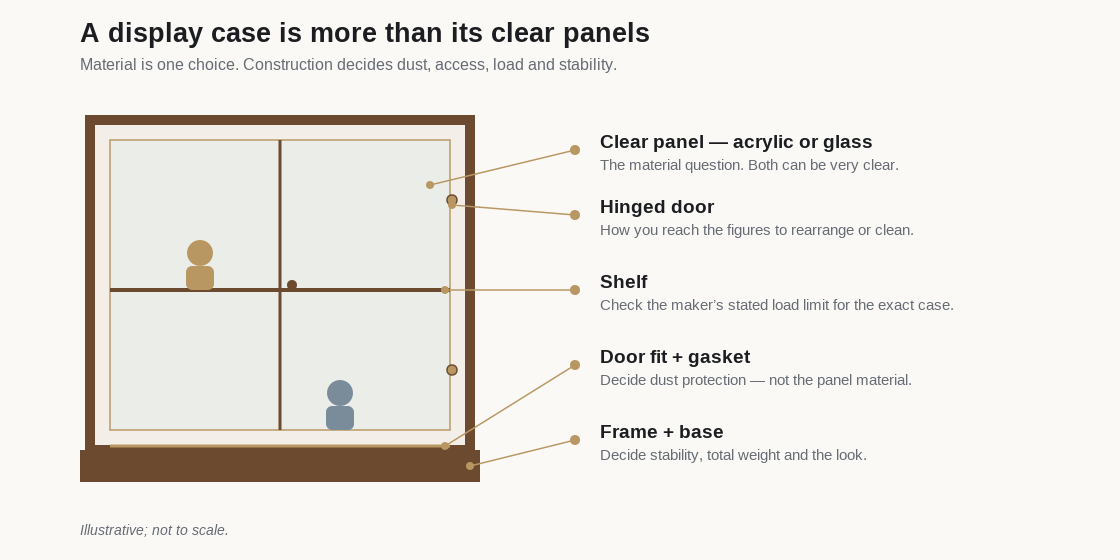
Diagram in words: the clear panel is acrylic or glass, and both can be very clear. The hinged door is how you reach the figures to rearrange or clean them. The shelf carries the figures — check the maker’s stated load limit for the exact case. The door fit and gasket decide dust protection, not the panel material. The frame and base decide stability, total weight and the look.
Table 1 is the specification-based comparison matrix for this guide. Read it as a checklist of what to verify on the exact case you buy: several rows end with “check the specification” because the material name alone does not settle them.
Swipe to compare all columns →
| Factor | Acrylic | Glass | What to check on the specification |
|---|---|---|---|
| Weight | About half the weight of glass for a comparable panel | Heavier; needs sturdier support | Total loaded weight, plus wall fixings or shelf rating |
| Impact safety | More resistant to shattering; breaks into large blunt pieces | Can chip, crack or shatter into sharp shards | Whether the glass is standard, tempered or laminated |
| Scratch resistance | Scratches more easily | Harder surface; resists everyday marks | A material property, not a specification |
| Cleaning | Soft cloth and acrylic-safe cleaner only | Standard glass cleaner is fine | The maker’s cleaning instructions |
| Clarity | Very clear; no green tint | Very clear; slight green tint at the edges | Low-iron or anti-reflective options, if offered |
| UV protection | Only if specified as UV-filtering | Only if specified as UV-filtering | The maker’s stated UV figure — never assume it |
| Custom sizes | Easy to cut, shape and fabricate | Possible, but heavier and more complex | Finished internal dimensions |
| Long-term appearance | Can yellow or haze with UV and age, by grade | Generally stable; does not yellow | Material grade and UV specification |
| Dust protection | Decided by door fit and gaskets, not the panel | Same — decided by construction | Door gaps, gasket, cover-to-base fit |
| Shelves and load | Acrylic shelves can bow or sag under heavy loads | Tempered glass shelves stay rigid until breaking point | The maker’s stated shelf load limit |
One number in this comparison needs a warning label. Sellers commonly describe acrylic as “up to 17 times stronger than glass.” That figure is repeated across seller guides, but it is a seller-cited claim, not a LanPicks measurement. The practical point does not need the number: acrylic is more resistant to shattering than ordinary glass, and when it does break it tends to break into large pieces with blunt edges rather than sharp shards. Glass can be made safer with tempered or laminated panels, but it stays heavier and needs careful consideration of support, edges and fixing points.
Weight and Placement
Weight is the clearest practical difference. Acrylic is typically around half the weight of standard glass for comparable sheet sizes and thicknesses, and that matters more than it sounds: a lighter case is easier to move when cleaning, easier to lift away from its base, and more practical for wall-mounted collections. For a single small display the difference may not change your decision. For a large wall system or a case that is regularly moved, it can be one of the strongest reasons to choose acrylic.
Wall mounting is where the weight gap turns into a placement decision. Acrylic is usually the more practical material for wall displays because the lower weight reduces the load on the mounting system and makes removable covers easier to handle. Glass needs fixings suitable for the wall construction and the total loaded weight — the case, the figures and the base together, not the empty case alone. A freestanding cabinet is where glass becomes more competitive: supported by the floor or substantial furniture, weight is less of a concern, and glass shelves and doors deliver a traditional cabinet feel with excellent resistance to everyday marks. For very large cases, glass has a structural advantage of its own: its tensile strength makes it well suited to large cases.
Impact safety follows the same placement logic. Acrylic is generally safer where accidental impact is realistic — family homes, busy rooms, or a display mounted above furniture — because it is more resistant to shattering. That does not make it indestructible: it can still crack under excessive force or poor handling. Glass can be made safer with tempered or laminated panels, but it stays heavier and more fragile to handle. If children or pets can reach the display, or if the case sits where it could be knocked, weight and impact safety point the same way — toward acrylic.
Scratches and Care
Scratch resistance is the category glass wins outright. Its harder surface generally copes better with routine wiping and accidental contact without developing fine marks. Acrylic is softer and more vulnerable to fine surface scratching: it can scratch if wiped with a dirty cloth, paper towel or abrasive cleaner, and dust trapped between the panel and a cleaning cloth can leave fine marks that become more noticeable under display lighting over time.
The difference is not only how easily each material scratches, but what happens after it does. Shallow scratches on some acrylic panels can be polished with suitable products and care, and inexpensive acrylic polishes can restore a case close to new — but deeper damage may be difficult to repair. Glass is the reverse: harder to scratch, but once scratched it is difficult and time-consuming to restore, and replacement is often the most practical solution. Acrylic forgives a mistake you can polish out; glass rewards careful handling and punishes a scratch permanently.
Cleaning method matters far more for acrylic than for glass, and using the wrong cleaner is the most common way collectors damage an acrylic case. Table 2 is the cleaning routine for each material.
Swipe to compare all columns →
| Step | Acrylic | Glass |
|---|---|---|
| Remove loose dust first | Yes — blot or brush dust off before wiping, so grit does not scratch the panel | Yes — good practice, but a missed speck is less likely to mark glass |
| Cloth | Clean, soft microfibre cloth only | Microfibre cloth or paper towel |
| Cleaner | Mild soap and warm water, or a cleaner made for acrylic | Standard glass cleaner |
| Avoid | Paper towels, abrasive pads, ammonia-based cleaners such as Windex, and alcohol-based glass cleaners | Abrasive scouring products; check compatibility with any anti-reflective coating |
| If it scratches | Shallow marks can sometimes be polished out with a suitable acrylic polish | Usually permanent — replacement is often the practical fix |
Two warnings are worth stating plainly. First, ammonia and alcohol-based glass cleaners can cause yellowing, hazing, microfractures, cracks and scratches on acrylic — a product safe for a glass window is not automatically safe for an acrylic case. Second, acrylic can accumulate dust because of static electricity, so an acrylic case may need dusting more often than a glass one in the same room; a damp microfibre cloth handles the dust without dragging grit across the panel. Long-term appearance follows the same split: glass generally holds its clarity for years and does not yellow, while acrylic can yellow or haze depending on grade, UV exposure and temperature — so do not assume UV stability unless the specification confirms it.
Access and Dust Seals
Dust protection is the factor most buyers get wrong, because they assume it follows the panel material. It does not. A well-designed acrylic case and a well-designed glass case can both provide excellent dust protection. What matters is how well the panels meet, whether the cover sits correctly on its base, whether doors have large gaps, and how often the display is opened. A sealed or close-fitting display reduces how often the figures themselves need cleaning, which matters most for delicate paint, decals and small attached parts.
The details that decide dust protection are the door fit and the gaskets. Silicone gaskets reduce gaps at junction points — where the base meets the clear enclosure, for example — to form a sealed environment that minimizes air exchange. Glass also provides a more effective barrier against moisture vapor than acrylic, so a well-sealed glass case can hold a more stable interior environment over time. None of this comes from the panel material alone: it comes from the case being built to close tightly.
Access trades directly against the seal. A case opened every week to rearrange figures needs easy access; a case opened twice a year can afford a tighter seal. Acrylic’s light weight makes access easier — a lift-off acrylic cover can be picked up with one hand, while a glass vitrine may need two people to lift over the objects without twisting it. Hinged doors and gas lifters are the middle ground: quick access without removing the whole enclosure, in either material. When you compare cases, check the door fit: a door that does not sit flush, a cover that rocks on its base, or a visible gap at a joint will let dust in whatever the panels are made of.
Verify Any UV Claims
This is where buyers should be most careful with assumptions. Some specialist acrylic sheets are manufactured with strong UV-filtering properties, and specialist glazing products are also available in glass — but you should not assume that every clear acrylic or glass case automatically provides meaningful UV protection. If UV performance matters because the collection sits near a bright window or contains sensitive paint, decals or packaging, check the actual material specification. A listing that says “UV protection” without a figure is a label, not a specification.
When a specification does exist, the figures are strong. UV-filtering acrylic or laminated glass filters out up to 99% of UV rays — 97 to 99% depending on the specific material — and museum-grade UV-resistant acrylic of the UF-5 type is typically rated to block 98 to 99% of UV light. Standard glass, by contrast, offers minimal UV filtering. These figures apply only to products specified as UV-filtering: a standard acrylic or standard glass case does not inherit them.
Three checks before you trust a UV claim. First, ask for the stated figure for the exact product — a percentage or a wavelength range — and treat a claim without one as unverified. Second, do not confuse the options: low-iron glass reduces the greenish tint of standard glass, anti-reflective glass reduces reflections, and UV-filtering glass reduces transmission of specified ultraviolet wavelengths; one should not automatically be assumed to provide the others. Third, UV filtering reduces exposure rather than eliminating it, so keep the display out of direct sunlight even with a UV-filtering case, and use cool, low-heat LED lighting inside it rather than bulbs that add heat.
Selection Checklist
Work through this list in order before you buy. The first three items decide the material; the rest decide the case.
- Measure the figures and the space. Measure the tallest figure in its display pose and the widest base, then check the case’s finished internal dimensions — not the material name. Leave room for the collection to grow, or pick a system you can expand.
- Decide wall-mounted, freestanding or tabletop. Wall mounting and frequent moving point to acrylic; a permanent floor cabinet lets glass compete on scratch resistance and feel.
- Decide how often you will open it. Weekly rearranging needs easy access — a lift-off cover or a hinged door. Twice-a-year access can afford a tighter seal.
- Check the door fit and gaskets. Look for a flush close, a gasket at the base joint, and no visible gaps. Dust protection comes from this, not from the panel.
- Check the shelf load limit. Use the maker’s stated limit for the exact case and shelf. Do not infer load capacity from the material name.
- Check the UV specification. Ask for a stated figure for the exact product. A “UV protection” label without a figure is unverified.
- Check the glass type, if glass. Standard, tempered or laminated glass behave differently on impact and security — ask which one the case uses.
- Check the cleaning instructions. If the case is acrylic, confirm you have an acrylic-safe cleaner, and that nobody in the household will reach for standard glass cleaner on it.
- Compare finished cases, not raw materials. Usable internal size, construction quality, access, weight, base design and fit for the figures matter more than the panel material alone.
- Check the total cost, including shipping. Glass is heavier and more expensive to ship; acrylic can also become costly with thicker sheets or custom fabrication. Compare the delivered, finished case.
FAQ
Is acrylic as clear as glass?
High-quality clear acrylic can provide excellent optical clarity and is widely used for retail, museum and collector displays. In practice, fabrication quality, cleanliness and reflections often matter more than the material alone. Standard glass can have a slight green tint, especially around the edges; low-iron glass reduces it. Acrylic has no green tint, and large acrylic panels with polished edges can look almost invisible around the figures.
Does acrylic scratch more easily than glass?
Yes. Acrylic is softer and more vulnerable to fine surface scratching, especially if wiped with a dirty cloth, paper towel or abrasive cleaner. Proper cleaning with a soft microfibre cloth and a suitable cleaner helps, and shallow scratches on some acrylic panels can be polished out. Glass is harder to scratch, but a scratch in glass is usually permanent.
Can acrylic display cases crack?
Yes. Acrylic is impact resistant rather than indestructible: excessive force, incorrect drilling, stress around fixings or poor handling can still cause cracks. It is far less likely than ordinary glass to break into sharp shards if knocked, which is why it is generally safer where impact is realistic — but “shatter-resistant” is not “unbreakable.”
Does acrylic or glass protect better from dust?
Neither, on the material alone. Dust protection comes from how the case is built: how the panels meet, whether the cover sits correctly on its base, whether the doors have large gaps, and how often the display is opened. Silicone gaskets at the joints reduce air exchange and help keep dust out — check the door fit on the exact case instead of choosing by panel material.
Do acrylic cases turn yellow?
Quality acrylic intended for display use can remain clear for many years, but some products may develop yellowing or haze depending on formulation, UV exposure, temperature and service conditions. Glass does not yellow. Do not assume UV stability unless the specification confirms it, and keep the case out of direct sunlight regardless of the panel material.
Conclusion
Choose the panel by placement and handling: acrylic for wall mounting, frequent moving and rooms where knocks are realistic; glass for a permanent cabinet that will be wiped often and rarely moved. Then choose the case by construction: check the door fit and gaskets for dust, the maker’s stated shelf load limit, the UV figure for the exact product, and the cleaning instructions you will actually follow. The panel material is the easiest part of the decision — the case around it is what protects the collection.
Sources
- Case Your Space — Acrylic vs Glass Display Cases for Model Cars (weight, scratch resistance, dust, UV caution, cost, customization; accessed 13 November 2026)
- Memorabilia Displays — Acrylic vs Glass: What Is The Best Case for Your Sports Memorabilia? (50% weight difference, glass price premium, cleaning rules, scratch repair; accessed 13 November 2026)
- Gaylord Archival — Exhibit Case Buyer’s Guide (acrylic vs glass advantages, UV filtering 97–99%, gaskets, access types, acrylic cleaner warnings; accessed 13 November 2026)
- LitSignage — Acrylic vs Glass Display Cases: Key Differences (“17 times stronger” seller figure, green tint, yellowing, cleaning; accessed 13 November 2026)
- WrestlingAura — Best Display Cases For WWE Action Figures: Acrylic Vs Glass Vs Shelves (shelf bowing, UV figures for UF-5 material, standard glass UV filtering; accessed 13 November 2026)
- Huabo Display — Acrylic vs Glass Museum Display Cases (scratch repair, yellowing, static dust, moisture barrier, low-iron / anti-reflective / UV-filtering glass options; accessed 13 November 2026)
Related Posts

Never pay a tested price for an untested system. A used retro console is decades-old electronics with no self-diagnostics and no error codes, so “works” has to be checked layer by layer: it powers on, produces stable video and audio, loads and plays a game, and keeps working for fifteen to twenty minutes — on […]

Buy the handheld that plays your games — not the one with the longest compatibility list. Write down the systems and the five or so games that would make or break the purchase, then check each candidate against that list: does the screen shape fit those games, do the controls suit them, and is there […]

Two light formats cover almost every display cabinet: LED strips for even light across a full shelf, and puck lights to spotlight a single piece. Neither is universally better. The right choice depends on what you want the light to do — wash a whole shelf or pick out one figure — and the right […]

A riser is a small decision that changes the whole shelf: it lifts the back row above the front row so every figure can be seen, instead of hiding behind the one in front. Choose it by measurement, not by eye. Measure the base of each figure and the depth of the shelf, work out […]

A good figure display starts with a tape measure, not a shopping cart. Measure the tallest point of each figure and the footprint of its base, check what the shelf can hold and fit, then arrange tallest at the back and shortest in front, with room to breathe. Enclosed cabinets cut dust and bumps; open […]