

Microfiber Towels for Cars: Types, GSM and Common Mistakes
A microfiber towel is not one product. It is a family of cloths that differ in density, weave, pile and edges — and the wrong one for the job is how most paint damage happens at home. The core rule the guides agree on: match the towel to the task first, then check the GSM, the weave and the edges. This guide shows how to do that, how to keep dirty towels away from paint, and how to wash them so they keep working. No towel here is scratch-proof: a clean towel used correctly is designed to be safe, and the scratches come from grit, pressure and the wrong towel, not from the word “microfiber” on the label.
Quick Decision
Match the towel to the task: plush 500–600 GSM for paint, wax and polish; waffle weave around 400 GSM for glass; light 220–350 GSM for interiors and dirty jobs; a large twist-loop drying towel for the whole car. Do not choose by GSM alone — weave, pile, blend and edges matter as much as density. Keep towels separate by job: paint, glass, interior and wheels each get their own cloths, colour-coded if you like, and a wheel towel never returns to paint. Wash at 40 °C or below, separately from cotton, with no softener and no bleach, and air-dry or tumble dry on low. Retire a towel from paint duty when it frays, stiffens or stops absorbing after washing.
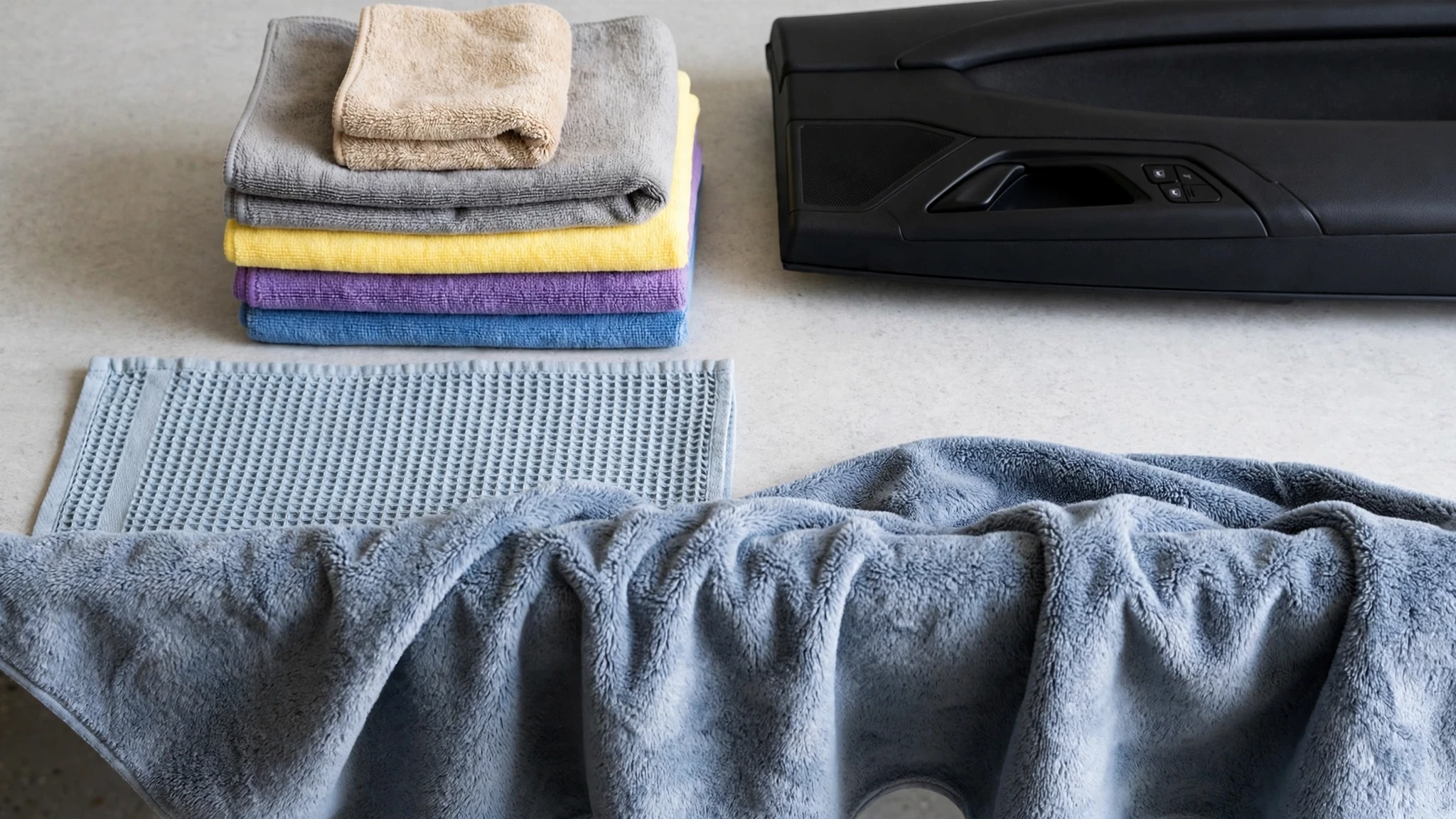
How this guide was put together. LanPicks does not test towels hands-on. The guidance here comes from published detailing guides checked on 13 November 2026 — Work Stuff, Jimbo’s Detailing, Fresh Layer, Dr. Detailer, Gulf News and The Towel Depot — and where those guides disagree, this article says so instead of picking a winner. The GSM bands are the typical ranges those guides state; the exact figure for any towel is on its own label. No prices, ratings or test results appear here, because none were measured by LanPicks. The hero image is an AI-generated editorial illustration; the four-type diagram is an original conceptual drawing, not a measurement. See our Editorial Policy.
On this page
Match the Towel to the Task
There is no single best microfiber towel for a car, because a car is not one surface. Paint needs cushioning, glass needs a flat low-lint wipe, interiors need control, and wheels need a cloth you do not mind ruining. Build a small set around the jobs, not around one universal towel. Table 1 is the whole system on one page — pick the row for the job in front of you.

Text equivalent of the diagram: plush pile, 500–600 GSM, for paint, wax and polish; waffle weave, about 400 GSM, for glass and windows; twist loop, 600–1,100+ GSM, for drying a whole car; short pile, 220–350 GSM, for interior and dirty jobs. Edgeless or laser-cut edges for paint; stitched edges are fine for interior work but can drag on clear coat.
Swipe to compare all columns →
| Task | Towel type | Typical GSM | Weave & edges | Why it works — and the catch |
|---|---|---|---|---|
| Drying a whole car | Large twist-loop drying towel | 600–1,100+ (see the disagreement in the next section) | Edgeless, high pile | High pile keeps the base fabric off paint and cuts passes. Heavy when wet, slow to dry. |
| Paint, wax & polish removal | Plush pile towel | 500–600 | Edgeless or laser-cut | Dense pile cushions grit off clear coat. Too thick for glass or tight gaps. |
| Quick detailer & spray sealant | Plush or dual-pile towel | 350–500 | Edgeless | Soft for paint, light to control. Dual-pile gives one fluffy side to apply and one flat side to buff off. |
| Glass & windows | Waffle weave towel | About 400 | Low-lint, flat weave | Grid cells trap residue and moisture instead of smearing it. A plush towel on glass leaves streaks and lint. |
| Interior plastics, dash & screens | Short pile towel | 220–350 | Edgeless or stitched | Easy to fold and rotate in tight spaces. No paint-grade plush needed. |
| Wheels, door jambs & engine bay | Light, cheap or old towels | 220–300 | Any — these never return to paint | Brake dust and grit live here. Use towels you can rotate often and retire without regret. |
Two rows deserve a warning. Drying is the step where most paint damage happens: a wet car still holds microscopic particles and the towel makes the most passes, so rinse thoroughly first, blot or pull gently — do not scrub — and work top to bottom. And on glass, a plush towel feels like the premium choice but leaves lint and streaks, while a flat waffle weave leaves nothing behind. The premium feel is not the point; the flat contact is.
A practical starting set, as the guides describe it, is six to ten towels separated by task for a normal maintenance detail — paint, glass, interior and dirty areas, plus spares ready when the first ones saturate. A small selection covering the different surfaces is enough for most detailing work.
What GSM Does and Does Not Tell You
GSM stands for grams per square meter — the weight of the fabric in a one-meter square, or in plain terms, how much fiber is packed into the same area. More grams means more fiber, which means more absorbency and more cushioning between towel and surface. That is the whole definition, and also the whole limit of what the number can tell you.
Swipe to compare all columns →
| GSM band | Typical use | What it does well | Its limit |
|---|---|---|---|
| 220–300 | Dirty jobs, wheels, interiors, volume work | Light, easy to control, quick to rotate and fast to dry | Too thin for paint — not enough cushion between grit and clear coat |
| 300–400 | General detailing, washing, interior work | Balanced softness and strength; the all-purpose range | Not plush enough for final finishing on delicate paint |
| 500–600 | Paint, wax, polish and sealant removal | Deep pile cushions grit and holds product | Clumsy on glass and in tight areas; holds more detergent, so wash with less soap |
| 700+ | Ultra-plush finishing | Maximum cushioning | Overkill for most jobs; heavy, slow to dry, no better than a good 500 GSM towel for most paint |
The number does not measure quality. A well-made 350 GSM towel can outperform a poorly made 600 GSM one — blend, weave and edge design decide that, not the weight. Higher GSM is not automatically better, and low GSM does not mean cheap: light towels are exactly right for the dirty jobs that would ruin a premium towel. Most professional detailers the guides quote work in the 300–550 GSM range and keep the very plush towels for finishing.
One disagreement is worth stating plainly: the best GSM for drying. The Towel Depot, writing for high-volume shops, puts the drying sweet spot at 300–400 GSM — those towels absorb two to three times their weight in water, dry fast between uses and are easy to wring out. Fresh Layer and Dr. Detailer put drying at 500–1,000+ GSM, ideally a 600–1,100+ GSM twist-loop towel, because fewer passes and a thicker cushion mean less time in contact with the paint — which matters most on dark paint and fresh paint correction. Both sides describe a real trade-off, so this guide declares no single drying GSM. If your car is dark, freshly corrected or ceramic-coated, the guides lean toward the heavier towel; if you value fast rotation and easy wringing, the lighter one is the honest choice.
Pile and Edges
Two towels with the same GSM can behave completely differently, because pile and weave decide how the fiber meets the surface. Plush pile — long, deep fibers — is for paintwork, wax removal and finishing: the pile keeps the base fabric away from the paint and gives trapped grit somewhere to go. Short pile gives more direct control for interiors and product removal. Waffle weave is the glass specialist: each grid cell acts as a small reservoir that channels cleaner residue and water away, leaving glass streak-free where terry leaves haze. Twist loop is the drying specialist: looped construction stacks fiber density vertically for more pile height, so the base fabric stays further from the paint while the towel holds more water per pass.
Edges matter as much as pile. An overlocked edge — a stitched border — reinforces the towel but is a harder surface that can catch on a panel edge or drag across paint. An edgeless towel is hemmed with soft microfiber binding or cut with a laser or ultrasonic blade, so there is no hard edge anywhere on it. For anything touching paint, the guides agree: edgeless is the right choice. Stitched edges are fine for interior work, where the surface is not clear coat — and the same logic applies to tags.
Then there is the blend: the ratio of polyester to polyamide. A 70/30 blend is softer and more absorbent — the professional-grade standard for anything touching paint or glass. An 80/20 blend is stiffer and more durable, which suits scrubbing interiors and washing panels by hand, but with slightly more friction against clear coat. If a towel’s blend ratio is not listed on the packaging, that is a red flag — reputable makers publish it because it matters.
Underneath all of this is the fiber itself. Microfiber is polyester and polyamide split during manufacturing into strands far finer than a human hair, creating tiny spaces and capillary channels that move water through the fabric, and far more fiber surface to interact with dirt. That is why a plush cloth gives loosened particles somewhere to move away from the paint instead of pushing them across it. But the cloth cannot make grit harmless by itself: rinse loose sand or dirt away first, and use plenty of lubricating shampoo with a wash mitt. Dry-wiping a dusty car defeats much of the point of choosing a soft cloth.
Separate Dirty Tasks
Separation is the single most important habit in this guide. A cloth used on wheels carries brake dust and grit, and one pass on paint afterwards leaves scratches that need machine polishing to remove — no washing makes that cloth safe for paint again. The same applies to door jambs, engine-bay areas and dirty lower panels: they get their own towels, and those towels never return to delicate surfaces.
Colour-coding is the simplest way to make separation automatic. The guides suggest different systems, so treat these as examples rather than a standard: one maker codes grey for paint, yellow for wheels and purple for interior; another codes blue for glass, grey for paint, yellow for interior and black for wheels and dirty jobs. Pick one system, write it down, and store each colour in its own stack or bag. The system matters less than the rule behind it — a towel’s history decides where it may go next, and paint is always the most protected job.
Technique completes the separation. Fold the towel into quarters for eight clean working faces; use light pressure and let the towel and product do the work; rotate to a fresh section as soon as one side saturates or dirties. When drying, blot rather than wipe: press and lift instead of dragging across a surface that may still hold microscopic particles. Rinse the car thoroughly before any towel touches it, work top to bottom, and swap or wring out a towel when it feels heavy — a soaked towel absorbs less and drags more. Drop a towel on the ground and it is finished for paint use: put it in the wheel pile. Store clean towels in a closed box or sealed bag, because garage dust settles on open shelves and ends up in the fibers.
Follow Washing Instructions
Washing is the step most people get wrong, and it is where good towels are ruined. A towel full of old wax, dirt or fabric softener will smear and scratch, and a towel washed like ordinary laundry loses the absorbency that made it worth buying. The rules below are convergent across the guides; where a maker states different care for its own towel, follow the maker’s instructions.
Swipe to compare all columns →
| Washing rule | What to do | Why it matters |
|---|---|---|
| Temperature | Machine wash at 40 °C / 104 °F maximum; several guides say 30–40 °C | Higher heat degrades the fiber structure and permanently reduces absorbency; very hot water can make fine fibers hard and scratchy |
| Separate loads | Wash microfiber only with microfiber, separately from cotton; wash heavily soiled wheel and engine-bay towels apart from paint, glass and coating towels | Cotton lint transfers to microfiber and clogs the fibers; wheel-towel grit in the drum ends up on paint towels |
| Detergent | Mild, fragrance-free liquid or a dedicated microfiber detergent; use less soap on high-GSM towels; add an extra rinse cycle | Powders and heavy detergents can clog the fibers; high-GSM towels hold more detergent and need the extra rinse |
| Never add | No fabric softener, no bleach, no dryer sheets | Softener coats the split fibers with a waxy film that blocks absorbency — one guide warns a single wash with softener can ruin a towel for good; bleach breaks down the split fibers |
| Drying | Air-dry whenever possible; if using a dryer, low heat only, never above 54 °C / 130 °F | High heat melts synthetic fibers and turns the towel stiff; remove towels while still slightly damp and hang them to finish |
| First use | Pre-wash all new towels before first use on the car | Manufacturing residues reduce absorbency and can leave loose fibers and fine particles that mark paint |
One temperature note: a product instruction quoted in one guide allows warm water below 60 °C for that maker’s cloths — a product-specific instruction, not a general rule. The detailing guides converge on 40 °C or below for car towels, so 40 °C is the safe general limit unless your towel’s maker states otherwise. If a towel has lost its softness, a wash with a microfiber cleaner and an extra rinse often revives it; if it stays stiff or smells, it is done for paint work.
Replacement Checklist
Towels do not last forever, and the honest signal is performance, not the calendar. Run through this checklist whenever a towel comes out of the wash — retire it from paint duty the moment it fails one check:
- Frayed edges: the border is unravelling or the edgeless cut has gone rough. A frayed edge is a hard edge, and hard edges mark paint.
- Stiff or rough patches: the pile no longer feels soft after washing, or parts of the towel have gone hard. Stiff fibers drag instead of lifting.
- Reduced absorbency: the towel pushes water around instead of picking it up, or needs many more passes than it used to — the most common end-of-life sign.
- Smell that survives washing: mildew or a sour smell after a proper wash means moisture was trapped in the fibers — do not put that towel back on paint.
- Embedded grit you cannot rinse out: run your hand across the surface before use; if you feel grit or hardened residue, set the towel aside for cleaning or replacement.
- Lint on dark paint: if a towel starts shedding fibers on dark surfaces, it has lost the low-lint structure that made it safe for finishing.
How long a towel lasts depends on how it is washed, and the guides disagree on the number. One wholesale guide reports 50 to 100 commercial wash cycles — about 6 to 12 months of daily use — with a 350 GSM towel losing about 15% of its water-holding capacity after 50 washes and up to 30% after 100. Another guide states that a quality towel washed correctly should last 200 wash cycles. Both figures come from the guides, not from LanPicks testing, so this article does not pick one: judge the towel in your hand against the checklist above. A towel retired from paint duty can finish its life on wheels or door jambs, but the move only goes one way — a wheel towel never comes back to paint.
FAQ
Can microfiber towels scratch car paint?
A clean, high-quality microfiber towel used correctly is designed to be safe for automotive surfaces. Scratches happen when the cloth is dirty, the GSM is too low for paintwork, too much pressure is applied, or a towel moves from a dirty area onto paint. Grit trapped in the towel is more dangerous than the microfiber itself. Rinse first, use light pressure, fold and rotate, and keep dirty towels away from paint — no towel is scratch-proof, so do not treat any cloth as one.
What GSM microfiber towel is best for drying a car?
The guides disagree. One wholesale guide puts the drying sweet spot at 300–400 GSM — those towels absorb two to three times their weight in water, dry fast and are easy to wring out. Detailing guides put drying at 500–1,000+ GSM, ideally a 600–1,100+ GSM twist-loop towel, because fewer passes and a thicker cushion mean less paint contact. Both describe a real trade-off, so there is no single best drying GSM: choose the heavier towel for dark paint, fresh paint correction or ceramic coatings, and the lighter one when fast rotation and easy wringing matter more.
What is the difference between 70/30 and 80/20 microfiber?
The numbers are the polyester-to-polyamide ratio. A 70/30 blend has more polyamide, making a softer, more absorbent fiber — the professional-grade standard for anything touching paint or glass. An 80/20 blend has more polyester, making a stiffer, more durable towel, better for scrubbing interiors, but with slightly more friction against clear coat. If a towel’s blend ratio is not listed, the guides treat that as a red flag.
Can I wash microfiber towels with normal laundry?
No. Wash them separately from cotton and other lint-producing fabrics, at 40 °C or below, with a mild fragrance-free liquid or a dedicated microfiber detergent. Never add fabric softener, bleach or dryer sheets, and never wash wheel towels with paint towels. Air-dry or tumble dry on low, and pre-wash new towels before first use.
How many microfiber towels do I need?
More than one, separated by task. A practical setup for a normal maintenance detail is six to ten towels covering paint, glass, interior and dirty areas, plus spares ready when the first ones saturate. One expensive towel for the whole vehicle is less useful than several mid-priced towels that stay in their own lanes.
Conclusion
Buy by task, not by the biggest number. A plush 500–600 GSM towel for paint, a waffle weave for glass, a light towel for interiors and dirty jobs, and a large drying towel for the whole car cover almost every job — and keeping them separate, colour-coded and washed properly does more for your paint than any single premium towel used for everything. Check the GSM, weave, blend and edges on the label before you buy, wash at 40 °C or below with no softener, and retire a towel from paint duty the moment it frays, stiffens or stops absorbing. The towel is the cheapest part of the detail and the one that touches the paint most — treat it that way.
Sources
- Work Stuff — Microfiber Towels for Car Detailing: Types, GSM & Uses (GSM chart 220–600; 70/30 blend; wash max 40 °C; no softener; color-coding; six paint-damage mistakes; pre-wash new towels)
- Work Stuff — Best Microfiber Towels for Cars: GSM Guide & Uses (task-based GSM ranges; weave types; fold, light pressure, rotate; separate by task; wash rules)
- Jimbo’s Detailing — Microfiber Towel GSM Explained – What It Really Means (GSM bands 200–300 / 300–400 / 500–600 / 700+; GSM myths; care; blend, weave and edge matter)
- Fresh Layer — Best Microfiber Towels for Detailing 2026 – Pro Picks (GSM bands; 70/30 vs 80/20; edgeless vs overlocked; pile height and twist loop 1,100 GSM drying; wash care; 200 wash cycles)
- Dr. Detailer — Microfiber Towels for Cars: How to Choose, Use and Wash Them (task GSM ranges; color code; drying technique; wash 30–40 °C, no softener, separate dirty loads; storage; replace when stiff or shedding)
- Gulf News — Why microfibre towels are better for cleaning your car (split-fiber science, Textile Research Journal; wash below 60 °C for the quoted maker’s cloths; no softener or bleach; separate jobs)
- The Towel Depot — Best Towels for Drying Cars: Detailing Guide (drying GSM 300–400; 70/30 standard; wash 40 °C, dryer max 54 °C; 50–100 washes, 6–12 months; capacity-loss figures; sizes 16×27 and 16×16 in)
Sources accessed 13 November 2026. LanPicks Editorial.
Related Posts

Quick Decision Start with five things: several microfiber cloths kept separate by task, a mild interior cleaner, an automotive glass cleaner, a set of soft detailing brushes, and access to a vacuum with crevice and upholstery tools. That minimum kit handles the routine cleaning of most interiors — hard surfaces, glass, and light dirt on […]

Quick Decision Start at the top and work down: check your owner’s manual, identify each material, remove everything loose, vacuum thoroughly, then clean each surface with a method made for it — screens and glass last. The one rule that prevents most damage is to match the cleaner to the material and keep liquid to […]

A portable car vacuum is easy to buy badly, because the number on the box is the least useful number in the decision. The suction figure is usually sealed suction — pressure measured with the nozzle blocked — and it says nothing about how long the vacuum holds that suction, whether its nozzle can reach […]