

Portable Car Vacuum Buying Guide: What Matters Beyond Suction Claims
A portable car vacuum is easy to buy badly, because the number on the box is the least useful number in the decision. The suction figure is usually sealed suction — pressure measured with the nozzle blocked — and it says nothing about how long the vacuum holds that suction, whether its nozzle can reach the dirt, or whether its filter is already choking airflow. This guide shows how to read the spec sheet, match the vacuum to the mess you actually get, and check the parts that decide whether you will still use it in six months. No prices, no ranked picks, and no claim that one headline number beats another.
Quick Decision
Match the mess first: crumbs and dust need airflow and a crevice tool; sand needs peak suction plus a brush; pet hair needs agitation before suction; spills need a wet/dry unit, not a dry handheld. Pick the power source by session length: cordless for short weekly pickups, corded 12V for long deep cleans that outlast a battery. Read suction with runtime: write down the peak kPa and the minutes at that peak — a 19 kPa figure that lasts 13 minutes is a different vacuum from one that holds it for 17. Check the nozzle set before the motor: a crevice tool, a brush head and an extension hose decide whether the suction can touch the dirt at all. Check the filter: washable beats disposable for running cost, and a clogged filter cuts suction faster than a weak motor ever will. Do not buy on the biggest Pa number alone.
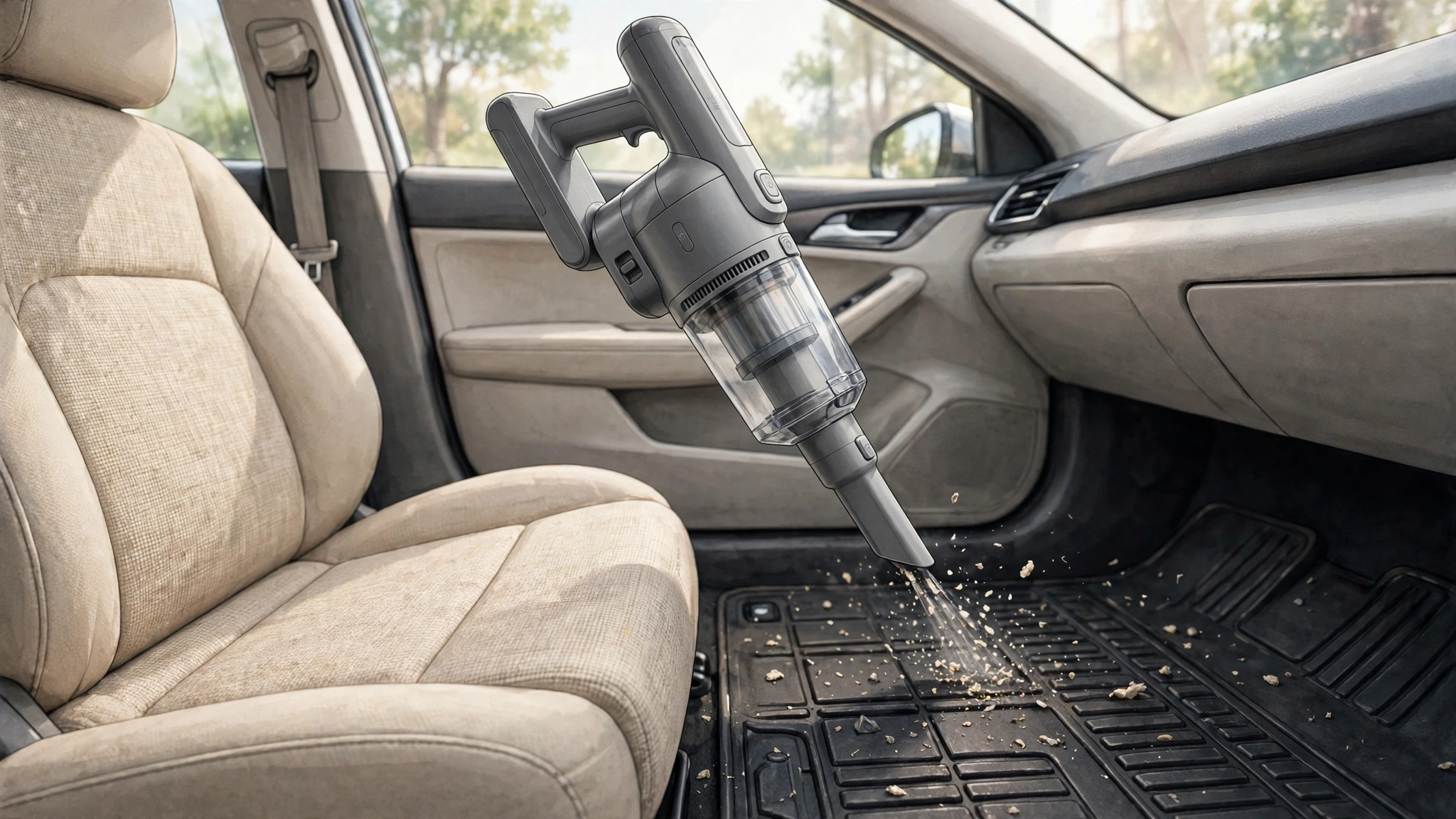
How this guide was put together. LanPicks does not test car vacuums hands-on. The guidance here comes from published buying guides and maker pages, checked on 13 November 2026, and the named models are quoted from the maker’s own pages or from guides reporting the maker’s figures — not from LanPicks measurements. Where guides disagree on suction bands, the article says so instead of picking one side. The hero image is an AI-generated editorial illustration; the suction diagram is an original conceptual drawing, not a measurement. See our Editorial Policy.
On this page
Identify the Debris and Spaces
Before you compare a single spec, list what actually ends up in your car: dust and crumbs in a commuter car; sand, crushed snacks and pet hair in a family car; gravel and mud in a work truck. Each mess stresses a different part of the vacuum, and the right buy is the one that covers your list.
Then list the spaces. A car interior is mostly gaps: the seam between the seat and the center console, the seat rails, the footwells, the door pockets, the vents, the cup holders and the trunk corners. Suction cannot help where the nozzle cannot go. Measure the awkward spots — the distance from the 12V socket to the rear footwell, the width of the seat rail gap — before you shop, because a vacuum that cannot physically reach the problem is the wrong vacuum at any suction level.
Swipe to compare all columns →
| Debris | What actually lifts it | What to check on the vacuum |
|---|---|---|
| Dust, crumbs, dry food | Airflow at the nozzle; eco or low mode is usually enough | A crevice tool and enough runtime to finish the cabin |
| Sand in carpet and floor mats | Peak suction plus agitation; sand sits between fibers | Max-mode kPa you can actually use, plus a brush to loosen grit |
| Pet hair on fabric seats | A pet or rubberized brush to break the weave, then suction | Attachments first, kPa second — a brush does more than a bigger number |
| Grit in vents, rails, cup holders | Reach, not motor size | Crevice nozzle and a flexible hose |
| Wet spills, mud, soaked mats | Wrong tool for a dry handheld | A wet/dry unit with a rinsable tank — or a shop vac |
The last row is the one people get wrong most often. Compact handheld car vacuums are dry vacuums with small filters. Liquid in a dry motor and filter is a failure, not a feature.
Compare Nozzles
Check the nozzle set before the motor, because the nozzle decides whether the suction can touch the dirt at all. A common first-timer mistake is buying strong suction with no usable narrow tool — the easy debris disappears and the mess in the seams stays put.
Swipe to compare all columns →
| Nozzle | Solves | Watch out for |
|---|---|---|
| Crevice tool | Seat rails, console edges, vents, trim gaps, the seam between seat and center tunnel | None — this is the single most useful attachment; do not buy a kit without one |
| Brush head | Dust on vents, buttons, dash trim and upholstery; loosens grit from carpet fibers | Soft bristles for hard trim; a stiff brush on a glossy surface can mark it |
| Pet hair nozzle | Embedded hair on upholstery, carpet and floor mats | Hair wraps around filters and rollers — clean the tool after use |
| Extension hose / extra tubes | Footwells, third rows and trunk corners where the vacuum body cannot fit | A long hose can cost some suction at the nozzle — check whether the maker states it |
| Floor nozzle | Wide floor mats and trunk floors in fewer passes | Too wide for seams; it complements the crevice tool, it does not replace it |
| Wet nozzle (wet/dry units only) | Spilled drinks and wet mats | Only on a unit rated for wet pickup — never on a dry handheld |
Two details are worth checking in the listing photos: whether the crevice tool is actually narrow enough to enter the seat rail gap, and whether the brush head is included or sold separately — the pet hair and brush tools are the parts that make the difference on fabric, and buying them later costs more than choosing a kit that includes them.
Understand Published Suction Claims
Suction separates a vacuum that pulls sand out of floor mats from one that just pushes it around — and it is also the spec most easily made to look impressive. The figure on the box is almost always sealed suction: the pressure difference the motor creates when the nozzle is blocked. One kilopascal equals 1,000 pascals, so 19 kPa and 19,000 Pa are the same figure written two ways. Sealed suction describes lifting force at a sealed inlet. It does not describe airflow — how much air moves when the nozzle is open — and airflow is what carries sand off a floor mat.

That is why two vacuums with the same kPa can clean differently. Air watts combine pressure and airflow. The standard test method for vacuum cleaner air performance, ASTM F558, treats suction and airflow as separate characteristics and derives air power from both — and states the result describes maximum potential air power, not the power present during actual cleaning. A Pa number quoted on its own is half a spec: sealed suction is the grip, airflow is the pull, and air watts is the only figure that carries both.
Three more traps show up on almost every product page. First, peak, not typical: the headline kPa is the maximum setting, and the vacuum holds it only briefly. Second, sealed, not open: blocked-nozzle pressure is easier to make look large than real pickup on carpet. Third, clean-filter lab conditions: makers quote maximum suction with an empty bin and a clean filter, and a clogged filter is the usual reason a unit “loses power” — not a dying motor. Electrical watts on the motor are power draw, not cleaning power.
Swipe to compare all columns →
| Unit on the listing | What it measures | How to read it |
|---|---|---|
| Pa / kPa | Sealed suction — pressure at a blocked nozzle (1 kPa = 1,000 Pa) | Compare peak to peak only; ask for the minutes at that peak |
| Air watts (AW) | Pressure and airflow combined (ASTM F558 method) | More complete than Pa alone — but few handheld makers publish it |
| CFM | Airflow volume through the nozzle | Useful when stated with the nozzle attached; rare on compact handhelds |
| Electrical watts (W) | Power the motor draws from the battery or socket | Not a cleaning score — ignore it when comparing suction |
| Water lift (inches) | Sealed suction measured as a column of water | Shows the class gap: miniature cordless units average about 5 in, wet/dry shop vacs about 64 in |
One maker’s published figures show the trade-off. Fanttik’s Slim V8 APEX lists 19 kPa maximum and 45 air watts, but holds 19 kPa for 13 minutes before eco mode drops to 8 kPa for 40 minutes. Its Slim V10 Ultra stretches the same peak to 17 minutes (10 kPa for 35 in eco), while the smaller V8 Mate publishes 13 kPa for 17 minutes. If a full interior takes 20 minutes, part of that session happens at eco suction unless you recharge. These are one maker’s figures for its own models, not a cross-brand test — the point is the shape of the trade-off, which every cordless handheld shares.
Guides disagree on what band to aim for. One puts most handhelds worth owning between 4,000 and 9,000 Pa; another puts published peak suction in the compact class at typically 13–19 kPa. Both can be right, because they measure different things — working suction against a surface versus peak sealed suction in a lab. Convert everything to pascals, ask whether the figure is peak or working suction, and never compare a peak figure from one listing with a working figure from another. Be skeptical of unbranded listings claiming 20,000 Pa with no third-party verification.
Check Power and Runtime Conditions
Power source is the first fork in the road, and it decides most of the rest. A corded 12V vacuum draws power straight from the car’s accessory socket, so suction stays constant from the first minute to the last. A cordless handheld goes anywhere but caps you at one battery charge. A wet/dry mains unit handles spills no handheld can, at the cost of needing a wall outlet. There is no best power source in general — only the one that fits your session length and your mess.
Swipe to compare all columns →
| Power source | Runs | Best for | Watch out for |
|---|---|---|---|
| Corded 12V (car socket) | As long as the car supplies power — no battery to fade | Long deep cleans, sand, trunk debris, several vehicles in a row | Reach is limited by cord length; run the engine or accessory mode so you do not drain the starting battery |
| Cordless (rechargeable battery) | Typically 15–30 minutes per charge, less at max power | Weekly quick pickups, crumbs and dust, cleaning away from the car | Suction can taper as the charge drops; lithium packs lose capacity over a few years |
| Wet/dry (mains powered) | Continuous, from a wall outlet | Spills, soaked mats, deep cleans at home | Needs a wall outlet and storage space; bulkier than a handheld |
Runtime is the quiet number, and the fine print matters. Published minutes almost always describe one setting, and it is rarely the maximum one. The Bissell Pet Hair Eraser 2390A publishes up to 17 minutes; Dyson quotes up to 50 minutes for the Car+Boat, but footnotes that figure as low mode with a non-motorized tool, while its own spec table lists 40 minutes maximum. A thorough interior clean on full power takes longer than a small battery lasts, which is why corded options still make sense for deep cleans. Write down the minutes at maximum power, not the longest number on the page. If a listing omits runtime entirely, assume it is short.
Cord length is the corded vacuum’s version of runtime. A 14-to-16-foot cord covers a sedan but gets awkward around a three-row SUV, and you can only clean where the car can supply power. The THISWORX corded car vacuum, for example, uses a 16-foot cord — enough for many sedans and compact SUVs, especially if the outlet is near the dash or center console. Reach is not the same as freedom, though: a long cord still has to clear pedals, door sills and seat tracks without snagging.
Two long-term points belong in the decision. First, battery aging: a cordless vacuum that runs 25 minutes today may give you 15 in its third season, and a model with a removable, replaceable battery beats one with a sealed pack you cannot service when it inevitably weakens. Second, weight: under three pounds is comfortable to hold overhead against a headliner. The 1.1 lb Fanttik Slim V8 APEX against its 2.56 lb Fold V10 APEX shows the trade — the bigger cup costs weight, and you hold a car vacuum at arm’s length under seats, so that gap shows up after ten minutes.
Filters and Maintenance
The filter and the dust cup are the two chokepoints nobody shops on. Media clogged with fine dust and a cup packed to the lid both restrict airflow long before the motor gives up, which is why a vacuum that felt strong in week one can feel useless in month three. Washing the filter on schedule buys back more cleaning power than any upgrade in the Pa column.
Start with what the filter actually is. A true HEPA filter, as the U.S. EPA defines it, can theoretically remove at least 99.97% of dust, pollen, mold, bacteria and other airborne particles with a size of 0.3 microns. Many compact car vacuums use a smaller HEPA-style or H11 filter instead — Fanttik’s Slim V8 APEX, for example, lists a HEPA 11 filter and a 95.99% capture claim, which is not the EPA 99.97% figure. “HEPA-style” on a listing is not the same claim as HEPA, and a tighter filter also adds resistance, so a clogged one cuts suction. HEPA filtration is most useful for allergy-sensitive drivers, but it does not make a weak vacuum strong.
Maintenance is a short routine, and it is the difference between a vacuum that lasts and one that fades. Empty the bin when it reaches about three-quarters full; a packed bin chokes airflow and drops suction fast. Rinse a washable filter every few cleans and let it dry fully before reinstalling, or you will trap mildew and lose performance. A washable filter also lowers running cost, since you are not buying replacements every few months. Before you buy, check whether the filter is washable and whether replacements are sold at all; a vacuum whose filter cannot be cleaned or replaced is a vacuum with a built-in expiry date.
Shortlist Worksheet
Use this checklist on every listing you shortlist. If a listing cannot answer a row, treat that as a missing spec, not as a pass.
Swipe to compare all columns →
| Spec on the listing | What to ask | Marketing claim vs measured result |
|---|---|---|
| Suction (Pa / kPa) | Peak or working? At the nozzle or at the motor? By which test method? | Measured: a Pa figure with a stated test condition. Marketing: a bare peak number with no method |
| Air watts (AW) | Is an AW figure published at all? | Measured: AW from the maker, ideally with the ASTM F558 method named. Marketing: no AW figure — only a Pa headline |
| Runtime | Minutes at maximum power — and minutes at eco? | Measured: runtime stated per power setting. Marketing: one long number with no setting attached |
| Dust cup | Capacity in ml or liters? One-handed emptying? | Measured: a stated capacity matched to your mess (120 ml suits a regularly cleaned car; 300–500 ml suits kids, pets or sand). Marketing: no capacity given |
| Filter | True HEPA or HEPA-style? Washable? Replacements sold? | Measured: a stated filter grade and washability. Marketing: “HEPA” with no grade, or a filter that cannot be cleaned or replaced |
| Attachments | Crevice tool, brush head, extension hose included? | Measured: the kit lists each tool by name. Marketing: “multi-tool kit” with no itemized list |
| Power source | Corded 12V, cordless, or mains wet/dry? Cord length or battery replaceable? | Measured: a stated cord length (14–16 ft covers a sedan) or a replaceable battery. Marketing: no cord length, sealed battery |
| Wet pickup | Rated for liquid, or dry only? | Measured: the maker states wet pickup and a rinsable tank. Marketing: a dry handheld shown next to a spilled drink |
| Weight | Weight with the nozzle attached? | Measured: a stated weight under 3 lb for overhead work. Marketing: no weight given |
Work through the rows in order: debris first, then power source, then suction with runtime, then attachments, then filter and cup. If two vacuums tie on the rows that matter for your mess, the tie-breakers are weight, storage (a charging dock or storage bag means it gets used), and whether the filter is washable.
FAQ
How much suction does a car vacuum need?
It depends on the debris. For loose surface debris, 4,000–5,000 Pa is adequate; for embedded grit, pet hair worked into upholstery or dense carpet, guides suggest 6,000 Pa or more. Published peak suction in the compact cordless class is typically around 13–19 kPa — but that is a peak sealed figure, so read it with the minutes at that peak, not on its own.
Is a higher kPa rating always better?
No. A Pa or kPa figure is sealed suction, measured with the airway blocked, so it describes pressure rather than the airflow that carries debris away. Two vacuums with the same rating can behave very differently once a nozzle and a full dust cup are in the path. Airflow, agitation and a clean filter matter more — and air watts, which combine pressure and airflow, are the more complete figure when a maker publishes them.
Should I buy corded or cordless?
Choose cordless if your cleaning is frequent, short and focused on quick pickups. Choose corded 12V if you do longer detailing sessions, haul dirty cargo often, or need continuous power for sand and heavy debris. Heavy detailers often keep one of each. If you wait several weeks between cleanups, corded power or a larger dust cup becomes more valuable, because the mess has more time to accumulate.
Do I need a wet/dry vacuum for a car?
Only if you get wet messes. Spilled drinks, melted snow and shampoo from an interior clean all need wet pickup, and no cordless handheld here is rated for liquid. If your messes are crumbs, dust and hair, a dry handheld is enough — and a dry-only vacuum can be damaged by liquid, so do not use one on a spill to save a purchase.
Will a handheld vacuum remove pet hair from carpet?
Partly. Loose hair comes up easily, but hair that has worked into the pile usually needs agitation first — a motorized brush head, or a rubber pet-hair brush worked over the carpet before you vacuum. Extra sealed suction on a smooth nozzle often just tugs the surface; the brush does more than jumping from 13 kPa to 19 kPa.
How often should I clean the filter?
Check it after every few uses and clean it more often if you vacuum pet hair or sand. Rinse a washable filter every few cleans and let it dry fully before reinstalling. A clogged filter cuts suction faster than a weak motor, so filter care is the cheapest performance upgrade the vacuum has.
Conclusion
Buy the vacuum that fits your mess, your session length and your spaces — in that order. List the debris you actually get, pick cordless for quick weekly work or corded 12V for long deep cleans, read the peak suction figure together with the minutes at that peak, and check the crevice tool, brush and hose before the motor. Then check the filter grade and the dust-cup size, because those two decide whether the vacuum still performs in month three. The headline Pa number is the last thing to compare, not the first — it is half a spec, and the other half is airflow, runtime and reach.
Sources
- Fanttik — How Strong Should a Car Vacuum Be? (sealed vs airflow; peak kPa with runtime for Slim V8 APEX, Slim V10 Ultra, V8 Mate, Fold V10 APEX; dust-cup sizes and weights; water-lift class comparison; HEPA 11 vs true HEPA) — accessed 13 November 2026
- AutoRoamer — Best Portable Car Vacuum Cleaner: Buyer’s Guide (corded 12V vs cordless; Pa bands; wet/dry and filtration; bin capacity and weight; battery aging; filter care; starting-battery caution) — accessed 13 November 2026
- DriveScored — Car Vacuum Suction: Why kPa Won’t Lift Pet Hair (ASTM F558; air-watt figures for Dyson Car+Boat and Armor All wet/dry; runtime footnotes for Bissell and Dyson; THISWORX cord and stated watts) — accessed 13 November 2026
- The Daily Automotive — Best Portable Vacuum Kits for Cars (attachment sets by job; mess-type matching; cord length; HEPA care; brushless motors; dust-cup trade-offs) — accessed 13 November 2026
- U.S. EPA — What is a HEPA filter? (true HEPA: at least 99.97% of 0.3-micron particles) — accessed 13 November 2026
Related Posts

Quick Decision Start with five things: several microfiber cloths kept separate by task, a mild interior cleaner, an automotive glass cleaner, a set of soft detailing brushes, and access to a vacuum with crevice and upholstery tools. That minimum kit handles the routine cleaning of most interiors — hard surfaces, glass, and light dirt on […]

Quick Decision Start at the top and work down: check your owner’s manual, identify each material, remove everything loose, vacuum thoroughly, then clean each surface with a method made for it — screens and glass last. The one rule that prevents most damage is to match the cleaner to the material and keep liquid to […]

A microfiber towel is not one product. It is a family of cloths that differ in density, weave, pile and edges — and the wrong one for the job is how most paint damage happens at home. The core rule the guides agree on: match the towel to the task first, then check the GSM, […]