

Wireless Earbuds for Travel and Calls: What to Compare
Quick Decision: Travel and calls are two different jobs, so compare them separately. If you fly or commute a lot, put noise cancelling, fit and battery first. If you spend your day on calls, put microphones, sidetone and multipoint first. No single number on the box tells you both.
How this guide was researched: Every claim below comes from a maker page, a standards body or a specialist guide checked on 18 November 2026 — LG on noise cancelling, Bose and QCY on multipoint, Yamaha and Anker on water-resistance ratings, TechCrunch quoting the FAA’s 2013 guidance on in-flight Bluetooth, and the Bluetooth SIG on codecs. LanPicks has not tested any earbuds for this guide and names no best model.
Contents
- ANC vs ENC: two separate jobs
- Microphones: what decides how you sound
- Battery: read the per-charge figure
- Multipoint: two devices, calls win
- Fit and seal: the part the box cannot show
- Codecs: music, not calls
- IP ratings: what the numbers mean
- Controls: touch is not always better
- In-flight: Bluetooth on a plane
- Fit checklist before you buy
- FAQ
- Sources
ANC vs ENC: two separate jobs
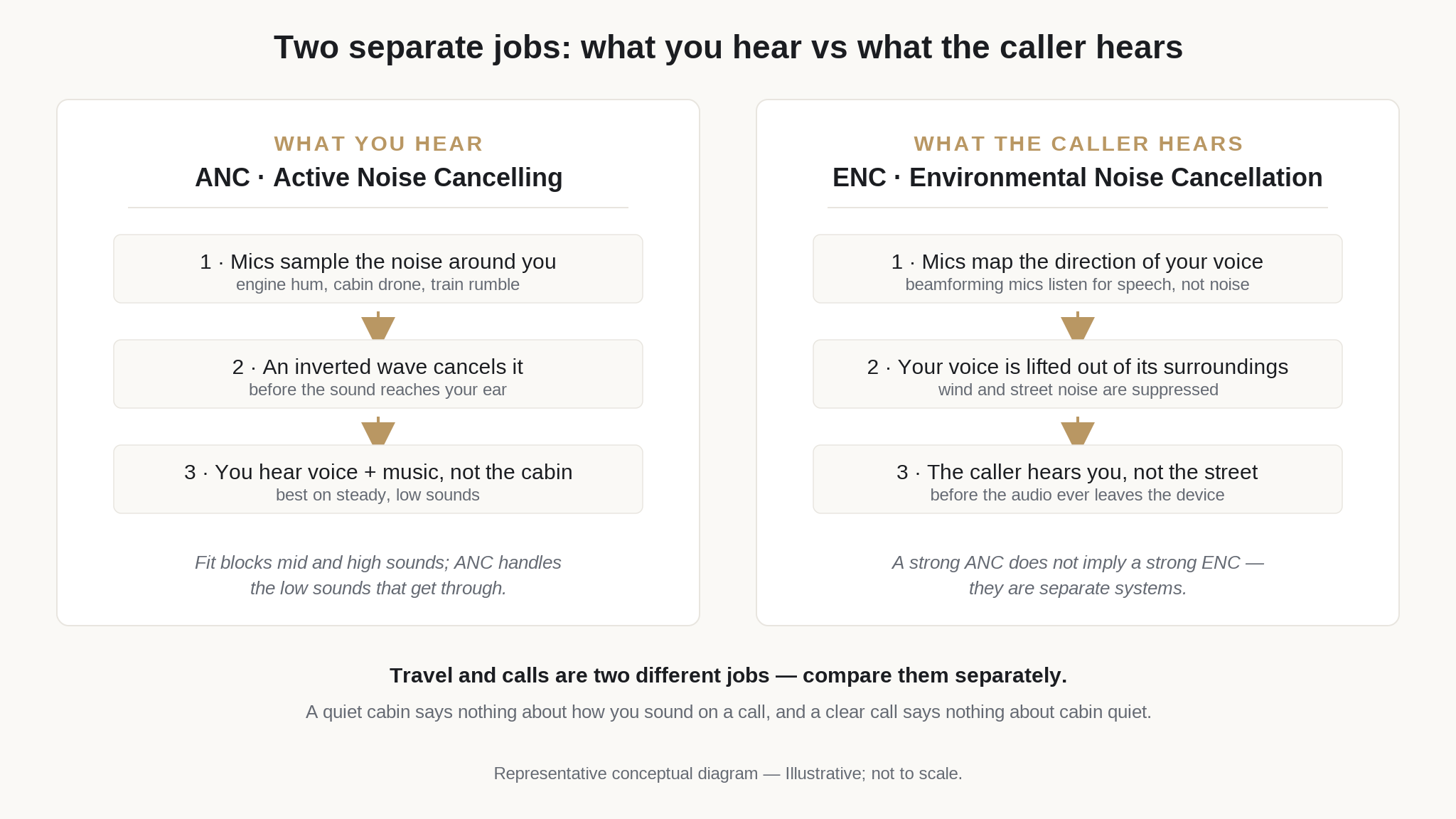
Start here, because this is the confusion that costs buyers the most. ANC and ENC sound alike and often appear on the same box, but they do opposite jobs: ANC — active noise cancelling — cleans what you hear, while ENC — environmental noise cancellation — cleans what the caller hears. A strong one says nothing about the other.
ANC works by using microphones to pick up the sound around you, then playing an opposite sound wave that cancels it before it reaches your ear. LG puts it plainly: the technology is most effective with steady, low-frequency sounds and works best with a snug fit. Engine hum, air conditioning, train noise and airplane cabins are the steady, low sounds it handles best. Voices, announcements and sudden bangs are only partly reduced.
Fit does the other half of the quiet. A good earbud fit blocks mid and high sounds, while ANC takes care of the low sounds that get through — also from LG, and the whole buying logic in one line: if the seal is poor, no ANC figure on the box will save the trip. Check the seal first, the ANC number second.
ENC works the other way round. Outgoing audio is handled separately: beamforming microphones map the direction of your voice and suppress almost everything that is not it, including wind, lifting your voice out of its surroundings before it ever leaves the device. That is the system your caller judges. A pair that is wonderfully quiet on a plane can still sound muffled on a call if its outgoing side is weak.
Microphones: what decides how you sound
Call quality is decided before the audio reaches the network, by the microphones and what the earbuds do with their signal. Three things matter, and none of them is the ANC number.
First, count the microphones. Anker’s buying guide gives a simple rule of thumb: look for at least two microphones per earbud if you regularly take calls outdoors. One mic hears everything at once; two or more compare signals, keep the one that looks like speech and suppress the rest. The rule is a floor, not a guarantee — more mics help, but they do not fix a bad fit or a windy street.
Second, wind. Wind across a bare mic sounds like a storm to the caller, and it is the most common reason a call from outside sounds bad. Makers handle it two ways: physical shielding, such as mesh-covered mics, and software tuned to cut low-frequency wind noise. A listing that mentions wind handling tells you the maker thought about outdoor calls; one that says nothing has not promised anything.
Third, sidetone: hearing your own voice in your ears while you talk, the way a phone handset lets you hear yourself. Without it, most people raise their voice without noticing, because a sealed earbud makes your own voice sound muffled and distant. JBL calls its version VoiceAware and Jabra builds sidetone into its calls. If you take long calls, sidetone is worth checking for — it decides whether a two-hour call is comfortable or exhausting.
One caveat: microphone performance varies with fit, wind, room acoustics and the phone, and labels like ENC, AI and CVC are indicators, not guarantees. Check the mechanism, not the label.
Battery: read the per-charge figure
Battery figures are the most misread numbers on the box, because every listing quotes two numbers and the big one is not the one you live with: the per-charge figure — how long the earbuds alone play — and the total with the case, which counts the case recharging them several times. Read the per-charge figure first: it decides whether the earbuds survive a flight, a workday or a long call without going back in the case.
Then read the conditions: headline figures are measured in a lab — ANC off, about half volume, a default codec, room temperature, a new battery. Change any of those and the number falls. ANC costs roughly 20 to 40 percent of playtime. As an example, Soundcore rates the Liberty 4 NC at about 10 hours per charge with ANC off against about 8 with it on, and Sony rates the WF-1000XM5 at 12 hours off against 8 on — examples, not a ranking, of how large the ANC gap can be.
Independent testing agrees. SoundGuys tests at 75 dB SPL with ANC on, and its wireless earbuds averaged about 6.4 hours per charge — well below most headline figures. There is no single mandatory battery-test standard, so two listings can quote figures measured in completely different ways. Compare per-charge figures with ANC on, at the same conditions, or do not compare them at all.
For travel, the case matters too, but for a different reason: the case total tells you how many days you can go without a wall socket, while the per-charge figure tells you whether one leg of the journey fits between charges. Both are useful; neither replaces the other.
Multipoint: two devices, calls win
Multipoint decides whether your earbuds work across a phone and a laptop, or force you to re-pair every time you switch. Bose explains it plainly: Bluetooth multipoint lets your headphones or earbuds stay connected to two devices at once, such as a phone and a laptop, and switch between them when a call comes in.
Three limits matter. First, both devices stay on standby, but only one plays audio at a time — multipoint is connection management, not audio mixing. Second, there is a priority order: phone calls come first, then alarms and notifications, then music, podcasts and video. A call on your phone will interrupt music from your laptop, which is exactly what you want on a work trip. Third, multipoint connects two sources, not three or more, and it is built in — not something an app adds later.
Do not confuse multipoint with remembering several devices. Most earbuds remember devices they have paired with before — that is not multipoint: remembering means reconnecting to any of them one at a time, while multipoint means two are live at once. QCY’s explainer adds that multipoint does not increase range. If your day is phone plus laptop, multipoint is worth having; if you use one device only, it buys you nothing.
Fit and seal: the part the box cannot show
Fit is the one factor no specification can settle for you, and it decides almost everything else. A good seal blocks mid and high sounds before ANC has to work, keeps the microphones close to your voice, and keeps the earbuds in place for hours. A poor seal leaks noise in, thins the bass and lets the earbuds slide.
Most earbuds ship with several tip sizes, and the right one seals without pressing. Try the size that feels right first, then one size up and one size down, each for a few minutes, while listening to something with low sound. The size that keeps the low sound full and the outside world quiet is the seal. A tip that hurts after ten minutes is the wrong size — a painful earbud will not survive a flight.
Fit also decides how the controls behave. Brushing an earbud while adjusting it can register as a tap on touch controls, and in-ear detection can fail with a poor seal, pausing your audio for no reason. If a pair keeps misbehaving, suspect the seal first, not the software.
Codecs: music, not calls
Codecs are the compression the earbuds and the phone agree on before any sound is sent, and they are the most overrated line on the box for a travel-and-calls buyer. Here is why: codecs decide music quality, and they barely touch calls.
The baseline is SBC. The Bluetooth SIG’s A2DP profile makes SBC mandatory, so every Bluetooth audio device supports it — the fallback that guarantees two devices can talk at all. Above it sit the optional codecs. Apple uses AAC at about 256 kbps and does not support aptX or LDAC, so AAC is the best option on an iPhone, iPad or Mac. Qualcomm rates aptX at about 352 kbps and aptX HD at about 576 kbps. Sony rates LDAC at up to about 990 kbps, built into Android 8 and later, but it needs a strong, clean link to hold its top rate. LC3 is the mandatory codec for Bluetooth LE Audio.
Two rules decide whether any of that matters. First, both ends must support the same codec, or the connection falls back to SBC — LDAC earbuds on an iPhone play AAC, and the LDAC badge buys nothing. Second, calls do not benefit from the high-rate codecs: a Zoom, Teams or phone call is a narrow voice channel. If your day is mostly calls, spend your attention on the microphones and skip the codec comparison. If your day is mostly music on an Android phone, check that the phone and the earbuds share a codec above SBC.
IP ratings: what the numbers mean
IP ratings are one of the few numbers on the box that mean exactly what they say — once you know the code. IP stands for Ingress Protection. The first digit rates dust, from 0 to 6; the second rates water, from 0 to 8. An X means not rated, not a grade: IPX4 is water-rated and dust-unrated, not dust-proof.
The water figures that matter are IPX4, IPX5 and IPX7. IPX4 means splashing water from any direction — sweat, light rain, a gym session. IPX5 means low-pressure water jets, tested with a 6.3 mm nozzle at about 12.5 litres per minute. IPX7 means temporary immersion up to 1 metre for 30 minutes — an accidental drop in a puddle, not swimming. The ratings are not cumulative: IPX7 does not imply IPX5 jet protection.
Two more limits. The tests use fresh water in controlled conditions, so chlorine, salt water, soap and sweat may not be covered. For travel, IPX4 covers sweat and rain. IPX5 adds hose-level jets you are unlikely to meet. IPX7 covers a drop in water, not a swim.
Controls: touch is not always better
Touch controls look modern and fail in exactly the situations travel creates. Capacitive touch misreads water and sweat as a finger, and brushing the earbud while adjusting it can register as a tap — so a rainy walk or a sweaty gym session can pause or hang up on you without warning.
The reliable alternatives are force or pinch controls — squeezing the stem — and physical buttons. Both work in rain, workouts and gloves, where touch fails. Physical buttons have their own cost: pressing one pushes the bud deeper into your ear. If you take calls outdoors, in rain or with gloves, prefer pinch or buttons. If you mostly use earbuds indoors, touch is fine — just know what it does when it gets wet.
In-flight: Bluetooth on a plane
Yes, with two conditions. The FAA’s 2013 decision to allow airlines to expand the use of personal electronics said devices must be used in airplane mode or with the cellular connection disabled, and that you can continue to use short-range Bluetooth accessories, like wireless keyboards. Airplane mode kills the cellular radio, not necessarily Bluetooth — most phones let Bluetooth stay on in airplane mode.
The airline decides which devices and when, and crew instructions override everything. Airborne cell voice calls remain prohibited under FCC rules, so a phone call from the cabin is not on the table even if the earbuds work. In practice: pair before boarding, keep the phone in airplane mode with Bluetooth on, and follow the crew.
| What to compare | Travel weight | Calls weight |
|---|---|---|
| ANC + fit | High — cabin quiet decides the flight | Low — your caller never hears it |
| Microphones + ENC | Low | High — this is what the caller judges |
| Sidetone | Low | High — stops you shouting on long calls |
| Battery, per charge, ANC on | High — must cover one leg of the trip | Medium — long calls drain it too |
| Multipoint | Medium — phone plus laptop | High — a call interrupts music, as it should |
| Codecs | Medium — music only, both ends must match | Low — calls do not benefit |
| IP rating | Medium — IPX4 covers rain and sweat | Low |
| Controls | Medium — rain and gloves punish touch | Medium — a stray tap can end a call |
Fit checklist before you buy
- Split the job. Decide how much of your day is travel and how much is calls, then compare ANC and fit for travel, microphones and ENC for calls.
- Check the mic count. At least two microphones per earbud for regular outdoor calls — and check whether wind handling is mentioned.
- Ask about sidetone. On long calls, hearing your own voice matters more than any codec.
- Read the per-charge battery figure with ANC on. Ignore the case total until it covers one leg of your trip.
- Check multipoint if you use two devices. Two live connections, calls first — not the same as remembering several devices.
- Match the codec on both sides. A badge means nothing if your phone does not support the same codec; calls do not benefit either way.
- Check the IP rating for your weather. IPX4 covers rain and sweat. IPX7 does not imply jet protection.
Conclusion
Compare wireless earbuds by the job you actually do with them. Travel rewards a good seal, strong ANC and a per-charge battery figure that covers a leg of the journey. Calls reward microphones, ENC, sidetone and multipoint. Codecs reward music, not calls, and only when both ends agree.
Next step: Crossbody Bag Size Guide: What Fits in 1L, 2L, 3L and 5L? — its 2L list names earbuds outright, and it shows where the charging case rides. For what else earns a place in your daily carry, see Everyday Carry Essentials: A Simple Guide for Men.
FAQ
Do I need ANC for flights?
If you fly often, yes — ANC plus a good seal quiets a cabin, because ANC handles the steady low sounds and the seal blocks the rest. ANC alone, without a seal, will disappoint.
Will better codecs make my calls sound better?
No. Calls run on a narrow voice channel, and the high-rate music codecs do not improve them. Call quality is decided by the microphones, ENC and the connection — not by LDAC or aptX.
What does multipoint actually do?
It keeps two devices connected at once — usually a phone and a laptop — and switches when a call comes in. Only one device plays audio at a time, calls take priority, and it connects two sources, not three.
Is IPX7 better than IPX5?
Not in the way the numbers suggest. IPX7 covers temporary immersion up to 1 metre for 30 minutes; IPX5 covers low-pressure water jets. The ratings are not cumulative. For rain and sweat, IPX4 is enough.
Can I use Bluetooth earbuds on a plane?
Yes, with the phone in airplane mode and Bluetooth on — the FAA allows short-range Bluetooth accessories with the cellular connection disabled. The airline decides which devices and when, and airborne cell voice calls remain prohibited.
Sources
- LG — How Does Noise Cancelling Work (ANC mechanism, ANC vs ENC, beamforming mics)
- Bose — Bluetooth Multipoint (two devices at once, one audio stream, call priority)
- QCY — Bluetooth Multipoint Explained (multipoint vs remembering devices, no mixing, no range gain)
- Yamaha — IP Code Explained (IP structure, IPX4, IPX5, IPX7)
- Anker — Waterproof Earphones Explained (IP ratings not cumulative, fresh-water test conditions)
- TechCrunch — New FAA Guidelines Permit More Device Use (Bluetooth accessories allowed, no voice calls, crew instructions)
- Earbud Insider — Touch Controls and Sensors (touch misfires, pinch and buttons as alternatives)
- Anker — Best Wireless Earbuds for Calls (at least two microphones per earbud for outdoor calls)
- SoundGuys — How Long Should Your Earbuds Last? (earbuds average about 6.4 hours per charge)
- BlafiLi Lab — SBC Codec Profile (SBC is the mandatory codec of the Bluetooth A2DP profile, A2DP 1.3.2)
Related Posts
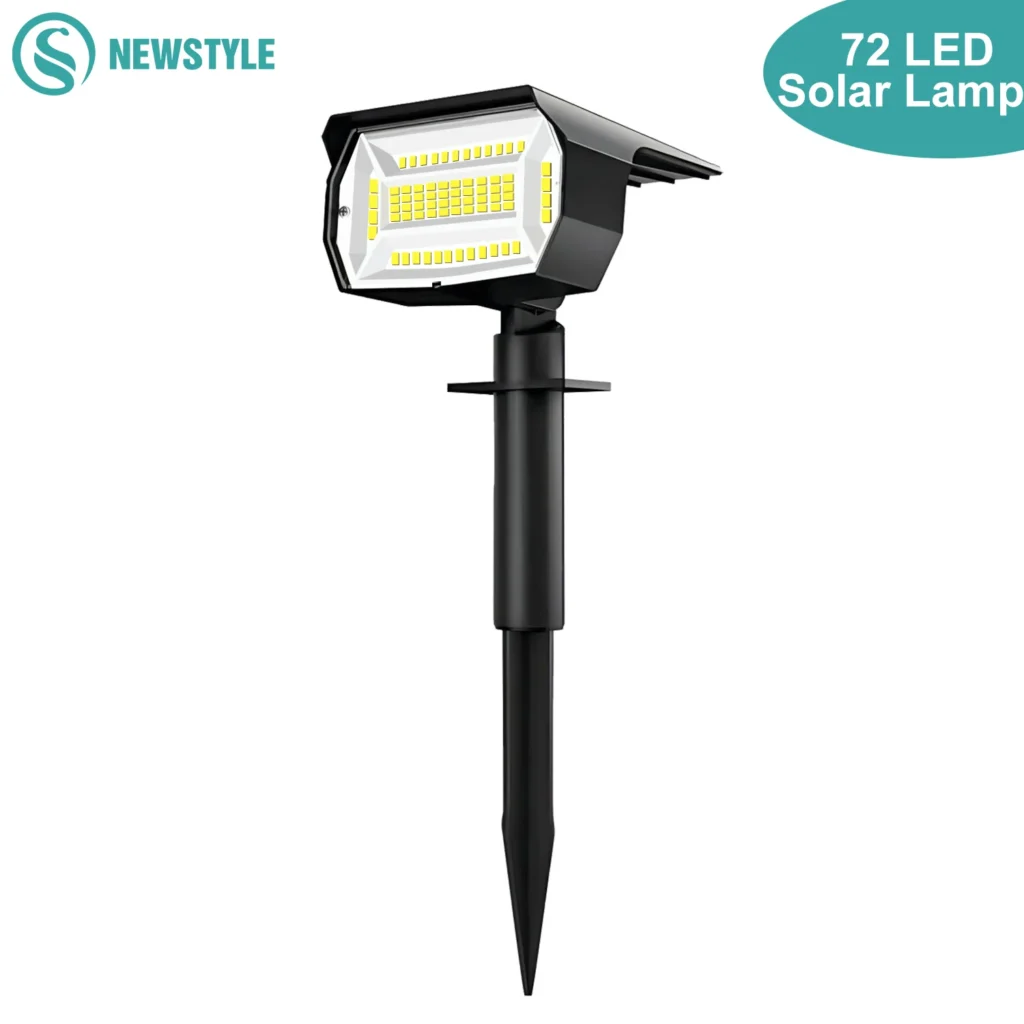
This guide covers one AliExpress listing: a 72-LED solar landscape spotlight, warm white, in the 1-piece variant. It is a buyer-check guide, not a hands-on review — LanPicks has not tested, owned, or measured this light. The direct answer is short: the listing states a solar-powered spotlight with 72 LED beads, a 1500mAh battery, 3.7 […]

This guide covers one AliExpress listing: a SHAHE stainless steel digital caliper, in the 0-150 mm (about 0-5.91 in) range variant. It is a buyer-check guide, not a hands-on review — LanPicks has not tested, owned, or measured with this caliper. The direct answer is short: the listing states a 0-150 mm stainless caliper with […]
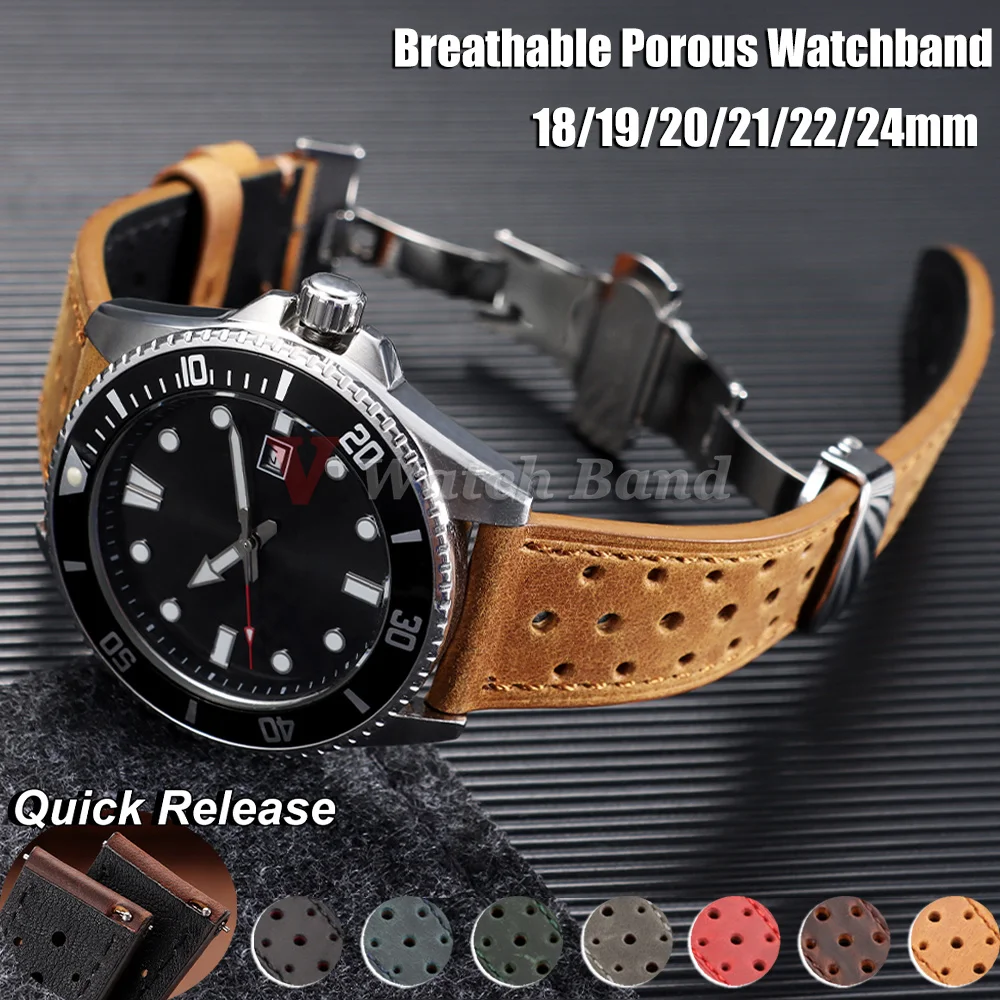
This guide covers one AliExpress listing: a vintage racing leather watch strap, in the light brown, 18 mm (about 0.71 in) width variant. It is a buyer-check guide, not a hands-on review — LanPicks has not tested, owned, or measured this strap. The direct answer is short: the strap is a perforated leather racing-style band […]
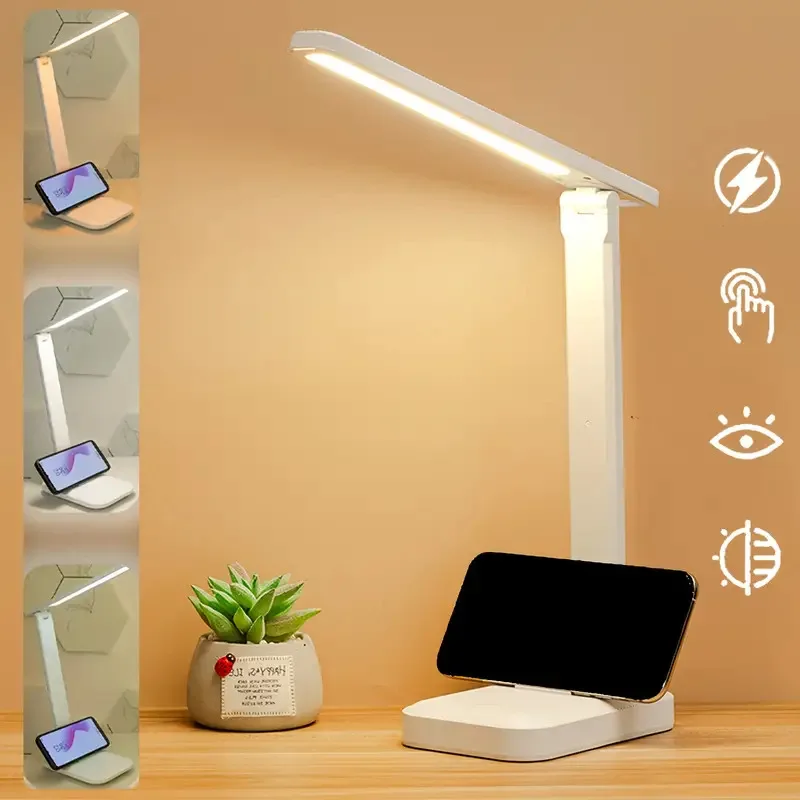
This foldable LED desk lamp is a small, USB-charged task light: it folds flat for travel, stands on a desk for reading or bedside use, and its base holds a phone or tablet. The listing states touch control, stepless dimming, three light modes (cold, warm and mixed), a rechargeable battery, and a nominal voltage of […]
This retro-style CCD camera is a compact point-and-shoot that leans on its look: a pocketable body, a flip-style dual-camera setup, a flash, and SD-card storage. The listing states 4K video at 4096×2160, a 1/1.6-inch CCD sensor, and 2x to 7x optical zoom. It is a reasonable fit if you want a cheap, fun second camera […]