

Crossbody Bag Size Guide: What Fits in 1L, 2L, 3L and 5L?
Quick Decision
Start with your item list, not the liter number. A 2L bag covers phone, wallet, keys, and earbuds for most days. Go to 3L when a passport, a portable charger, and a sunglasses case join the list. Choose 5L only when a small bottle or a light layer has to come too. Liters alone do not decide fit: two bags with the same liters can hold different things, because shape, depth, and the opening matter as much as volume. Measure your phone with its case on, check the bag’s width, depth, and zipper opening, and check the strap’s full adjustment range before you buy.
How this guide was researched. We checked the search results for “crossbody bag size guide” on 13 November 2026: the dominant intent is a sizing and fit guide, led by HRDLF, Poelle, and Eric Javits. Dimensions and capacities come from the makers’ published specifications and from reviews that checked them against the makers’ pages (lululemon, Aer, Eddie Bauer, Bellroy, Patagonia). We did not test any bag hands-on, and the dimensions below are the makers’ published figures, not our measurements. No prices are given, and where a guide states a range, it is labeled as a starting point, not a standard — there is no universal size standard for crossbody bags.
Contents
List and Measure Your Items
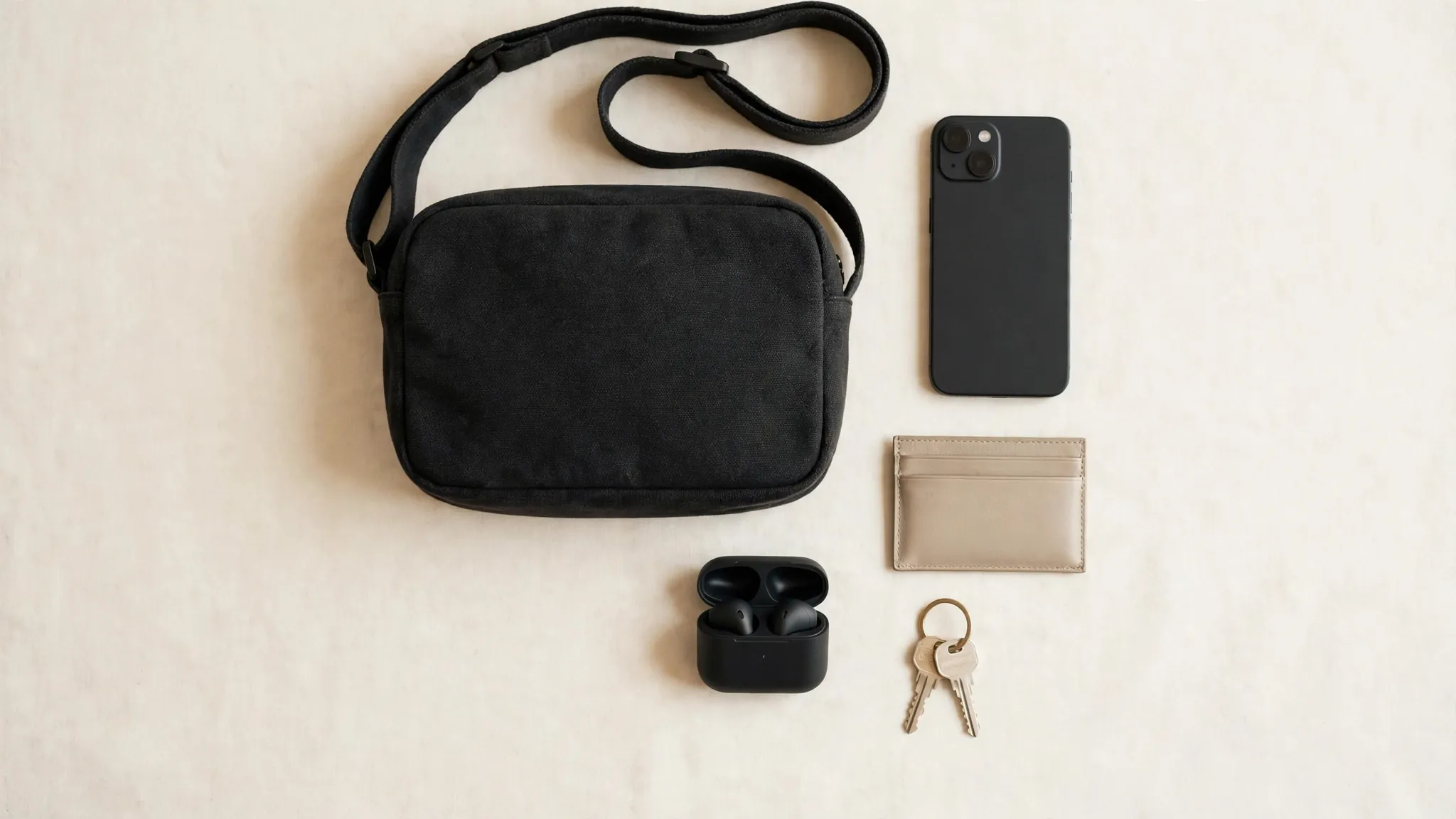
A crossbody bag is bought for an ordinary day, not the exception. Eric Javits puts it plainly: pick by what you carry on an ordinary day. So the first step is not a size chart — it is the pile on your desk. Lay out everything you carry on a normal day: phone, wallet, keys, earbuds, charger, sunglasses, and anything else that always comes along. If the pile changes between workdays and weekends, make two lists and size the bag for the bigger one.
Then measure the items, not just the bag. The phone matters most, because it is usually the largest rigid object. Measure it with its normal case installed: full length, full width, and thickness including any raised camera areas. A 6.7-inch screen measurement describes the display diagonal, not the phone’s length and width, so it tells you nothing about fit. Measure the wallet the way you actually carry it — loaded, not empty — because a slim cardholder and a stuffed bifold are different objects. Measure the sunglasses case too: a rigid case uses more space than its volume suggests.
Test the fit before the bag exists. Fold a sheet of paper to the bag’s listed width and depth, then lay your phone, wallet, and daily items on top of it — HRDLF’s paper test. If they do not fit flat with room to spare, size up. If you are rebuilding the whole carry from scratch rather than sizing one bag, our everyday carry essentials guide walks through deciding what belongs in the pile in the first place.
Liters vs Usable Shape
A liter is 1,000 cubic centimeters of volume — the only exact thing the number says. It does not say how wide the bag is, how deep it is, or whether your phone goes through the opening. VanCharli’s capacity guide states the consequence directly: there is no reliable universal conversion between liters and external dimensions, so the capacity categories are a starting point rather than a fixed size chart.
Exterior dimensions are not interior dimensions. The outside measurement includes fabric, seams, lining, and structure, so the usable interior is normally smaller. VanCharli gives the arithmetic: a box measuring 25 × 15 × 7 cm has a theoretical volume of 2,625 cubic centimeters, or 2.625L — but a soft, curved bag with the same exterior measurements will not necessarily provide 2.625L of usable capacity. Curved corners, tapered ends, padding, and zipper construction all take space back. There is no standard test for small bags either: ASTM F2153, the method for measuring backpacks, states it cannot practically be used for capacities below 4L.
The same liters can therefore be two different bags. Pack Hacker’s review of the 2L Aer City Sling 3 makes the point with two bags in hand: the 2L City Sling 3 “feels somewhat large for a two-liter sling” — it is 5 inches tall, while the ostensibly larger 2.5L City Sling 2 is 4.75 inches tall. Or compare two 3L bags: Patagonia’s Terravia Sacoche is a flat pouch of about 3.8 oz that holds a large phone, card wallet, keys, and sunglasses but not a water bottle, while Aer’s 3L Day Sling 3 is a structured 29 × 15 × 7.5 cm sling with divided compartments. Same number, different shape, different load. Size labels are no more reliable than liters: HRDLF’s five tiers and Eric Javits’s width bands do not agree with each other, so treat the label as a hint and the dimensions as the fact.
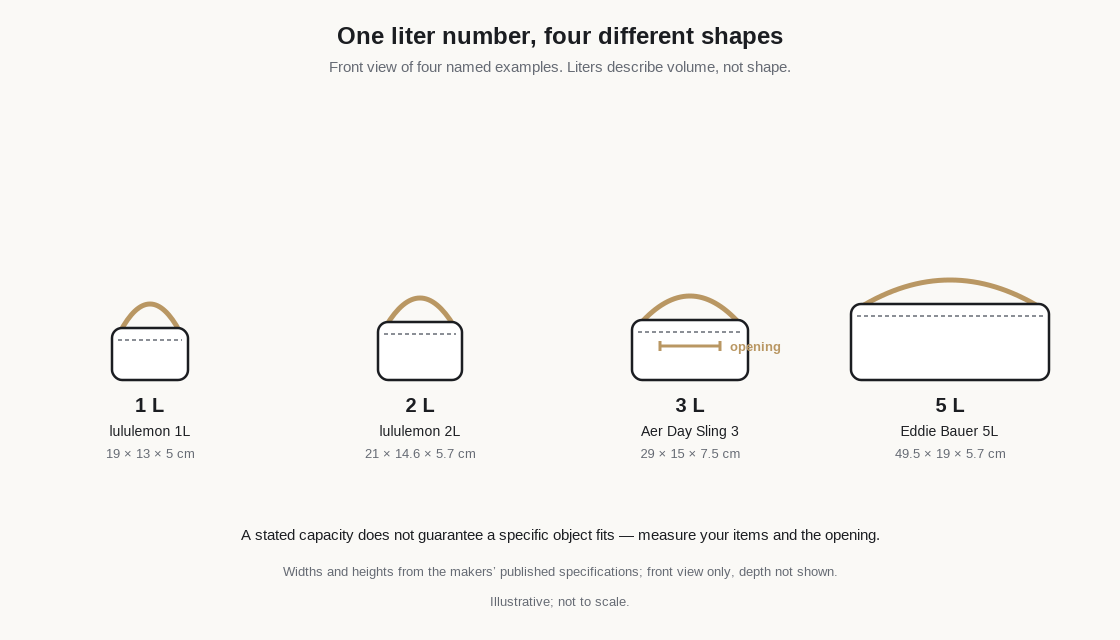
Diagram text equivalent. Four bag silhouettes, front view: 1L — lululemon Everywhere Belt Bag 1L, 19 × 13 × 5 cm; 2L — lululemon 2L, 21 × 14.6 × 5.7 cm; 3L — Aer Day Sling 3, 29 × 15 × 7.5 cm; 5L — Eddie Bauer 5L Transit Sling, 49.5 × 19 × 5.7 cm. A bracket on the 3L bag marks the zipper opening, shorter than the body width. A stated capacity does not guarantee a specific object fits — measure your items and the opening.
Compare Example Capacity Ranges
The table below uses four named models as examples of what each liter range looks like in practice. They are not a ranking and not a recommendation of any brand — they are the models whose published dimensions could be verified on 13 November 2026. Check the current listing before buying: models retire — Aer’s standard Day Sling 3 is already retired, replaced by the Day Sling 4 at 2.5L.
Swipe to compare all columns →
| Capacity (example) | Published dimensions (W × H × D) | Strap | What it may hold | Check before buying |
|---|---|---|---|---|
| 1L — lululemon Everywhere Belt Bag 1L | 19 × 13 × 5 cm (7.5 × 5 × 2 in) | Up to 106 cm (41.7 in) fully extended | Phone, slim cardholder, keys, earbuds | Your phone with its case against the 19 cm width — and the opening |
| 2L — lululemon Everywhere Belt Bag 2L | 21 × 14.6 × 5.7 cm (8.3 × 5.7 × 2.2 in) | Up to 114 cm (44.9 in) fully extended | Above, plus a slim wallet and sunglasses | Whether the extra 2 cm changes what lies flat |
| 3L — Aer Day Sling 3 | 29 × 15 × 7.5 cm (11.5 × 6 × 3 in) | Not stated in the sources used — check the listing | Above, plus passport, charger and cable, sunglasses case | A rigid sunglasses case still needs a flat pocket of its own |
| 5L — Eddie Bauer 5L Transit Sling | 49.5 × 19 × 5.7 cm (19.5 × 7.5 × 2.25 in) | Waistband adjusts up to 56 in max | Above, plus a small bottle or a light layer | Long and slim: length is the story, not depth |
Dimensions from the makers’ published specifications (lululemon and Aer as quoted by reviewers; Eddie Bauer from its own page). “May hold” follows VanCharli’s capacity ranges — shape, pockets, and your items decide.
Read the table as four answers to four different days. The 1L bag is a pocket replacement: phone, cardholder, keys, earbuds, and nothing else. The 2L bag in the same family adds about 2 cm of width and 1.6 cm of height — the capacity doubles on paper while the footprint barely changes. The 3L sling is the first size that behaves like a small bag: at 29 cm wide and 7.5 cm deep, with divided compartments, it takes the daily essentials plus passport, charger, and sunglasses case. The 5L example is a different animal: 49.5 cm long but only 5.7 cm deep — a standard bottle, about 7 cm across, may not fit inside at all. Above 5L, packs turn technical.
Check Openings and Compartments
A bag that holds your items on paper can still fail at the opening. The zipper is the gate, and the gate is usually shorter than the bag. Measure the opening against the longest rigid thing that has to pass through it — normally the phone with its case. A bag can be wider than the phone but still fail the fit test if the zipper opening is shorter, curved, or partly blocked by binding. If the listing gives no opening measurement, look for a photo of the bag open.
Where the opening sits matters too. A top-center zipper opens the full width of the bag. A side-split opening — the kind Pack Hacker notes on the Aer City Sling 3’s front pocket, where the zipper runs down the middle — leaves a shallower floor, and small items sit awkwardly in it: keys on the built-in leash fit only halfway, with the rest sticking out. The same split design means the pocket feels small once the main compartment is fully packed.
Swipe to compare all columns →
| Check | What to look for | Why it matters |
|---|---|---|
| Zipper opening length | Opening at least as long as your phone with its case | A bag wider than the phone can still fail if the opening is too short |
| Opening position | Top-center opening vs side-split opening | Side-split openings have a shallower floor; small items sit awkwardly |
| Dedicated phone pocket | A separate sleeve, not just the main compartment | Keys and a power bank press against the phone in a shared space |
| Internal dividers | Mesh pockets, a zip pocket, a divider panel | Dividers stop items pooling at the bottom and eating dead space |
| Closure | A zip you can feel shut; magnet or drawstring as a second choice | In crowds and on transit, a closure you can feel shut is the safer pick |
Compartments decide whether the bag stays usable after the first week. Dividers stop items pooling at the bottom and eating dead space, so a structured bag with an organizer panel can feel like a medium. Count the pockets, then check what each one actually takes: in the City Sling 3, a minimalist wallet fits the smallest mesh pocket but the zipper will not close smoothly over it. For travel, Poelle’s rule is simple: a closure you can feel shut, a light bag, worn in front of you in crowds.
Strap Adjustment
Two numbers get confused constantly: strap drop and total strap length. Drop is the distance from the top of your shoulder to the top of the bag when it is worn. Total length is the full strap measured end to end, including any hardware. A bag can have a 50-inch total strap and still sit at a 22-inch drop, because part of that length is taken up by the adjustment buckle and the attachment points. When a listing gives only one number, ask which one it is. The most useful specification, per VanCharli, is the complete minimum and maximum wearable circumference, bag body included.
Benchmark drops, from HRDLF’s sizing guide, are starting points by frame: petite frames under 5’3″ — 18–20 inches; average height — 21–23 inches, the range most brands design around; tall frames 5’9″ and up, or bulky outerwear — 24–26 inches and up. Hip-level carry runs 22–26 inches depending on torso length. Poelle’s height table agrees in centimeters: under 160 cm, about 105–120 cm; 160–170 cm, about 115–130 cm; over 170 cm, about 125–145 cm — and add 5–10 cm for a thick winter coat. Look at the adjustment range, not one number: webbing straps typically give 4–6 inches of range, and one bag with a wide range — the Bellroy Classic 3 Sling is listed at about 100–170 cm — can cover most heights.
Check the fit on the body, not on the page. If you already own a bag that fits, wear it over the clothing you normally use, take it off, and measure the complete strap path from one attachment point to the other. Without one, run a string across the torso and over the opposite shoulder, holding a book where the bag will sit. Comfort comes from strap width and padding more than from an exact drop number — a padded 1-inch strap beats an unpadded thin strap at the “correct” length every time — and from empty weight: under 400 g you forget the bag is there, at 800 g you feel it by evening.
Fit Checklist
Work through the checklist before you buy. Each check takes a minute, and each one rules something out — a bag that will not take your phone is not a bargain at any size, and a strap that does not adjust to your frame will hang wrong for as long as you own it.
Swipe to compare all columns →
| Check | How to check | What it decides |
|---|---|---|
| Items list | Lay out everything you carry on a normal day | Which liter range to start in |
| Phone with case | Measure length, width, and thickness; compare with the usable pocket and the opening | Whether the bag takes your phone at all |
| Wallet shape | Measure the wallet you actually carry, loaded | Whether 2L is enough or 3L is the honest size |
| Dimensions, not labels | Width, height, and depth from the listing; width decides phone fit | Whether “medium” means anything for your items |
| Strap range | Minimum and maximum wearable length, including the bag body; test over your usual coat | Where the bag sits: hip, waist, or ribs |
| Empty weight | Listed weight; under 400 g is easy all day | Whether a full day on foot stays comfortable |
| Openings and compartments | Opening length, pocket layout, closure you can feel shut | Whether you can reach the phone without emptying the bag |
Choose 2L if your list is phone, wallet, keys, and earbuds, with maybe a charger — the everyday default, and the smallest size that holds the list without forcing the zipper. Choose 3L if a passport, a portable charger, and a sunglasses case regularly join the list, or if your wallet is a bifold rather than a cardholder. Choose 5L if a small bottle or a light layer has to come along — after checking the bottle’s diameter against the bag’s depth and opening, not the liter number. Past 5L, the answer is usually a different format, not a bigger crossbody.
If the bag is one piece of a wider carry rethink, start with the list itself: our everyday carry essentials guide covers deciding what belongs in the pile before you buy a bag to hold it.
Conclusion
Choose by what you carry, not by the litre number on the label. A 1L bag is a pocket replacement for a phone, wallet and keys, a 2L bag is the default for that list plus earbuds and maybe a charger, a 3L bag adds room for a passport, a charger and a sunglasses case, and a 5L bag is for a bottle or a layer, after checking the bottle against the bag’s depth. Check the maker’s volume and dimensions against the items you measured, and pick the smallest size that holds your list without forcing it.
FAQ
Is 2L or 3L better for everyday carry?
It depends on the list. A 2L bag covers a phone-first carry: phone, wallet, keys, earbuds, and a charger. A 3L bag adds room for a passport, a sunglasses case, and a snack. Note the step can be small: the lululemon 2L is only about 2 cm wider than the 1L.
Will my phone fit in a 1L bag?
Measure the phone with its case on and compare it with the bag’s usable pocket and the zipper opening. The 1L example here is 19 cm wide, and Poelle’s rule is that a bag at least 18 cm wide takes a large phone lying flat — but the opening must be long enough to get the phone in.
Do liters tell me the size of a bag?
No. Liters describe volume, not shape: a 2L pack may be wide and slim or short and deep, and there is no reliable universal conversion between liters and external dimensions. Pack Hacker found the 2L Aer City Sling 3 feels larger than the ostensibly bigger 2.5L City Sling 2, and two 3L bags — a flat sacoche and a structured sling — hold different loads. There is also no standard test for small bags: ASTM F2153 cannot practically be used for capacities below 4L.
How long should the strap be?
Long enough to sit the bag at your hip: a 22–26 inch drop is the usual hip-level range, with 21–23 inches the sweet spot most brands design around. Poelle’s table gives about 105–120 cm under 160 cm, 115–130 cm at 160–170 cm, and 125–145 cm over 170 cm, plus 5–10 cm for a thick coat. Look at the full adjustment range, not one number, and measure over the clothing you normally wear.
Will a 5L bag fit a water bottle?
Maybe — and the shape decides, not the liters. The 5L example in this guide is 49.5 cm long but only 5.7 cm deep, and a standard bottle is about 7 cm across, so it may not fit inside at all. VanCharli’s 3–5L range says a small bottle “may” fit. Check the bottle’s diameter against the bag’s depth and the opening before you buy.
Sources
- VanCharli — “What Size Fanny Pack Do I Need? Capacity & Dimensions.” https://vancharlioutdoor.com/blog/what-size-fanny-pack-do-i-need/
- HRDLF (Hardlife Apparel Co.) — “5 Crossbody Bag Sizes and Strap Drops for Streetwear Fit.” https://hardlifeapparelco.com/2026/09/06/crossbody-bag-size/
- Poelle — “Leather Crossbody Bag: Strap Length and Size Guide.” https://poelle.com/blogs/guides/leather-crossbody-bag
- Eric Javits — “What Is a Crossbody Bag? Types, Sizes and How to Wear One.” https://ericjavits.com/blogs/news/what-is-a-crossbody-bag
- Christori — “Crossbody Bag Sizing Guide: What Dimensions Work for Different Markets?” https://christori.com/blog/crossbody-bag-sizing-guide-dimensions-wholesale/
- Digital Nomads World — “Aer Day Sling 3 Review: Worth Buying in 2026?” (specs checked against Aer official pages, 21 October 2026). https://digitalnomads.world/tips/aer-day-sling-3-review/
- Carryology — “Aer Day Sling 3 Review.” https://www.carryology.com/reviews-2/aer-day-sling-3-review/comment-page-1/
- Aer — “Day Sling 4” product page. https://www.aersf.com/products/day-sling-4
- Pack Hacker — “Aer City Sling 3 Review.” https://www.packhacker.com/travel-gear/aer/city-sling-3/
- Eddie Bauer — “5L Transit Sling” product page (read directly). https://www.eddiebauer.com/products/5l-transit-sling-ebb1018
- Apartstyle — “Lululemon Belt Bag vs. Extended Strap: Which one should you buy?” (lululemon 1L specs as quoted from the maker). https://www.apartstyle.com/post/lululemon-belt-bag-vs-extended-strap
- Luxury Check-In — “Lululemon Everywhere Belt Bag Review: Is it Good for Travel?” (lululemon 2L specs table). https://luxurycheckin.com/lululemon-everywhere-belt-bag-review/
- Mondani — “Patagonia Crossbody Bags: Sacoche vs Atom Sling vs Rivals.” https://www.mondani.com/patagonia-crossbody-bags-sacoche-atom-sling/
- Wardow listing — “Bellroy Classic 3 Sling bag” (retailer listing quoting Bellroy specs: 25 × 15 × 8 cm, 3L, strap about 100–170 cm). https://uk.wardow.com/products/bellroy-classic-3-sling-bag-bcsa-oli-244
Related Posts
Quick Decision Start with function, not with a shopping list. Pick one main accessory that solves a real need — a bag because you carry things, a cap because you are outside, a chain because the outfit needs one clear detail — and keep everything else quiet. Three starter pieces cover almost every day: a […]
A baseball cap that fits comes down to three checks, in this order: measure your head, read the brand’s size chart, and check the crown depth. Most people do only the first one — and then wonder why a cap in the right size still sits too high, pinches after an hour, or looks bulky. […]

If your daily load is a phone, keys, wallet and earbuds, a sling is enough — and it is the lighter, quicker format for that job. Add a tablet, a notebook and a charger, and you are at the edge of a sling: a larger sling or a small messenger both work. Add a laptop, […]
Most sunglasses fit or fail on three numbers printed inside the temple arm — lens width, bridge width and temple length, in millimetres, in that order. A pair marked 52-18-140 has 52 mm lenses, an 18 mm bridge and 140 mm arms. The number that actually decides whether a frame fits your face is a […]
The best everyday carry is personal. It should fit your routine, your pockets and your sense of style — without turning every outing into a packing project. Start with a few reliable essentials, then add only what earns its place. Start With What You Actually Carry Open your pockets and bag and lay everything out. […]