

Sunglasses Size Guide: Frame Width, Bridge and Temple Length
Most sunglasses fit or fail on three numbers printed inside the temple arm — lens width, bridge width and temple length, in millimetres, in that order. A pair marked 52-18-140 has 52 mm lenses, an 18 mm bridge and 140 mm arms. The number that actually decides whether a frame fits your face is a fourth one, total frame width, which is almost never printed: measure it on a pair you already own, or estimate it as two lens widths plus the bridge plus about 10 mm for the frame edges. Match that total to your face width, measured temple to temple, and the rest of the numbers fall into place.
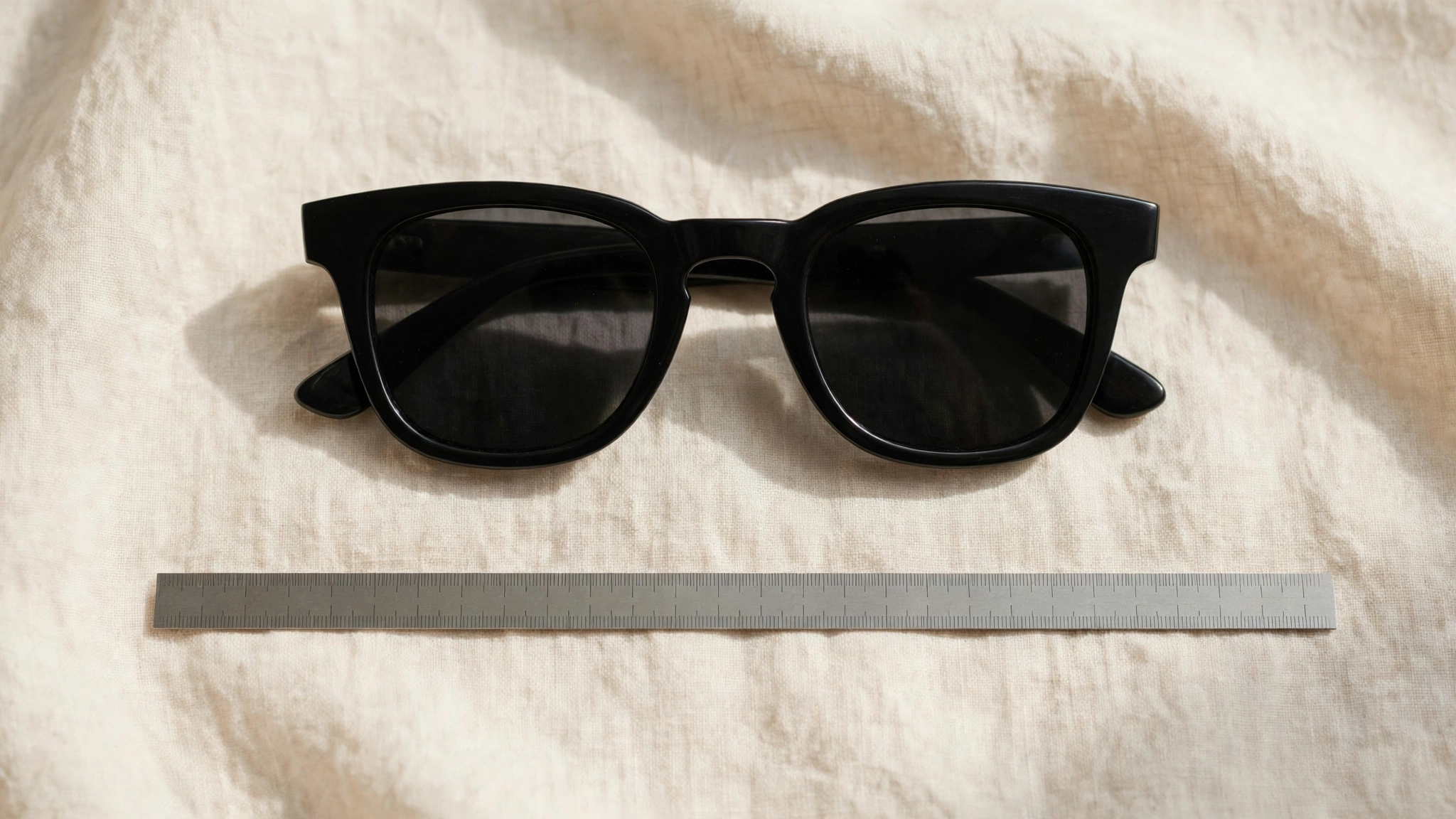
Quick Decision
Read the three numbers first: lens width, bridge width, temple length, all in millimetres — 52-18-140 means 52 mm lenses, an 18 mm bridge and 140 mm arms. Match total frame width to your face width: measure your face temple to temple, then look for a total frame width within about 5 mm of it. Copy a pair that fits: if you already own sunglasses that feel right, measure them and stay within about 2 mm on lens and bridge and about 5 mm on temple length. Fix the right number: a frame that slides down usually needs a narrower bridge, not smaller lenses; arms that press your temples usually need a wider total frame width, not shorter arms. Check protection separately: fit says nothing about UV protection — look for a UV400 or “100% UV protection” label, and remember that dark lenses and polarized lenses do not add UV protection on their own.
How this guide was put together. LanPicks does not test sunglasses hands-on or measure frames in a lab. The size ranges, measurement methods and fit guidance come from sizing guides and maker pages checked on 13 November 2026 — the size guides published by Cutler and Gross and RAEN, and the detailed chart published by Fur and Silk — and the UV guidance comes from the U.S. Food and Drug Administration and the American Academy of Ophthalmology. Size bands differ between brands, so this guide presents one working chart and says where makers disagree, instead of pretending there is a single standard. There is no official standard sunglasses size. The hero image is an AI-generated editorial illustration; the frame diagram is an original schematic drawing, not a measurement. See our Editorial Policy.
On this page
Read the Numbers on a Frame
Look on the inside of the left or right temple arm first. That is where almost every frame prints its size: three numbers, usually written like 52-18-140, sometimes with a small square in place of the first dash, like 52□18-140. Some frames print the size behind the bridge instead, and a few small or rimless styles leave it off entirely — if your pair has no printed size, measure it yourself, as the next section shows.
The order never changes. The first number is the lens width, the horizontal width of one lens at its widest point. The second is the bridge width, the shortest gap between the two lenses, where the frame sits on your nose. The third is the temple length, the length of one arm from the hinge to the tip that curves behind your ear. All three are in millimetres. The small square, when you see it, shows the frame was measured with the boxing system, where each lens is measured inside an imaginary rectangle drawn around it — the method set out in the international standard ISO 8624. A dash in the same spot means the same thing.

The diagram uses one example frame, 52-18-140, to show where each measurement is taken. The table below it says the same thing in words, so the diagram is not the only place the measurements are explained.
Swipe to compare all columns →
| Measurement | Where it is taken | Example |
|---|---|---|
| Lens width | Horizontal width of one lens at its widest point | 52 mm |
| Bridge width | Shortest gap between the two lenses, where the frame sits on your nose | 18 mm |
| Temple length | One arm, from the hinge to the tip, following the curve | 140 mm |
| Total frame width | Straight across the front, from the outer edge of one hinge to the other — rarely printed | About 132 mm |
| Lens height | Vertical depth of one lens at its tallest point, sometimes called the B measurement — not part of the three printed numbers | — |
Lens height — the vertical depth of a lens, sometimes called the B measurement — is never part of the three printed numbers, though listings sometimes include it; most sunglasses fall roughly between 35 and 50 mm, and a taller lens covers more of the eye area but can rest on your cheeks on a short face or with high cheekbones. Total frame width, when you have to work it out yourself, is two lens widths plus the bridge plus about 10 to 14 mm for the end pieces — toward the higher end on thick acetate frames — and that is an estimate, not a measurement.
The size usually shares the temple arm with the model number, the colour code, and a CAT number from 0 to 4 showing how dark the lens is. None of these change the size.
Measure a Pair You Own
The most reliable way to find your size is to measure a pair that already fits the way you like. A chart can tell you what usually fits a face of your width; a pair you own tells you what fits your face, your nose and your ears. Lay the pair upside down on a flat surface, lenses facing you, and measure in millimetres with a ruler or a soft tape.
Measure the lens width straight across one lens at its widest point, from the inside edge of the rim on one side to the inside edge on the other. Measure the bridge width as the gap between the two lenses at the point where they come closest, just above the nose pads. Open one arm and measure the temple length from the hinge screw to the very end of the tip — a soft tape follows the curve more easily than a ruler. Finally, measure the total frame width straight across the front, from the outer edge of one hinge to the other. Write all four numbers down; they are your target for the next pair.
Measure your face the same way. Face width is temple to temple, across the soft spots just outside the corners of your eyes, at about eyebrow level: stand at a mirror, hold a ruler flat just below your eyebrows, line up zero with one temple and read at the other — a second person makes this easier. Measured in inches? Multiply by 25.4.
Small differences do not matter much. The table below shows how close a new pair needs to be to feel like the one you already own — a jump of 3 mm on the lens or the bridge, or 10 mm on the temples, is where most people notice the change.
Swipe to compare all columns →
| Measurement | Feels the same within | Noticeably different at |
|---|---|---|
| Lens width | ±2 mm | 3 mm or more |
| Bridge width | ±2 mm (±1 mm on acetate) | 3 mm or more |
| Temple length | ±5 mm | 10 mm or more |
Width and Bridge Fit
Once you know your face width, the chart below turns it into numbers to shop by. Lens width is the number most brands use to label a size, but total frame width is what decides whether a pair actually fits — so the last column connects the two: measure your face width once, find your row, and you have the lens, bridge and temple ranges to look for. Across all frames, lens widths usually fall between about 40 and 60 mm, bridges between about 14 and 24 mm, and temple lengths between about 120 and 150 mm.
Swipe to compare all columns →
| Size | Lens width | Bridge | Temple length | Total frame width | Fits face width |
|---|---|---|---|---|---|
| Small | 48–51 mm | 14–18 mm | 130–135 mm | 122–132 mm | Under 130 mm |
| Medium | 52–55 mm | 16–20 mm | 135–140 mm | 132–142 mm | 130–138 mm |
| Large | 56–59 mm | 17–21 mm | 140–145 mm | 141–150 mm | 138–145 mm |
| Extra large | 60 mm and up | 18–22 mm | 145 mm and up | 148 mm and up | Over 145 mm |
All measurements are in millimetres, and the ranges overlap slightly because brands size differently — there is no official standard sunglasses size, and the same word means different numbers at different makers. Cutler and Gross calls a 49–54 mm lens medium and a 55–62 mm lens large, while the chart above calls 52–55 mm medium; RAEN calls 52–54 mm medium and 55 mm and up wide. Shop by the measurements, not by the label. If most sunglasses already fit you, you are probably in the medium row: many adult frames have a lens width of about 52 to 55 mm, a bridge of 16 to 20 mm and temple arms of 135 to 140 mm, for a total frame width of roughly 132 to 142 mm.
The bridge deserves its own check, because it carries most of the frame’s weight on your nose. Cutler and Gross publishes its bridge bands: narrow, 14–19 mm, suits small nose bridges and people whose frames often sit below their eyebrows; medium, 20–22 mm, suits most bridge widths; wide, 23–24 mm, suits wider nose bridges and people whose frames often sit above their eyebrows. Shape matters too: standard acetate frames sit on the slope of the nose, while keyhole and metal bridges rest on the widest part of the nose. If a frame slides down your nose, the bridge is usually the number to change, not the lens width.
Use your own fit complaints as the diagnostic — and remember the frame should stay in place when you look down or smile, with your pupils near the centre of each lens. If it slips with cheek movement, the fit is wrong even if the numbers look right on paper.
Swipe to compare all columns →
| What you notice | Check first |
|---|---|
| Frame slides down your nose | Narrower bridge — or a different bridge shape |
| Arms press your temples or leave marks behind your ears | Wider total frame width |
| Lenses sit high toward your brows | Wider bridge, or a bridge shape that sits lower |
| Frame rests on your cheeks when you smile | Shorter lens height, or a smaller lens width |
| Frame extends past the sides of your face | Smaller lens width |
| Frame looks narrow against your face | Wider total frame width and longer temples |
Temple Length and Shape
Temple length is the measurement most people ignore, and it decides whether sunglasses stay put or slowly work their way forward. It is the length of each arm from the hinge to the tip behind your ear, including the curve. Most adult temple lengths run from about 135 to 150 mm — small frames 130–135 mm, medium 135–140 mm, large 140–145 mm, extra large 145 mm and up. Short arms pull the frame forward; long ones leave the tips loose behind your ears.
Makers package the same idea in different words. Cutler and Gross lists Regular at 145 mm for most head sizes, Long at 150 mm for people whose bend falls before the ear so the frames tip forward, and Extra Long at 155 mm for longer or larger head shapes; RAEN’s typical range is 140–145 mm. The number matters less than where the bend lands: the arm should run straight back from the hinge and the bend should fall just behind your ear, so the tip holds the frame without pressing.
If you fall between two sizes, the choice is about the look you want: size down for a snug, refined fit, or size up for a bolder, more relaxed one. Spring hinges add a little give, which helps if you fall between two sizes. And if a pair is close but not quite right, an optician can usually adjust it — temples tightened or loosened, a crooked bridge or temple straightened, nose pads added to most frames. Do not adjust frames yourself: they can break without professional tools and guidance.
Fit Is Separate From Lens Protection
Nothing in this guide so far says anything about whether sunglasses protect your eyes. That is deliberate: size and protection are two different checks, and a pair that fits perfectly can still offer no UV protection at all. Check the label separately, every time.
The label that matters is the UV rating. The U.S. Food and Drug Administration advises choosing sunglasses with a UV400 rating or “100% UV protection” on the label — these block more than 99% of UVA and UVB radiation and provide the most protection against UV rays. The American Academy of Ophthalmology gives the same advice: look for a sticker or tag that promises 100% UV protection from all types of UV light, and a label that says “UV absorption up to 400nm” is also acceptable.
Three things people commonly mistake for protection are not protection. First, darkness: the FDA states plainly that the darkness of the lens does not indicate its ability to shield your eyes, and light-coloured tints such as green, amber, red and gray can offer the same UV protection as very dark lenses. A dark lens with no UV filter is a particular problem, because tinted glasses let your pupils dilate, which can increase your retina’s exposure to UV light. Second, polarization: polarized lenses reduce the glare bouncing off reflective surfaces such as water or roads, but polarization itself does not provide UV protection — some polarized lenses come with a UV-blocking finish, so check the label. Third, price: pricier sunglasses do not ensure greater UV protection, and the Academy notes that drugstore sunglasses labelled as 100% UV-blocking are a better choice than designer sunglasses with no protection.
Coverage is the one place size and protection meet. Large lenses offer the largest shield from sun damage, and wraparound styles offer even more protection by preventing UV rays from entering along the sides — the FDA adds that large, wraparound-style frames may provide more UV protection because they cover the entire eye socket. That is a reason to consider a larger lens or a wraparound shape, not a reason to assume a large lens protects you: without the UV label, the coverage is only shade. Two final notes: children should wear sunglasses that indicate the UV protection level, since toy sunglasses may not have it; and wear sunglasses even on cloudy days, when up to 80% of the sun’s UV rays can still get through.
Two practical checks round out the section. The Academy suggests a quick lens-quality test: look at a rectangular pattern such as a tiled floor, cover one eye, hold the glasses at a comfortable distance and move them slowly side to side, then up and down — if the lines stay straight, the lenses are fine; if they are wavy or wiggle, especially in the centre, discard them. On durability, all sunglasses sold in the U.S. must meet FDA impact safety standards; plastic lenses are less likely than glass to shatter, and for sports, polycarbonate withstands stronger impacts — get a scratch-resistant coating, since uncoated polycarbonate scratches easily. It is not clear whether UV protection fades over time, but an optical shop can test a pair you already own.
Buying Checklist
Use this worksheet before you order. Write your own numbers in the right-hand column — the guide is only useful once your measurements are in it.
Swipe to compare all columns →
| Write down | How to get it |
|---|---|
| Your face width | Ruler, temple to temple, just below your eyebrows |
| Your current pair — lens / bridge / temple | Inside the temple arm, or measure the pair yourself |
| Your current pair — total frame width | Straight across the front, outer hinge to outer hinge |
| Your target row | The size-chart row for your face width |
| UV label | UV400 or “100% UV protection” on the label or listing |
Then run the checks. The three numbers are read and in the right order. The total frame width is within about 5 mm of your face width. The bridge matches your nose and the frame sits on its slope rather than sliding down it. The temple length lets the bend fall just behind your ear, and the arms do not press your temples. The lens height does not rest on your cheeks when you smile. The UV400 or “100% UV protection” label is present — darkness, polarization and price were not treated as evidence of it. Between sizes, you chose deliberately: down for snug, up for bold. And if the pair is close but not quite right, an optician can adjust the temples and add nose pads — do not bend the frame yourself.
FAQ
What does 52-18-140 mean on sunglasses?
It means each lens is 52 mm wide, the bridge between the lenses is 18 mm and each temple arm is 140 mm long. The small square some brands print between the first two numbers shows the frame was measured with the boxing system, the method defined in ISO 8624; a dash in the same spot means exactly the same thing.
What size sunglasses should I buy if I am between sizes?
Size down if you prefer a snug, refined look, or size up for a bolder, more relaxed fit. Stay within about 2 mm on lens width and bridge width and about 5 mm on temple length of a pair that already fits you — beyond that, most people notice the change. Spring hinges add a little give if you fall between two sizes.
Are men’s and women’s sunglasses sized differently?
The numbers are measured the same way for everyone, and many frames are unisex. Women’s collections often start at smaller lens widths, while men’s lines tend to run wider, but the label matters less than the measurements. Compare the total frame width with your face width instead of shopping by the tag — especially useful if your face is wider or narrower than average, since the right size may sit in the other collection.
How do I know if my sunglasses are too big?
Sunglasses are too big if the frame reaches past the sides of your face, slides down your nose when you look down, or rests on your cheeks when you smile. A gap between the temple arms and the sides of your head is another sign. A smaller lens width or narrower bridge usually fixes it. Oversized styles are meant to extend a little past the face, but they should still stay put on the nose.
Does a bigger lens mean more UV protection?
No. Size is about coverage; protection comes from the UV filter. A large lens or a wraparound frame blocks more UV from the sides, but only a UV400 or “100% UV protection” label establishes that the lenses filter UV. Darkness and polarization do not add protection on their own, and price is not a signal either.
Conclusion
Read the three numbers, work out the fourth, and copy a pair that already fits. The lens width, bridge width and temple length printed inside the arm tell you what a frame is; the total frame width, measured or estimated, tells you whether it fits your face. Match that total to your face width within about 5 mm, pick the bridge that sits on your nose instead of sliding down it, and let the temple bend fall just behind your ear. Then check the UV label on its own terms — UV400 or “100% UV protection” — because no measurement in this guide proves a lens protects your eyes. Sunglasses are also one of the small items most men carry every day — if you are planning what goes in your pockets, our everyday carry essentials for men guide shows how to plan the kit around them.
Sources
- Fur and Silk — Sunglasses Size Chart: How to Measure Sunglasses and Read 52-18-140 (size chart; measurement methods; tolerances; fit signs; boxing system and ISO 8624)
- Cutler and Gross — Size Guide for Opticals and Sunglasses (maker size bands; bridge fit; temple lengths; adjustments; Global Fit frames)
- RAEN — Sunglasses Size Guide & Calculator Overview (maker ranges; face-width guidance; between-sizes advice)
- U.S. Food and Drug Administration — Tips to Stay Safe in the Sun: From Sunscreen to Sunglasses (UV400 / “100% UV protection”; darkness; price; wraparound; children; UV through clouds)
- American Academy of Ophthalmology — How to Choose the Best Sunglasses to Avoid Sun Damage (100% UV protection; wraparound coverage; tile test; polarization; impact standards; price)
- ISO 8624:2020, Ophthalmic optics — Spectacle frames — Measuring system and vocabulary (boxing-system method; cited in Fur and Silk’s source list — standard text not opened directly)
Related Posts

Quick Decision Start with your item list, not the liter number. A 2L bag covers phone, wallet, keys, and earbuds for most days. Go to 3L when a passport, a portable charger, and a sunglasses case join the list. Choose 5L only when a small bottle or a light layer has to come too. Liters […]
Quick Decision Start with function, not with a shopping list. Pick one main accessory that solves a real need — a bag because you carry things, a cap because you are outside, a chain because the outfit needs one clear detail — and keep everything else quiet. Three starter pieces cover almost every day: a […]
A baseball cap that fits comes down to three checks, in this order: measure your head, read the brand’s size chart, and check the crown depth. Most people do only the first one — and then wonder why a cap in the right size still sits too high, pinches after an hour, or looks bulky. […]

If your daily load is a phone, keys, wallet and earbuds, a sling is enough — and it is the lighter, quicker format for that job. Add a tablet, a notebook and a charger, and you are at the edge of a sling: a larger sling or a small messenger both work. Add a laptop, […]
The best everyday carry is personal. It should fit your routine, your pockets and your sense of style — without turning every outing into a packing project. Start with a few reliable essentials, then add only what earns its place. Start With What You Actually Carry Open your pockets and bag and lay everything out. […]