

Robot Vacuum vs Robot Mop: Which Fits Your Floors?
Hero image: AI-generated editorial illustration; not an exact product depiction.
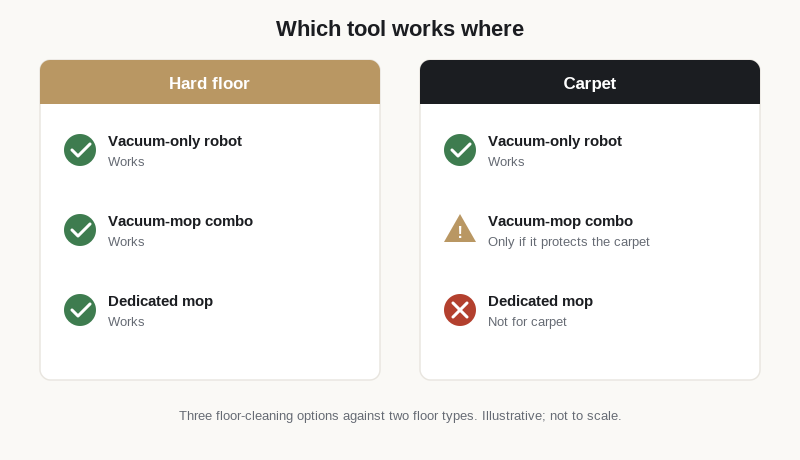
Your floors decide. A vacuum lifts dry debris — dust, crumbs, pet hair, grit — and it is the only one of the three options that works on carpet. A mop wipes what vacuuming leaves behind on hard floors: fine dust, dried spills, grime. A vacuum-mop combo does both in one machine, but only the carpet handling decides whether it is safe on rugs. So the decision is not “vacuum or mop” in the abstract — it is what your floors are made of. Mostly hard floors point at a combo. Mostly carpet points at a vacuum-only robot. Mixed floors point at a combo that protects the carpet — and that protection is tier-dependent, not a given.
| Option | What it does | Best floor | What it gives up |
|---|---|---|---|
| Vacuum-only robot | Lifts dry debris with suction and brushes | Carpet, or any floor where mopping is not wanted | No wet cleaning — hard floors keep their sticky residue |
| Vacuum-mop combo | Vacuums and mops in one run, or either alone | Mostly hard floors, or mixed floors if it protects the carpet | More hardware and more maintenance — water, pads, washing and drying |
| Dedicated mop | Mops hard floors only, no vacuuming | Almost all hard floors, where a vacuum already exists | Cannot vacuum, cannot clean carpet — a second machine, not a replacement |
This guide uses maker pages only: iRobot’s Roomba 105X Combo page, Dreame’s L10s Ultra page, Roborock’s Q7 L5+ page, and ECOVACS’s DEEBOT N20 PLUS page. No prices are stated. No product was tested. Where a maker states nothing, this guide says so instead of filling the gap from a retailer listing. The vacuum side of the decision is covered in full in our robot vacuum buying guide — navigation, mapping, suction figures and the dock — so this guide spends its words on the mop side and the floor decision itself.
- What vacuuming does
- What mopping does
- Hard floors: where a combo earns its keep
- Carpet and rugs: the check that separates combos
- Mixed floors: the most common home
- Combo vs dedicated: what you actually give up
- Mop maintenance: water, pads and washing
- How to decide
- FAQ
- Sources
What vacuuming does
Vacuuming removes dry debris: dust, crumbs, pet hair, grit — lifted by suction and agitated by brushes. It is the only cleaning a carpet gets from any of these machines, because no maker describes mopping as a carpet tool. On hard floors it does the first half of the job: it takes the loose dirt off, and leaves the damp, sticky residue for the mop.
The vacuum side is the same on a combo as on a vacuum-only robot — the same suction, the same brushes, the same navigation. iRobot’s 105X describes a 4-stage clean: “70X more suction”, a multi-surface bristle brush, an edge-sweeping brush, “plus a microfiber mop pad to leave floors shiny and clean”. Roborock states 8,000 Pa for the Q7 L5+ with carpet boost — it “automatically detects (or set in the app) carpeted areas and increases suction power for deeper cleaning”. ECOVACS states 8,000 Pa for the N20 PLUS. Dreame states 5,300 Pa for the L10s Ultra, with a footnote: “Based on tests in Dreame’s lab. Actual performance may vary depending on the real-world environment and usage.” Dreame is the only maker checked that states any test basis for its suction figure, and no maker page checked states a vacuum-only versus combo suction comparison — so do not buy a combo expecting a stated suction sacrifice, and do not buy a vacuum-only robot expecting a stated suction advantage. The suction story is the same story told in the buying guide: Pa figures have no common test method behind them, so they cannot rank models across brands.
What mopping does
Mopping removes what vacuuming leaves on hard floors: fine dust, dried spills, grime — wiped and scrubbed with a damp pad. Every maker positions it for hard floors. Dreame states its L10s Ultra covers “wood, tile, vinyl, or other hard floors”. iRobot’s 105X lets you “choose from settings including vac only, mop only, or combo vac-mop”, so the mop can run on its own. Roborock’s DEEP+ mopping mode is for stubborn dirt: “movements slow down, and mopping paths are finely divided for a deep, thorough clean, helping to tackle stubborn dirt with enhanced slow-mop action.” ECOVACS’s OZMO Mopping System is built to “effortlessly scrub away stubborn stains, while its composite material mopping pad locks in dirt and the 220ml water tank ensures continuous wetness”.
The mechanism differs by tier, and it is not one “mopping” feature. Dreame’s L10s Ultra uses dual rotary mops that “spin at 180RPM under firm pressure” to scrub floors. ECOVACS’s N20 PLUS uses a static composite pad with a 220 ml water tank. iRobot’s 105X uses a micro-pump “controlling water flow and keeping the mopping pad uniformly moist”, with SmartScrub “for 2x deeper scrubbing”. Roborock’s Q7 L5+ uses a “Consistent Water Flow Mopping System” with an upgraded electric water tank — the page states no tank volume. Do not compare these as if they were the same thing: a spinning mop, a drag pad and a pump-fed pad are different mechanisms, and no maker page checked states a measured stain-removal test result for any of them. No “removes X% of stains” figure appears in this guide, because none exists in the sources.
Treat mopping as maintenance, not a deep clean. None of the makers checked states that a robot mop fully replaces a manual mop, and none states a measured stain-removal result. The honest way to read it is that a robot mop keeps hard floors fresh between deeper cleans — it does the light, frequent wiping, and the occasional manual clean still does the heavy work. That is this guide’s own reasoning from what the sources do and do not state, not a maker claim.
Hard floors: where a combo earns its keep
If your home is mostly hard floor — wood, tile, vinyl — a combo is the natural pick, because the two jobs happen on the same floor and the combo does both in one run. All four makers position their combos exactly there. Dreame states the L10s Ultra “wipes out dirt and grime throughout your home, covering up to 200m² (2,152ft²) thanks to a large 2.5L water tank, to make your wood, tile, vinyl, or other hard floors refreshingly clean”. iRobot’s three modes mean the same machine can vacuum the whole home, mop the hard floors, or do both in one pass. Roborock’s DEEP+ mode and ECOVACS’s OZMO system are both hard-floor features.
The one hard-floor check that matters is water control. A mop that floods the floor is worse than no mop: iRobot’s micro-pump keeps the pad “uniformly moist” and lets you adjust the “amount of mopping solution pumped onto the microfiber mopping pad” per clean, along with the number of cleaning passes and the suction power. ECOVACS offers water-flow regulation in the app alongside suction adjustment. Roborock’s Consistent Water Flow system is the same idea under a different name. Dreame automates the whole loop: “automatic water and solution adding top off your robot with the proper solution/water ratio”. If you have unsealed wood or a floor the maker warns about, check the maker’s own guidance for that floor before you buy — none of the four pages checked gives a per-floor-type water verdict, and this guide does not invent one.
Carpet and rugs: the check that separates combos
Carpet is where combos differ, and it is the single most important check in this decision. A mop pad dragged across a rug is the failure mode of a cheap combo — so the question is not “does it mop?” but “what does it do when it meets carpet?”
Only one maker states the guarantee outright. iRobot states the 105X “won’t mop rugs thanks to automatic carpet detection”, and its FAQ confirms “it automatically avoids carpets in vac+mop or mop-only cleaning modes”. That is the strongest carpet promise on any page checked. The other three do not match it. Roborock’s Q7 L5+ does NOT lift its mop — the same page’s Q7-versus-Q10 comparison states the Q10 series has “an additional mop module lifting feature… which automatically lifts the mop module when the robot is on a carpet or performing obstacle avoidance, charging, and waiting for orders”. The lift is a Q10 feature, not a Q7 one, so do not attribute it to the Q7. Dreame states the L10s Ultra “raises the mops when returning to the base station” — on return to base, not a stated auto-lift over carpet during cleaning, so do not claim carpet auto-lift for Dreame. ECOVACS states the N20 PLUS has “carpet detection sensors for smooth floor transitions” — sensors for transitions, with no statement that the robot avoids mopping carpets. Only iRobot states the won’t-mop-rugs guarantee explicitly.
The practical rule follows from that table. If your home has rugs you care about, buy the carpet handling, not the mop: either a vacuum-only robot, or a combo whose carpet behaviour is stated on the maker page — automatic carpet detection with a no-mop promise, or a mop lift that engages on carpet. A combo that states neither is a combo you should assume will drag a damp pad across your rugs. And if your home is mostly carpet with a small hard-floor area, the vacuum-only robot plus an occasional manual mop is the simpler answer: the mop would run on a fraction of your floors, while the carpet risk would run on all of them.
Mixed floors: the most common home
Most homes are mixed: hard floors in the kitchen and bathroom, carpet or rugs in the bedrooms and living room. That is where a combo earns its keep — and where its carpet handling is tested on every run. The decision is the same check as the carpet section, applied to your own floor plan: count the rugs, check the maker page for the carpet behaviour, and buy the tier that states it.
Two details from the maker pages matter here. First, the vacuum side does not stop at the carpet edge: Roborock’s carpet boost and Dreame’s automatic carpet detection with suction boost both raise suction on carpet, so the same run that mops the kitchen can vacuum the rug properly. Second, the mop side has a cost even when it works: Dreame is the only maker stating both runtime figures, and mopping costs time — 210 minutes vacuuming only versus 160 minutes vacuuming and mopping, both in Quiet Mode, on the same 5,200 mAh battery. A combo that mops the whole home will cover less ground per charge than the same machine vacuuming alone. No other maker page checked states a vac-only versus vac+mop runtime, so Dreame’s is the only such figure in this guide.
Combo vs dedicated: what you actually give up
A vacuum-mop combo adds hardware to a vacuum: a water tank, a pump or plumbing, mop pads, and on higher tiers a lift mechanism. That hardware is what you maintain — water, pads, washing and drying — on top of everything a vacuum already needs. What you do not give up, on the evidence checked, is a stated amount of suction: no maker page checked states a same-brand vacuum-only versus combo suction comparison, so this guide claims no suction sacrifice for a combo and no suction advantage for a vacuum-only robot. The honest framing is the added hardware and the added maintenance, not a suction number.
A dedicated mop is the niche pick, and the niche is narrow: a home that is almost all hard floor and already has a vacuum. A dedicated mop does one job — it mops — and it cannot vacuum or clean carpet, so it is a second machine, not a replacement for the first. No dedicated robot-mop maker page was checked for this guide, so no specific dedicated-mop claim appears here: no model, no spec, no price. If your floors are almost entirely hard and you already own a good vacuum, a dedicated mop is worth a look; if you do not own a vacuum, the combo is the machine that does both jobs. And for the jobs no floor robot does at all — stairs, car interiors, tight spots — a handheld is the tool: our portable car vacuum guide covers that comparison.
Mop maintenance: water, pads and washing
Mopping adds a second maintenance list on top of the vacuum’s. The vacuum list is the same as in the buying guide — empty the bin or the dock, clean the brushes, wipe the sensors and contacts, and change the filter when the owner’s guide says so; the only maker-stated replacement interval found is iRobot’s filter every 3–6 months. The mop list is water, pads and washing.
Water first. The tank sizes cannot be compared across brands, because only two makers state a volume and only one states a coverage figure: Dreame’s base station holds a 2.5L clean water tank covering up to 200m², with an 80 mL tank on the robot itself; ECOVACS’s N20 PLUS has a 220 ml tank. iRobot and Roborock state no tank volume on the pages checked. What matters more than the volume is what goes in it: Dreame states “only Dreame’s solution should be used with L10s Ultra” — its Multi-Surface Floor Cleaner — while iRobot lets you “use water or a compatible cleaning solution”. Check the maker’s solution rule before you buy, because the wrong solution can be a warranty question, not just a cleaning one.
Pads second. iRobot states its microfiber mop pads “can be used up to 30x” — a consumable with a stated life, not an unlimited one. Dreame automates the washing: “automatic mop-washing, mop-cleaning and -drying” in the dock, with automatic water and solution refills. Roborock’s DEEP+ mode and ECOVACS’s composite pad add no stated pad-life figure on the pages checked. The pattern is the same as the vacuum’s filter: if the maker states a life, use it; if it does not, the owner’s guide is where the buyer should look — not a retailer listing.
How to decide
Work through five checks in order, and the answer usually decides itself.
1. Count the floors. Walk the home and count hard floor versus carpet, room by room. Mostly hard floor points at a combo. Mostly carpet points at a vacuum-only robot. Mixed floors point at a combo — and straight to check 2.
2. Check the carpet handling. Read the maker page for the exact model, not the product line: does it state automatic carpet detection with a no-mop promise, or a mop lift that engages on carpet? iRobot states the won’t-mop-rugs guarantee; Roborock’s lift is a Q10 feature, not a Q7 one; Dreame lifts its mops on return to base only; ECOVACS states detection sensors with no no-mop promise. If the page states neither, assume the pad will touch your rugs.
3. Check the mop mechanism. Spinning mops, a drag pad and a pump-fed pad are different mechanisms — Dreame’s dual rotary mops at 180 RPM, ECOVACS’s static OZMO pad, iRobot’s micro-pump pad, Roborock’s Consistent Water Flow system. No maker states a measured stain-removal result for any of them, so do not buy on a stain percentage; buy on the mechanism and the water control.
4. Count the maintenance. A combo adds water, pads and washing to the vacuum’s list. Pads have a stated life where the maker gives one — 30 uses on iRobot. A dock that washes and dries the mops itself, like Dreame’s, removes the hand-washing; a model without one adds it. And the runtime cost is real: Dreame’s vac+mop run is 160 minutes against 210 minutes vacuuming alone, both in Quiet Mode.
5. Decide whether you need a second machine. If you already own a good vacuum and your floors are almost all hard, a dedicated mop is the niche pick. If you do not own a vacuum, the combo is the machine that does both jobs. If your floors are mostly carpet, the vacuum-only robot plus an occasional manual mop is the simpler answer.
The short version: hard floors point at a combo, carpet points at a vacuum-only robot, and mixed floors point at a combo whose carpet handling is stated on the maker page. If you have not chosen the vacuum yet, start with our robot vacuum buying guide — navigation first, then the dock, then the mop.
FAQ
Do I need a vacuum, a mop, or both?
Your floors decide. Mostly hard floors point at a vacuum-mop combo, which does both jobs in one run. Mostly carpet points at a vacuum-only robot, since no maker describes mopping as a carpet tool. Mixed floors point at a combo — provided its carpet handling is stated on the maker page.
Can a vacuum-mop combo replace a manual mop?
No maker page checked states that it does. A robot mop is best read as maintenance that keeps hard floors fresh between deeper cleans — it does the light, frequent wiping, and the occasional manual clean still does the heavy work. No maker states a measured stain-removal result, so there is no figure to buy on.
Will a combo mop my rugs?
It depends on the model, and the difference is tier-dependent. iRobot states its 105X “won’t mop rugs thanks to automatic carpet detection”. Roborock’s mop lift is a Q10 feature, not a Q7 one. Dreame lifts its mops when returning to the base station, not over carpet during cleaning. ECOVACS states carpet detection sensors with no no-mop-on-carpet promise. Check the exact model’s maker page before you buy.
Does mopping cost runtime?
Yes, on the one maker that states both figures. Dreame states the L10s Ultra runs 210 minutes vacuuming only versus 160 minutes vacuuming and mopping, both in Quiet Mode, on the same 5,200 mAh battery. No other maker page checked states a vac-only versus vac+mop runtime.
How much extra maintenance does mopping add?
Water, pads and washing, on top of the vacuum’s list. iRobot states its microfiber pads can be used up to 30 times. Dreame’s dock washes, cleans and dries the mops automatically and refills the water and solution. And check the solution rule: Dreame states only its own solution should be used, while iRobot allows water or a compatible cleaning solution.
Sources
- iRobot — Roomba 105X Combo Robot + AutoEmpty Dock (vac / mop / combo modes; “won’t mop rugs”; micro-pump; SmartScrub; pads up to 30 uses; filter every 3–6 months)
- Dreame — DreameBot L10s Ultra (dual rotary mops 180 RPM; 2.5L tank, up to 200m²; 210 / 160 minutes Quiet Mode; auto mop-washing and drying; mop lift on return to base only; “only Dreame’s solution”)
- Roborock — Q7 L5+ Robot Vacuum and Mop with Auto-Empty Dock (Consistent Water Flow Mopping System; DEEP+ mode; Q7 has no mop lift, Q10 does; carpet boost; 8,000 Pa)
- ECOVACS — DEEBOT N20 PLUS (OZMO Mopping System; composite pad; 220 ml water tank; water-flow regulation; carpet detection sensors; 8,000 Pa)
Related Posts
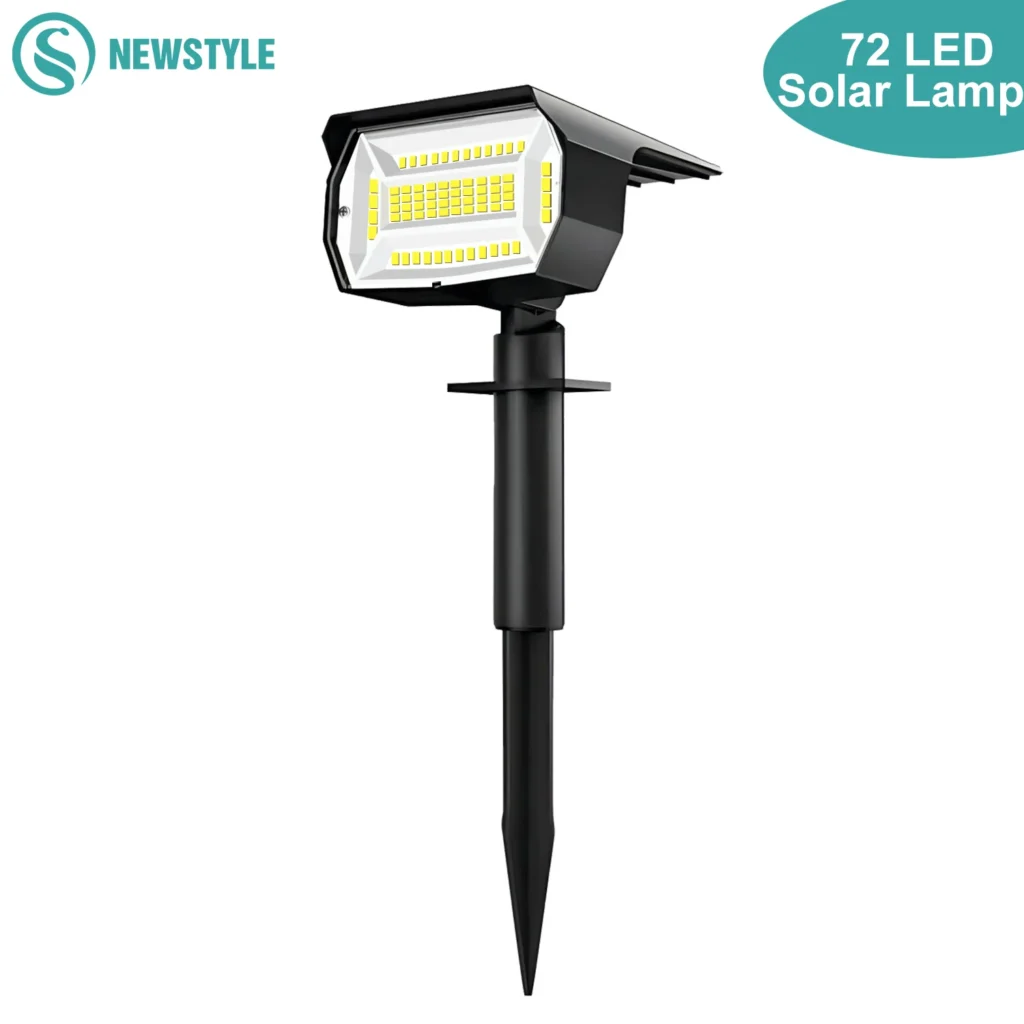
This guide covers one AliExpress listing: a 72-LED solar landscape spotlight, warm white, in the 1-piece variant. It is a buyer-check guide, not a hands-on review — LanPicks has not tested, owned, or measured this light. The direct answer is short: the listing states a solar-powered spotlight with 72 LED beads, a 1500mAh battery, 3.7 […]

This guide covers one AliExpress listing: a SHAHE stainless steel digital caliper, in the 0-150 mm (about 0-5.91 in) range variant. It is a buyer-check guide, not a hands-on review — LanPicks has not tested, owned, or measured with this caliper. The direct answer is short: the listing states a 0-150 mm stainless caliper with […]

This guide covers one AliExpress listing: a vintage racing leather watch strap, in the light brown, 18 mm (about 0.71 in) width variant. It is a buyer-check guide, not a hands-on review — LanPicks has not tested, owned, or measured this strap. The direct answer is short: the strap is a perforated leather racing-style band […]
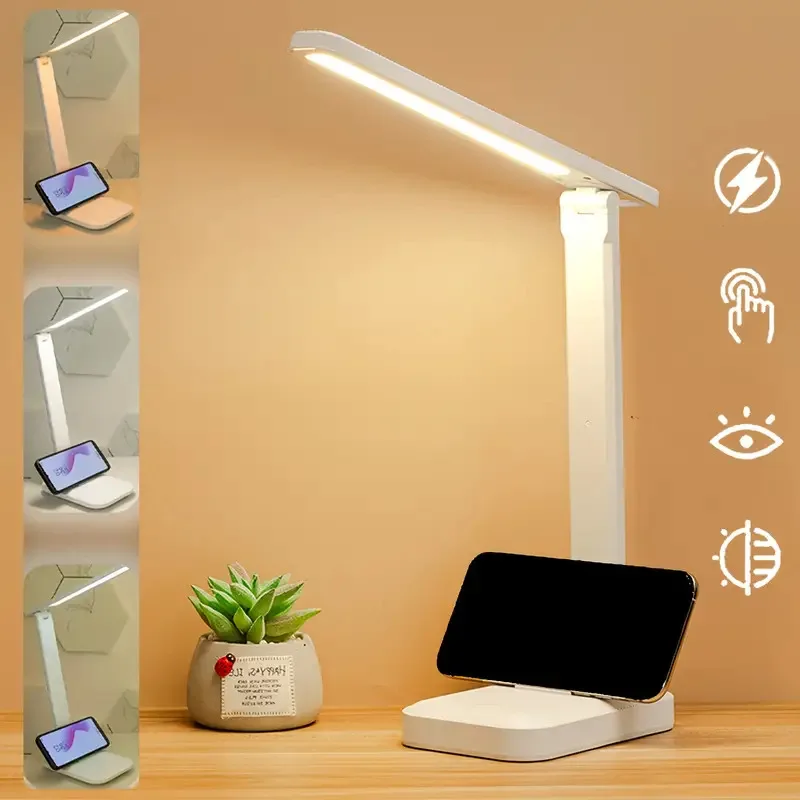
This foldable LED desk lamp is a small, USB-charged task light: it folds flat for travel, stands on a desk for reading or bedside use, and its base holds a phone or tablet. The listing states touch control, stepless dimming, three light modes (cold, warm and mixed), a rechargeable battery, and a nominal voltage of […]

This retro-style CCD camera is a compact point-and-shoot that leans on its look: a pocketable body, a flip-style dual-camera setup, a flash, and SD-card storage. The listing states 4K video at 4096×2160, a 1/1.6-inch CCD sensor, and 2x to 7x optical zoom. It is a reasonable fit if you want a cheap, fun second camera […]