

Car Interior Cleaning Kit: What You Actually Need
Quick Decision
Start with five things: several microfiber cloths kept separate by task, a mild interior cleaner, an automotive glass cleaner, a set of soft detailing brushes, and access to a vacuum with crevice and upholstery tools. That minimum kit handles the routine cleaning of most interiors — hard surfaces, glass, and light dirt on seats and carpet. Add only what your surfaces demand: a leather cleaner and conditioner if you have leather seats, an upholstery cleaner if you have cloth seats or carpet stains, and a pet-hair brush if pets ride along. Do not buy a dressing, a steam cleaner, or a specialty tool before the minimum kit is in regular use — and do not assume a cleaner labeled “multi-purpose” is safe on every surface. Check its label against each material you own.
How this guide was researched. We checked the search results for “car interior cleaning kit” on 13 November 2026: the dominant intent is kit selection, led by buying guides from DetailXperts, The Auto Wire, and RoadHubs, and surface-care guidance from Consumer Reports, Broombook, and Ultra-Shine. Every claim below names its source. We did not test any product hands-on, we name no product to buy, and no price appears in this guide. Where a source gives a number, such as a dilution or a time estimate, it is attributed to that source and flagged as its example, not a universal rule.
Contents
List Your Surfaces
A car interior is not one surface but a mix of materials, each needing different care. The kit you need follows from the mix you actually have — not from the longest list in a store. Walk your car once and write down what you see.
Start with the hard surfaces: the dashboard, centre console, door panels, steering wheel, and shifter trim. Most are vinyl or hard plastic, even in cars that feel expensive — Ultra-Shine notes that most of what people think is leather in modern vehicles is actually vinyl or synthetic leather, including the seats. A cleaner that suits vinyl is not automatically right for leather, so check your seats in the owner’s manual before buying a leather-specific product.
Then the seats and floors. Leather seats need a cleaner and a conditioner, and the steering wheel needs the same treatment — Ultra-Shine calls it the most neglected leather surface in any vehicle. Cloth seats and carpet need a vacuum and, for stains, an upholstery cleaner. Rubber mats are a separate job from carpet mats: scrub and rinse them outside the car.
Then glass and screens. The inside of the windshield collects a film from the cabin’s vinyl and plastic and needs a dedicated automotive glass cleaner — not the household window cleaner under your sink. The screen is a third category: ammonia-based cleaner can damage its anti-glare and anti-fingerprint coatings, and some carmakers say to use a dry cloth only. Check the owner’s manual before buying anything for it.
Finally the headliner — the ceiling fabric, thin material glued to a foam backing board, with the adhesive as the weak point. It needs almost nothing: a barely damp cloth and a light blot at most. If it is clean, it needs no product at all.
That walk gives you the list the rest of this guide works from. A car with cloth seats, carpet mats, and no pets needs a different kit from a car with leather seats, rubber mats, and a dog — and both need less than a pre-made kit’s longest box suggests.
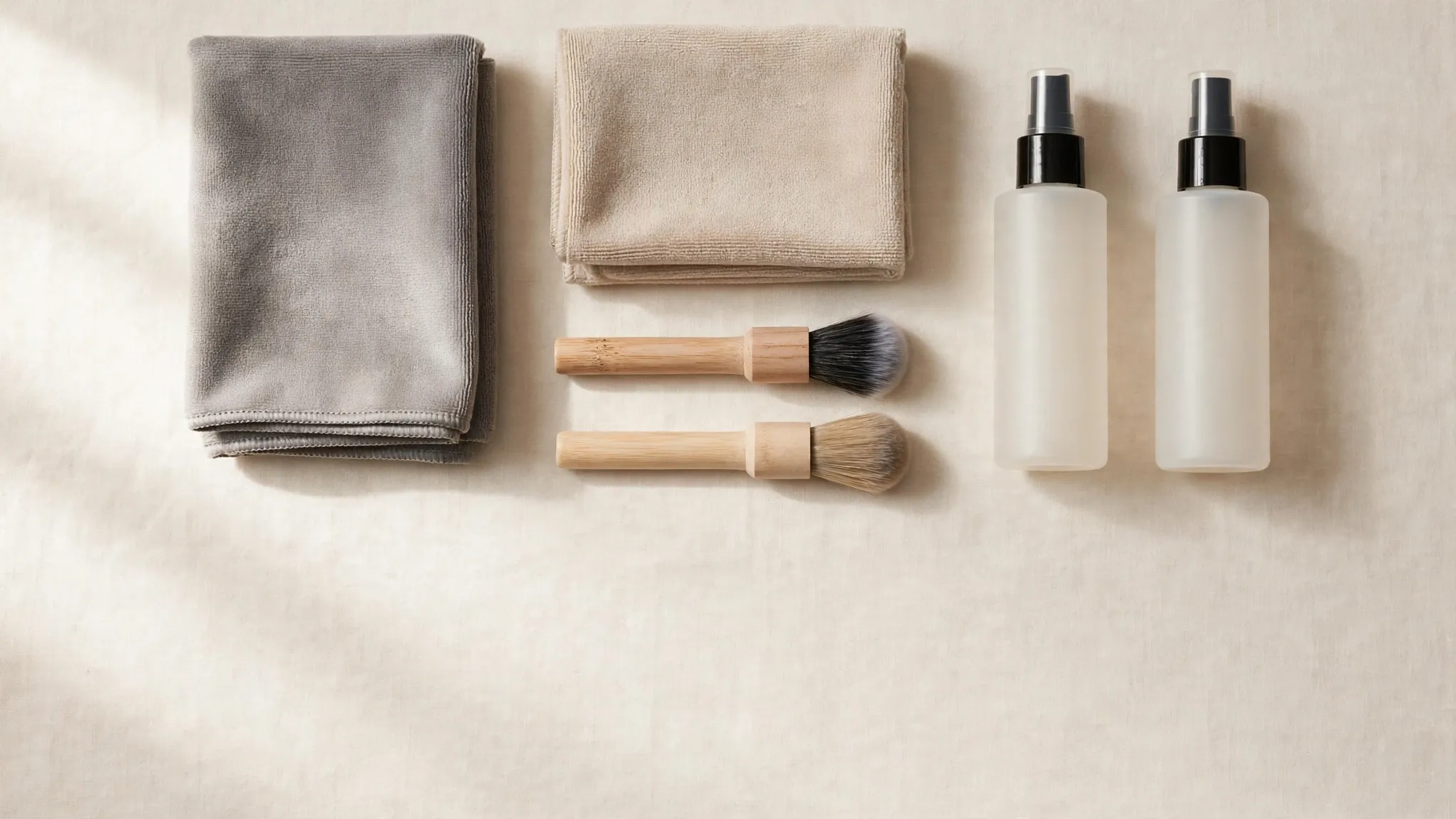
Build a Minimum Kit
Five categories cover the routine cleaning of most interiors. Buy these first, use them for a month, and only then decide what is missing — every source we checked converges on the same short list.
Microfiber cloths — several, kept separate by task. Cloths do half the work in interior cleaning. Keep them separate: one set for glass, one for hard surfaces, one for dirty work. A cloth that has picked up grit on a floor mat has no business on a windshield or a screen. Cloths in different colors help organize them by job; paper towels are out — they leave lint behind.
A mild interior cleaner. One bottle for dashboards, consoles, door panels, and vinyl. Spray it onto the cloth, not onto the surface, so it does not run into buttons, vents, and electronics.
An automotive glass cleaner. Glass needs its own product: an automotive glass cleaner containing alcohol, applied with one cloth and buffed with a second dry one. Household window cleaner may not remove the film inside a windshield, and its ammonia damages tinted windows.
A set of soft detailing brushes. A cloth cannot reach into air vents, seams, switches, and cup holders — a small, clean paintbrush or a soft toothbrush does, and detailing guides sell the same idea as a brush set. One soft brush for vents and seams and one stiffer brush for mats cover the range.
Vacuum access with crevice and upholstery tools. Vacuuming comes before any wet cleaning — liquid cleaner on a dusty surface just creates mud. A household vacuum with a crevice tool and an upholstery attachment is enough to start: the crevice tool reaches under and between seats, the upholstery tool’s short bristles agitate dirt out of cloth. A portable car vacuum adds reach away from an outlet — a convenience, not a requirement.
That is the whole minimum kit. If a pre-made kit contains these five categories and nothing you cannot use, it is a fair starting point. If it holds five more bottles you have no surface for, you are paying for shelf space.
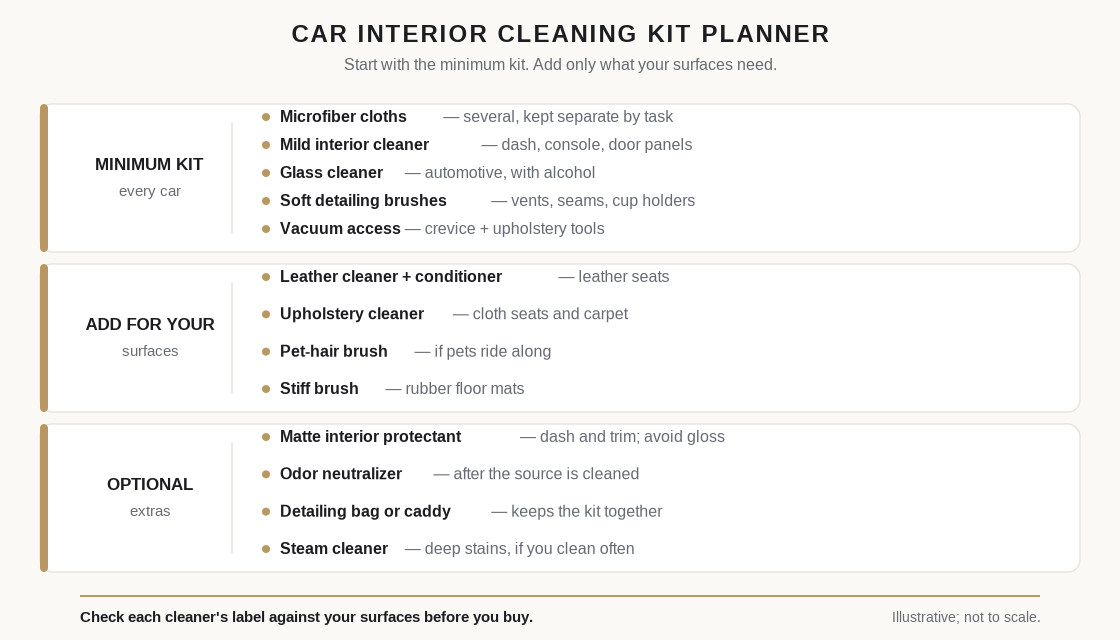
Diagram text equivalent. Three tiers. Minimum kit, every car: microfiber cloths (several, kept separate by task); mild interior cleaner; glass cleaner; soft detailing brushes; vacuum access. Add for your surfaces: leather cleaner + conditioner; upholstery cleaner; pet-hair brush; stiff brush. Optional extras: matte interior protectant; odor neutralizer; detailing bag or caddy; steam cleaner. Footer: check each cleaner’s label against your surfaces before you buy.
Add Tools for Actual Needs
Once the minimum kit is in regular use, the gaps show up on their own. Add one item per gap, for the surface that caused it. The matrix below is the decision aid: find your surface, see what the minimum kit covers, and see what to add.
Swipe to compare all columns →
| Surface | Minimum kit covers it with | Add if you have this surface | Avoid |
|---|---|---|---|
| Hard plastics and vinyl (dash, console, door panels) | Mild interior cleaner + microfiber cloth; soft brush for vents and seams | Matte protectant for a sun-exposed dash | Glossy dash dressings (glare); paper towels (lint) |
| Leather seats and steering wheel | Soft cloth + a little dish soap and water | Dedicated leather cleaner + conditioner | Bleach, hydrogen peroxide; all-purpose cleaner as a leather cleaner |
| Cloth seats and carpet | Vacuum with upholstery + crevice tools | Upholstery cleaner; stiff brush for mats | Soaking seats or carpet (mold, musty smell) |
| Glass (windshield, windows) | Automotive glass cleaner + two microfiber cloths | A glass-specific cloth (thinner, tighter weave) | Ammonia window cleaner; spraying the glass |
| Touchscreens | Dry microfiber cloth | Alcohol on the cloth, only if the manual allows | Ammonia-based glass cleaner; spraying the screen |
| Headliner | Barely damp cloth, blot only | Nothing — do less, not more | Soaking or scrubbing (glue fails, fabric sags) |
Surface guidance from Consumer Reports, Broombook, and Ultra-Shine (13 November 2026); the “avoid” column states those sources’ warnings.
A few additions deserve a closer look, because they are the ones buyers get wrong. Leather care is two products, not one: a cleaner and a conditioner. Use a dedicated leather cleaner — not an all-purpose cleaner — applied to a soft brush or microfiber towel, then a thin coat of conditioner, left to absorb for ten to fifteen minutes and buffed off. For light cleaning, a soft cloth with a small amount of dish soap and water — saddle soap if you can find it — followed by the conditioner does the job.
Upholstery cleaner is for cloth seats and carpet stains, and the method matters more than the bottle. Mist the cleaner onto the stain, work it in with a soft brush, and blot with a clean microfiber cloth until no more color comes up. Use as little liquid as possible: soaked seat foam dries slowly and can grow mold.
A pet-hair brush earns its place only if pets ride along. Hair works into cloth and carpet where a vacuum alone struggles; a rubber or silicone brush lifts it into clumps the vacuum can pick up.
A steam cleaner is the last addition, not the first. It lifts stains from carpet and upholstery, and hot-water extraction is the correct tool for seriously dirty cloth seats and carpet — but for lightly soiled seats, a spray cleaner and a brush do the job.
Pre-Made Kit vs Separate Items
A pre-made kit and a kit you build yourself solve the same problem in opposite ways: one trades fit for convenience, the other trades convenience for fit. Neither is wrong. The right choice depends on how much you already know about your car.
Swipe to compare all columns →
| Factor | Pre-made kit | Separate items |
|---|---|---|
| Fit to your car | Fixed contents — check each item against your surfaces | Built around your surfaces from the start |
| Convenience | Ready to use; good if you want to start this weekend | Takes a shopping list and a little research |
| Duplicates | May include tools or cleaners you already own | You buy only what you do not have |
| Quality control | One brand’s range; a weak item stays in the box | Each item chosen on its own merits |
| Best for | A first kit, or a gift | A car with leather, pets, or stains — or a second kit |
A pre-made kit is the better buy in exactly one situation: you have not cleaned a car interior before and you want to start now. Pick a kit whose contents match the minimum kit in this guide, and treat anything beyond that as a bonus. Read the label on every bottle in the box before the first use: a kit’s “multi-purpose” cleaner is multi-purpose only for the surfaces its label lists.
Building your own kit is the better buy once you know your car. You did the surface walk, so you know whether leather care or upholstery cleaner belongs in the basket, and you skip the rest until a real gap appears. DetailXperts makes the same point: building your own lets you try products and add them as you go.
One warning applies to both routes: a kit that promises to clean “all surfaces” with one bottle is promising something no single cleaner does. Leather needs conditioning after cleaning, glass needs a dedicated cleaner, and screens need their owner’s manual checked first. The bottle’s label is the claim; the surface list in this guide is the check.
Compatibility and Storage
Compatibility is a label question, not a brand question. Before a cleaner touches a surface, read what the label says it is for — and what it says it is not for. Three checks cover most mistakes.
First, the cleaner-to-surface check. A mild interior cleaner covers hard plastics, vinyl, and consoles — not leather conditioning, glass, or screens. A dedicated leather cleaner is for leather; an upholstery cleaner is for cloth and carpet; a glass cleaner is for glass. “Multi-purpose” on a label means the maker tested it on the surfaces the label lists — nothing more.
Second, concentration. Some all-purpose cleaners are sold concentrated and need diluting; others are ready to use. Ultra-Shine’s guide gives 10:1 for light cleaning and 4:1 for heavier grime as its example — not a universal recipe. The label on the bottle you buy governs: follow its ratio, and never guess at a stronger mix for a stubborn spot.
Third, the screen check. This is the one surface where the wrong product causes damage you cannot undo. Ammonia-based glass cleaner can damage a screen’s anti-glare and anti-fingerprint coatings, and some carmakers allow less than others — Nissan’s manual, cited by Broombook, says to use a dry soft cloth only. The check costs a minute in the owner’s manual and saves a screen.
Storage is the part of the kit most buyers skip, and it is what keeps the kit usable. A detailing bag or caddy holds the bottles upright and the brushes and cloths together, so the kit is one grab instead of a search through the garage. Keep bottles upright and out of heat and direct sun — a car trunk in summer is the worst place to store cleaners. Keep glass cloths separate from the cloths used on dirty work; a cloth that has picked up sand is sandpaper on glass.
And the safety rules, which belong in every kit, not in any bottle: never mix cleaning products; keep sprays off airbag covers marked SRS or AIRBAG; work with the doors open and the engine off; park in shade so cleaners do not dry on hot surfaces; leave the windows cracked while the interior dries.
Purchase Checklist
Work through the checklist in order. Each check takes a minute, and each one rules something out — a cleaner with no surface to clean is not a bargain, and a tool with nowhere to live is not a kit.
Swipe to compare all columns →
| Check | How to check | What it decides |
|---|---|---|
| Surfaces | Walk the car; note leather, cloth, vinyl, glass, screens | Which cleaners and tools you actually need |
| Cleaner labels | Read each label for the surfaces it lists | Whether a “multi-purpose” cleaner covers your materials |
| Cloth count | Count the jobs: glass, dash, seats, dirty work | How many microfiber cloths to buy, and how to separate them |
| Vacuum tools | Check for crevice + upholstery attachments | Whether your current vacuum is enough, or a portable one earns a place |
| Storage | Find a dry spot the kit will live in | Bag or caddy size, and whether bottles stay upright and out of heat |
| Duplicates | Compare the kit’s contents with what you own | What not to buy twice |
Buy the minimum kit first if you have never cleaned a car interior, or your current supplies are a single old towel and a household spray. Five categories, used for a month, will show you what is missing. Add one item at a time if the minimum kit is already in regular use and a specific gap has appeared — a stain, a leather seat, a pet, a smell. One gap, one item, then use it before buying the next. Buy a pre-made kit if you want to start this weekend and the box matches the minimum kit in this guide — and check every label in the box before the first use.
Conclusion
A useful kit follows your car, not the longest list in a store. Start with the five minimum items: several microfiber cloths kept separate by task, a mild interior cleaner, an automotive glass cleaner, soft detailing brushes, and vacuum access with crevice and upholstery tools. Then add only what your surfaces demand, such as a leather cleaner and conditioner, an upholstery cleaner, or a pet-hair brush. Check every label against each material, never mix cleaning products, and skip dressings and a steam cleaner until the minimum kit is in regular use.
FAQ
Can one cleaner do everything inside the car?
No. A mild interior cleaner handles hard plastics, vinyl, and consoles, but leather needs a conditioner after cleaning, glass needs a dedicated automotive glass cleaner, and screens need their owner’s manual checked first. “Multi-purpose” on a label covers only the surfaces that label lists.
Do I need a special vacuum, or will my household vacuum work?
A household vacuum with a crevice tool and an upholstery attachment is enough to start — the attachments matter more than the machine. A portable car vacuum adds reach away from an outlet, which is a convenience, not a requirement.
Can I use household cleaners inside the car?
Some, carefully. A soft cloth with a little dish soap and water is fine for leather and vinyl, per Consumer Reports. But household window cleaner with ammonia can damage touchscreens and tinted film, and bleach can discolor upholstery.
How do I keep microfiber cloths from scratching glass and screens?
Keep separate cloths by task: one set for glass, one for hard surfaces, one for dirty work. A cloth that has picked up grit on a floor mat will scratch glass and screens. Fold a cloth to a clean face as you work, and retire a cloth once it feels gritty or looks worn.
How long does a full interior clean take?
Longer than a wipe-down. Broombook estimates 20 to 30 minutes for a routine vacuum and wipe-down and 1.5 to 3 hours for a full interior clean; Ultra-Shine estimates two to four hours for a thorough detail of a typical sedan. Both are those guides’ estimates.
What should I skip buying first?
Dressings and protectants, a steam cleaner, odor products, and any specialty tool. Buy the minimum kit, use it for a month, and let the gaps decide the next purchase — the most commonly useless first purchase is a tool for a surface the car does not have, like a pet-hair brush in a pet-free car.
Sources
- Consumer Reports — “How to Clean Your Car’s Interior.” https://www.consumerreports.org/cars/how-to-kill-coronavirus-in-your-car-without-damaging-interior-surfaces-a2151658448/
- DetailXperts — “How to Choose the Best Car Interior Detailing Kit.” https://detailxperts.com/car-interior-detailing-kit/
- Broombook — “How to clean car interior (seats, dash, glass, screens).” https://broombook.com/home-cleaning/how-to-clean-car-interior
- Ultra-Shine — “Interior Detailing: The Complete Guide.” https://ultra-shine.ca/detailing/interior-detailing-complete-guide.php
Related Posts

Quick Decision Start at the top and work down: check your owner’s manual, identify each material, remove everything loose, vacuum thoroughly, then clean each surface with a method made for it — screens and glass last. The one rule that prevents most damage is to match the cleaner to the material and keep liquid to […]

A portable car vacuum is easy to buy badly, because the number on the box is the least useful number in the decision. The suction figure is usually sealed suction — pressure measured with the nozzle blocked — and it says nothing about how long the vacuum holds that suction, whether its nozzle can reach […]

A microfiber towel is not one product. It is a family of cloths that differ in density, weave, pile and edges — and the wrong one for the job is how most paint damage happens at home. The core rule the guides agree on: match the towel to the task first, then check the GSM, […]