

Front Pocket Wallets: Size, Comfort and What to Look For
A front pocket wallet only works if it fits the pocket it lives in. The wallet, the cards and the cash inside it, and the pocket itself all have to agree — and the agreement is measured in inches, not in marketing words. This guide shows how to measure your pocket, check a wallet’s loaded thickness, and run a fit checklist before you buy, so the wallet you choose sits flat, stays comfortable when you sit, and still lets you reach the card you need.
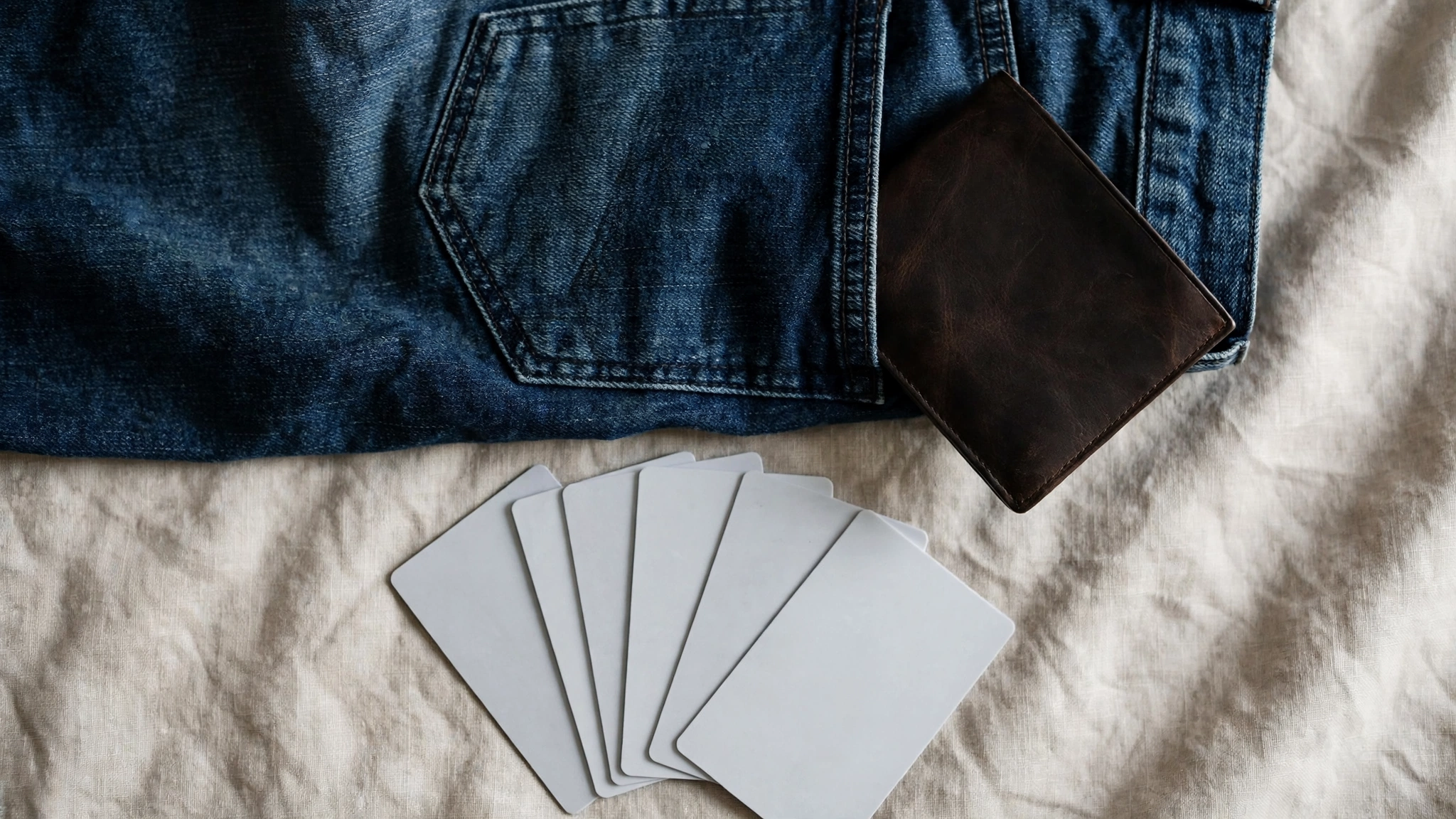
Quick Decision
Measure your pocket first: width across the opening and depth to the bottom seam. Then size the wallet to the cards you actually used in the last week — for most men, four to six cards plus an ID. Keep the loaded thickness at about half an inch or less; guides converge on that figure as the point where a front pocket still lies flat. Pick smooth, rounded corners, a quick-access slot or pull tab for the card you use most, and a cash fold or money clip that matches how often you carry bills. Test the fit sitting down, not just standing up, and in the trousers you actually wear. If the wallet is wider than 4.5 inches, taller than 3.5 inches, or thicker than about half an inch loaded, it is the wrong wallet for that pocket — whatever the product page says.
How this guide was put together. LanPicks does not test wallets hands-on. The fit figures in this guide come from published wallet guides and standards documents checked on 13 November 2026: card dimensions from the ISO/IEC 7810 ID-1 standard, US bill dimensions from the Bureau of Engraving and Printing specification, and fit guidance from Steel Horse Leather, Hedonist Style, House of Jack Co and GSTAR Technology. Where guides disagree — for example on how many cards a front pocket wallet should hold — this guide says so and gives the range. The hero image is an AI-generated editorial illustration; the measurement diagram is an original conceptual drawing, not a product specification. See our Editorial Policy.
On this page
Measure Your Pocket
Start with the pocket, not the wallet. Front pockets are not made to a single standard — the same wallet fits one pair of jeans and not the next, and a pocket that looks roomy on a hanger can sit differently once the trousers are on. Two measurements decide almost everything: width across the pocket opening and depth from the opening to the bottom seam. Measure both while wearing the trousers you will carry the wallet in, because the pocket flattens and shifts when worn, and a flat measurement can flatter the result.

Text equivalent of the diagram. Panel 1, pocket front view: a wallet inside a trouser pocket, with a width target of under 4.5 inches (11.4 cm) and a height target of under 3.5 inches (8.9 cm); pocket depth is measured from the opening to the bottom seam. Panel 2, loaded thickness: a side view of a wallet loaded with cards and cash, with a guide limit of about 0.5 inches (1.3 cm) loaded. What has to fit inside: an ID-1 card, 85.60 × 53.98 mm (3.37 × 2.13 in), and a US bill folded once, about 3.07 × 2.61 in, from 6.14 × 2.61 in unfolded.
Table 1 gathers the numbers that decide fit. The card and bill figures are standards; the wallet figures are targets from wallet guides, not a specification — a wallet outside them can still work in a deep pocket, and a wallet inside them can still fail in a shallow one. What matters is the comparison against your own pocket, which is what the worksheet in the Fit Checklist is for.
Swipe to compare all columns →
| What you measure | Size | Why it matters |
|---|---|---|
| ID-1 card — every credit and debit card, and most IDs | 85.60 × 53.98 mm (3.37 × 2.13 in) | The wallet must be wider and taller than the card, with room for the slot that holds it |
| US bill, folded once | About 3.07 × 2.61 in | A cash fold or money clip must clear the folded bill without forcing it |
| Wallet footprint, closed (guide target) | Under 4.5 in wide × 3.5 in tall | Larger than this, it rides up or will not sit flat in most front pockets |
| Loaded thickness (guide target) | About 0.5 in or less | Thicker than this shows through the pocket and defeats the purpose of a slim wallet |
Two details are easy to miss. First, the pocket opening is usually narrower than the pocket itself, because the opening is cut on a slant — a wallet that fits the pocket body can still be awkward to draw if it is wider than the opening. Second, a wallet’s stated dimensions are usually the empty, closed size; the same wallet measures more once loaded, which is why the next section checks thickness with everything inside.
Check Loaded Thickness
Thickness is the number that decides whether a front pocket wallet works, and it has to be measured loaded. A wallet is tested the way it will be used — with your cards and cash inside, not empty on a product page. Load the wallet exactly as you would carry it, close it, and measure across the thickest point with a ruler or caliper. If you do not have a caliper, lay the loaded wallet on a table and measure its height with a ruler held upright against it; the figure does not need laboratory precision, it needs to be honest.
Wallet guides agree on the limit for a front pocket: about half an inch loaded. Steel Horse Leather puts it plainly — anything thicker than half an inch when loaded defeats the purpose — and Hedonist Style gives the same figure, adding that a back pocket tolerates roughly 0.75 inches. Table 2 sets out the limits by pocket. They are guide figures from those guides, not a standard, and the practical test is always the same: does the outline show, and does the wallet press against you when you sit?
Swipe to compare all columns →
| Guide limit, loaded | What happens over it | |
|---|---|---|
| Front trouser pocket | About 0.5 in | The outline shows through jeans or trousers, and the wallet presses against the thigh when seated |
| Back trouser pocket | About 0.75 in | More room, but a thick wallet under one hip is uncomfortable on long sits |
| Jacket pocket or bag | No strict limit | Thickness matters less here; capacity and organization matter more |
It helps to know where the thickness comes from. A single ID-1 card is 0.76 mm thick, so six cards stack to about 4.6 mm — under a fifth of an inch. The bulk comes from the wallet body, the fold, the cash, and above all the extras: receipts, folded notes, loyalty cards and old tickets. That is why the carry audit in the Fit Checklist comes before the purchase. Hedonist Style warns that a slim wallet loaded like a bifold bulges and stretches within weeks — and the fix is carrying less, not a stronger wallet.
One more check: measure at the fold. A bifold doubles its leather at the centre crease, so the thickest point is usually the fold, not the middle. If the fold measures well over half an inch while the rest is thin, the wallet will still show through the pocket. A card holder avoids the doubled leather but holds less — the trade-off the next section weighs.
Shape and Edges
Once the size and thickness check out, the shape decides how the wallet behaves in the pocket. Smooth, rounded corners slide in and out easily; sharp square corners catch on the pocket lining and on the seam, especially in a new pair of jeans where the pocket is still stiff. Run a finger along the wallet’s edges before you buy: a clean, burnished or folded edge feels smooth, while a raw cut edge can drag. This is a small detail that matters every time you reach for a card, which is several times a day.
The fold is the other shape decision. A slim bifold folds once, with card slots on both sides and a cash section. A card holder skips the fold and holds a short stack of cards in a sleeve, sometimes with a pull tab that lifts them out. A rigid plate design — metal or carbon fibre — holds its shape exactly and does not flex with the pocket the way leather does, so its fit depends entirely on its stated dimensions matching your pocket. None of these is right in general; the right shape is the one whose loaded thickness and footprint pass the checks above. Material trade-offs between leather and metal are a separate decision, covered in our leather vs metal wallet comparison.
Access deserves the same attention as shape. The card you use most should sit in a quick-access slot or on a pull tab, so you can draw it without opening the wallet or pulling the whole wallet out of the pocket. Test this with the wallet in the pocket, not in your hand: if you have to fish for the card, the slot is in the wrong place. An ID window is worth having only if you show your ID often — at a bar, an airport or an office — because it adds material and thickness for a feature you may never use.
RFID blocking is the feature most often oversold. It places conductive material — a metal layer or shielding fabric — so a compatible reader has a harder time communicating with a contactless card. That is a real, narrow effect, worth having if you carry tap-to-pay cards. What it is not is a guarantee against fraud: contactless cards work only at very close range, reported real-world fraud specifically attributed to RFID skimming appears limited, and RFID protection does nothing against phishing, account compromise, data breaches, malware or physical theft. Treat it as one privacy layer, and do not accept a wallet as RFID-blocking merely because it contains metal — the shielding has to cover the card, and the maker should say so plainly.
Access While Seated or Standing
A front pocket wallet is used sitting down more than standing up — at a desk, in a car, on a flight — so test it sitting down. Sit in the chair or car seat you actually use, with the loaded wallet in your front pocket, and try to reach the card you use most. If you can draw it without standing, twisting or pulling the wallet halfway out, the combination passes. If you cannot, the pocket is too deep, the wallet too tall, or the quick-access slot on the wrong side — and no feature list fixes that.
Sitting is also where a front pocket wallet earns its keep. It does not sit underneath you when you sit, so it does not press against one hip the way a back-pocket wallet does. Guides and clinicians have described a pattern called “wallet neuritis” or “wallet sciatica” — buttock or leg discomfort linked to pressure near the piriformis muscle and the sciatic nerve when a thick wallet is sat on for long periods — but the published evidence is mostly case-based, and the same guides caution against absolute claims: fit depends on body shape, trouser cut, pocket depth and how much you carry. This guide makes no medical promise. A front pocket wallet is a practical way to avoid sitting on a lump; it is not a treatment. If you have persistent pain, see a clinician.
Two habits make the seated test easier. First, test both front pockets while sitting, standing and walking, and keep the comfier side — most people have a natural side, and it is not always the dominant hand. Second, on long drives, use the front pocket or move the wallet to the console; sitting on any wallet for hours is uncomfortable, and a front pocket wallet is no exception when overfilled. When you stand and walk, a slim wallet in a front pocket stays put and feels light — but only if the carry stays edited.
Clothing and Carry Differences
The same wallet fits differently in every pair of trousers you own, so check the fit in the clothes you actually wear. Jeans usually have the deepest front pockets and the sturdiest fabric, which hides an outline better — but slim jeans have tighter pockets, and a wallet that fits relaxed jeans can be a struggle in a slim cut. Chinos and dress trousers have thinner fabric, so the half-inch limit matters most here: an outline that disappears in denim shows clearly in a light chino. Suit trousers are the strictest case — a wallet thick enough to show pulls the jacket line out of shape, so keep it thin and dark.
Shorts and active days change the test again. A wallet in a front pocket stays put when you move, while a back-pocket wallet bounces and shifts — but a loose shorts pocket lets a wallet swing, and a tight one makes it hard to reach. If you only need a card and an ID, a card holder is lighter still, and a legitimate second carry rather than a compromise.
Travel is the case that breaks most slim wallets. Trips add boarding passes, a backup card and foreign cash, and a slim wallet loaded with all of that overfills — the same guides that recommend one for daily use suggest a larger wallet for trips. That is not a failure of the slim wallet; it is a different job. The practical answer is two wallets: a slim one for daily use and a standard bifold or long wallet for travel.
Fit Checklist
Run the audit before you buy. Empty your current wallet onto a table and sort everything into three piles: used in the last seven days, used in the last thirty days, and not used in a month. The first pile is your daily carry — for most men, four to six cards plus a driver’s license. The second pile is occasional carry and the main reason wallets grow thick; the third pile belongs in a drawer. Size the wallet to the first pile. As a cross-check, use the Rule of 6: one debit card, one or two credit cards, a driver’s license, and two extra cards at most, plus a few bills. If one goes in, one comes out.
Then work through the worksheet. Fill in your own numbers, compare them with the guide targets, and count the failures. If the wallet fails two or more checks, change the wallet or change what you carry — do not buy a bigger pocket.
Swipe to compare all columns →
| Check | Your measurement | Guide target | Pass? |
|---|---|---|---|
| Pocket width, across the opening | ___ in | Wider than the wallet | |
| Pocket depth, opening to bottom seam | ___ in | Deeper than the wallet is tall | |
| Cards used in the last 7 days | ___ cards | 4–6 for most men | |
| Wallet footprint, closed | ___ × ___ in | Under 4.5 × 3.5 in | |
| Loaded thickness, cards + cash inside | ___ in | About 0.5 in or less | |
| Seated reach test | Pass / fail | Reach the most-used card while seated | |
| Outline test in your usual trousers | Pass / fail | No visible bulge | |
| Cash: fold or clip | Fold / clip | Bills fold flat and the clip holds |
Cash handling is the last check, and it decides the format. If you carry bills most days, choose deliberately: a money clip holds folded bills outside the leather body and tends to keep the wallet thinner, while a cash fold is an interior slot where bills slide flat. A US bill is 6.14 × 2.61 inches, so a folded bill is about 3.07 × 2.61 inches — if the cash section is shorter than that, the bills stick out or crease. If you rarely carry cash, skip both and take the thinner wallet.
FAQ
How many cards should a front pocket wallet hold?
Four to six cards is the practical sweet spot — a debit card, one or two credit cards, an ID and a backup. Guides agree four to eight cards sit comfortably in a front pocket wallet, and some designs hold up to twelve. The limit is not the slot count, it is the thickness: past six to eight cards, the loaded wallet usually passes the half-inch guide limit, and a slim bifold fits the same carry better.
How thick is too thick for a front pocket wallet?
About half an inch when loaded with your actual cards and cash. That figure comes from wallet guides, not from a standard, and it is the point where the outline starts to show through jeans or trousers and the wallet starts to press against your thigh when you sit. Measure the wallet loaded, across the thickest point — usually the fold — and measure it in the trousers you actually wear.
Can I carry cash in a front pocket wallet?
Yes. A money clip holds folded bills flat against the outside of the wallet and tends to keep the whole thing thinner; a cash fold is an interior slot where bills slide flat inside the body. A folded US bill measures about 3.07 × 2.61 inches, so check that the cash section clears it. If you rarely carry cash, a wallet without either is thinner — do not pay in thickness for a feature you never use.
Is a front pocket wallet better for sitting?
It does not sit underneath you, so it avoids the lump under one hip that a back-pocket wallet creates — and that is the whole of the claim this guide makes. Guides and clinicians have described a pattern of buttock or leg discomfort from sitting on a thick back-pocket wallet, but the evidence is mostly case-based, and comfort still depends on your body, your trousers and how much you carry. This guide is not medical advice; if you have persistent pain, see a clinician.
Does RFID blocking matter?
It is one privacy layer, not security. RFID blocking uses conductive material to make it harder for a compatible reader to talk to a contactless card, which is worth having if you carry tap-to-pay cards. It does not protect against phishing, online account compromise, card-data breaches, malware or physical theft, and reported real-world fraud specifically attributed to RFID skimming appears limited. Check that the maker states the shielding plainly — a wallet is not RFID-blocking merely because it contains metal.
Conclusion
Measure the pocket, count the cards you actually use, and check the loaded thickness before you buy. A front pocket wallet that passes those three checks sits flat, stays comfortable when you sit, and lets you reach the card you need without standing up. A wallet is one piece of a daily carry — our everyday carry essentials guide shows how the wallet fits with the rest of what you carry every day.
Sources
- Steel Horse Leather — Best Front Pocket Wallets: A Guide to the Finest Choices (wallet footprint under 4.5 × 3.5 in; thicker than 0.5 in loaded defeats the purpose; 4–8 cards; money clip vs cash fold; quick-access slots)
- Hedonist Style — Men’s Wallet Guide: Choose by How You Carry (carry audit; front pocket about 0.5 in loaded, back pocket about 0.75 in; slim bifold 4.1 × 3.0 in; sitting and driving comfort; travel needs a larger wallet)
- House of Jack Co — Why Front Pocket Wallets Are Better for Your Back & Posture (Rule of 6; wallet neuritis / wallet sciatica as described in medical literature; test both pockets; not a substitute for professional medical advice)
- GSTAR Technology — Differences Between Front Pocket Wallets And Traditional Back Pocket Bifolds (capacity ranges 4–12 vs 8–20+; RFID as one privacy layer, not a fraud guarantee; test loaded, not empty; no wallet is theft-proof)
- LegalClarity — ISO/IEC 7810 ID-1 Standard: Dimensions and Requirements (ID-1 card 85.60 × 53.98 mm, 0.76 mm thick)
- WonderLearning — How Big is a Dollar Bill? Exact Dimensions & Weight Guide (US bill 6.14 × 2.61 in, 0.0043 in thick; all denominations the same size)
Related Posts
Quick Decision Measure two numbers on your wrist — the circumference and the flat width across the top — then check three numbers on the listing, in this order: lug-to-lug first, thickness second, diameter third. If the lug-to-lug is longer than the flat width of your wrist, the lugs overhang and the watch will look […]
Quick Decision If you carry eight or fewer cards and almost no cash, a cardholder is the better fit: the flattest thing you can carry, it disappears into a front pocket and every card is within one pull. If you carry cash most days, coins, or more than about eight cards, a wallet is the […]
Quick Decision If you pay by card and phone and carry one to three cards, a card sleeve or a money clip is enough. If you carry four to eight cards plus a few folded bills, a slim bifold or a pop-up wallet fits. If you carry nine or more cards, a minimalist wallet will […]
Every watch on your wrist keeps time in one of two ways: a battery sending current through a vibrating quartz crystal, or a wound spring driving gears that your wrist keeps wound. Quartz is more accurate and asks less of you. An automatic is a small machine you wear, and it rewards regular wear and […]
A leather wallet and a metal wallet are not two versions of the same thing. One is a soft container that folds, stretches and ages with you; the other is a rigid frame that holds a fixed stack of cards and refuses to change shape. Both carry cards. Almost everything else — how much they […]