

How to Choose a Minimalist Wallet That Fits Your Routine
Quick Decision
If you pay by card and phone and carry one to three cards, a card sleeve or a money clip is enough. If you carry four to eight cards plus a few folded bills, a slim bifold or a pop-up wallet fits. If you carry nine or more cards, a minimalist wallet will overflow in the first week — either move the cards you rarely use to your phone, or choose a standard bifold instead. Whatever the format, size it to the cards you used in the last seven days, check the loaded thickness against your pocket, and make sure the cash arrangement matches how you actually pay.
How this guide was researched. We checked the search results for “minimalist wallet buying guide” and “how to choose a slim wallet card capacity” on 13 November 2026: the dominant intent is a buying guide, led by GearOrbit, Hörner, Hedonist Style, and Smartish. Card dimensions come from the ISO/IEC 7810 ID-1 standard; banknote dimensions from the European Central Bank and the U.S. Bureau of Engraving and Printing. Secrid’s Cardprotector was verified on Secrid’s own support page. We did not test any wallet hands-on; capacities are the makers’ stated figures. No prices are given.
Contents
Count Your Cards and Cash
Start with the wallet you have now, not with a product page. Empty it onto a table and sort everything into three piles: used in the last seven days, used in the last thirty days, and not used in a month. This carry audit, recommended by Hedonist Style, separates the cards you actually use from the cards you merely store. The first pile is your daily carry — for most men, four to six cards plus a driver’s license. The second pile is occasional carry, and the main reason wallets grow thick. The third pile belongs in a drawer.
Size the new wallet to the first pile, not to the wallet you are replacing. A wallet with twelve slots invites twelve cards, and a sleeve built for four will overflow in the first week if your first pile holds eight to ten. If your pile is larger than expected, do not buy a bigger minimalist wallet: move loyalty and membership cards to your phone, keep one backup card at home, and recount.
Cash is the second count, and it decides the format more than the card count does. Bills fold; coins do not — a wallet with no coin section forces coins into a pocket or a separate pouch. Every US bill, from $1 to $100, measures 6.14 × 2.61 inches, so a bill folded once is about 3.07 inches long. Euro banknotes grow with the denomination, from 120 × 62 mm for a €5 note to 140 × 77 mm for a €50 note, so a pocket sized for one currency may not fit a larger foreign note.
Swipe to compare all columns →
| Your carry | Size for | Format that fits | Watch out for |
|---|---|---|---|
| Cards only, 1–3 | 1–3 cards | Card sleeve or money clip | No room for a bill you are handed |
| Cards only, 4–8 | 4–8 cards | Slim bifold or pop-up wallet | Embossed and metal cards cut capacity |
| Cards + a few bills | Cards + folded bills | Slim bifold, or pop-up with a bill pocket | Bill pocket must fit your folded notes |
| Cards + bills + coins | Cards + bills + coins | Bifold with a coin section, or coins elsewhere | Most minimalist formats have no coin storage |
| 9+ cards | 9+ cards | Standard bifold — or trim the carry first | A minimalist wallet will overflow |
Capacity figures in this table are the ranges makers typically state, not test results. Count your own cards first; the table only narrows the format.
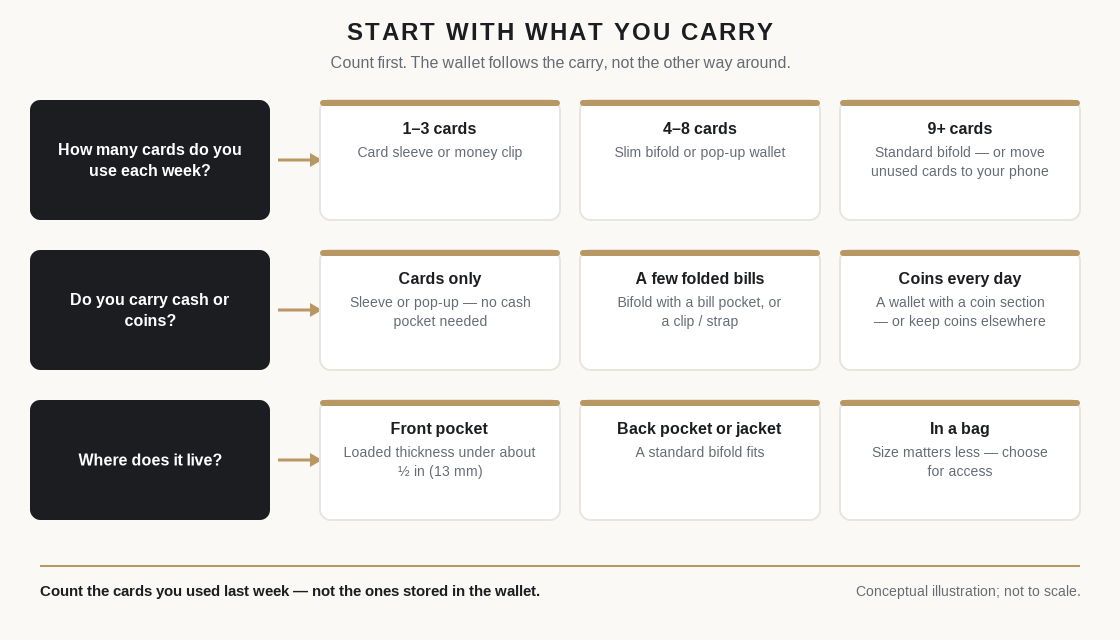
Diagram text equivalent. Three questions decide the format: how many cards you use each week, whether you carry cash or coins, and where the wallet lives. Each answer points to a format — a sleeve or money clip for the lightest carry, a slim bifold or pop-up wallet for the middle, a standard bifold (or a trimmed carry) for the heaviest.
Compare Formats
Minimalist wallets come in a handful of formats, and the names are not standardized — one maker’s “slim wallet” is another’s “cardholder.” Judge by what the format does, not by what it is called.
A card sleeve is the simplest format: a leather or fabric pocket, sometimes with a pull tab, that holds a small stack of cards and little else. It is the flattest option, but it has no real cash storage — a folded bill rides in the center at best — and an overfilled sleeve drops cards.
A money clip holds folded bills against a few cards with a metal clip or magnetic band. It is the slimmest option when cash is the main carry, and the least forgiving: it takes discipline to keep the stack small, and loose cards slip out more easily than from a pocket.
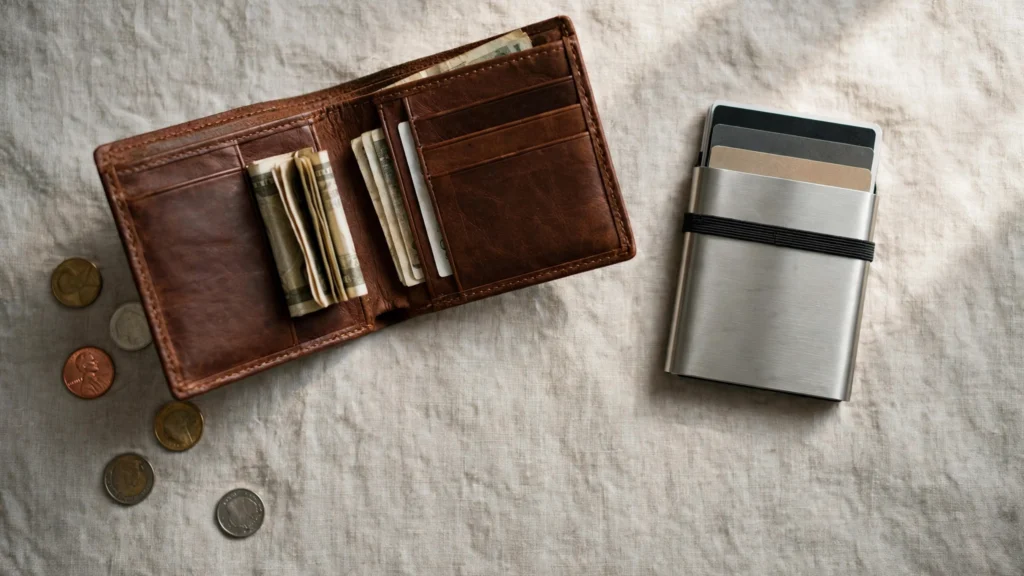
A pop-up wallet is a compact metal case with a lever or slider that fans the cards out in a staggered row for one-handed access. Secrid’s Cardprotector is the best-documented example: Secrid states on its own support page that it holds four to six cards depending on thickness — four embossed, or six flat — and that it is made for standard plastic cards only, because paper cards such as business cards can jam the mechanism. The format trades capacity for speed, and cash lives in a separate leather wrap or band on the models that offer it.
A slim bifold keeps the familiar folding shape with fewer layers: four to eight cards, a bill pocket, and a front-pocket footprint. It is the most forgiving minimalist format — it handles a few bills naturally and still sits flat — and the one most people should start with if they are unsure. Its limit is thickness: load a slim bifold like a standard one and it bulges and stretches within weeks.
A standard bifold is not a minimalist wallet, and that is the point. If your first pile holds nine or more cards, or flat bills and receipts are part of your day, a standard bifold is the honest choice. Buying a minimalist wallet and then forcing the old carry into it defeats the purpose.
The cardholder-versus-wallet decision is covered in a separate guide (M3, pending). Here the rule is simple: if the format cannot hold your first pile plus your cash, it is the wrong format, however slim it looks empty.
Check Loaded Dimensions
A wallet’s listed dimensions are its empty dimensions. What matters is the loaded wallet — your cards, your cash, closed, in your pocket. Two wallets with the same empty thickness can feel very different loaded, because one stretches and the other does not, and because embossed cards are thicker than flat ones.
Start from the card itself. The ISO/IEC 7810 ID-1 standard sets a payment card at 85.60 × 53.98 mm and about 0.76 mm thick, and most ID cards and driver’s licenses follow the same format. Six flat cards stacked are therefore about 4.6 mm of card alone, before any wallet material — simple arithmetic, not a measurement. Embossed cards add thickness on top of that, which is why Secrid’s stated capacity drops from six flat cards to four embossed ones in the same case. Metal cards are thicker still, and GearOrbit notes that a metal card can tap poorly when sandwiched between other cards — put it on the outside of the stack.
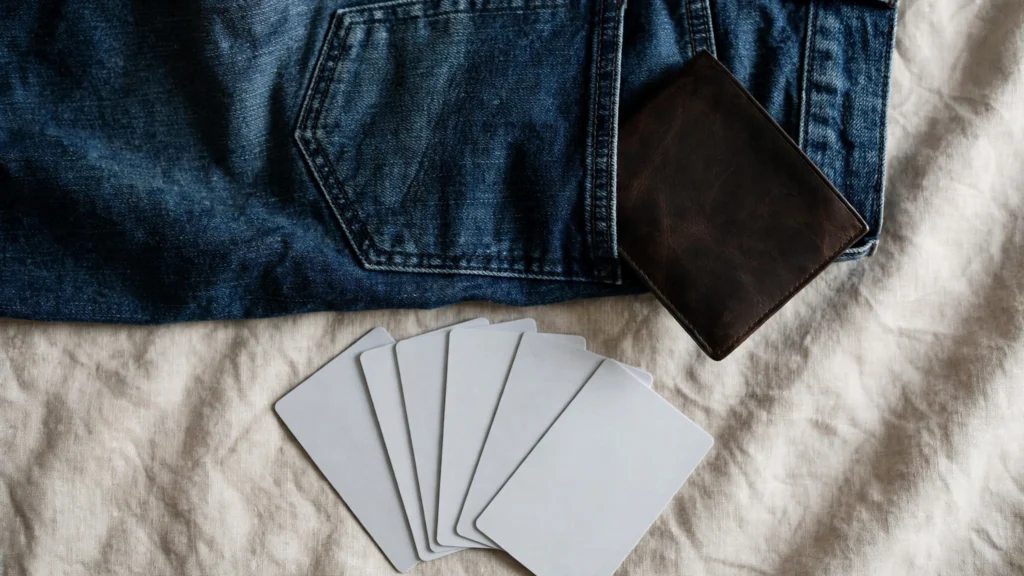
Measure the loaded wallet before you commit, if you can. Stack your actual cards, add your folded bills, and measure the stack with a ruler: that is the minimum thickness any wallet must hold, and the wallet’s material adds to it. Leather stretches and molds around the stack over the first weeks; a rigid metal case does not stretch at all, so its stated capacity is a hard limit. Pocket decides the thickness limit: guidance from Hedonist Style and Smartish converges on the same number — a front pocket tolerates about half an inch loaded before the outline shows. A back pocket tolerates more, but a thick wallet in a back pocket is also the one you sit on, which wears both the wallet and the pocket.
Swipe to compare all columns →
| Measurement | How to check | Why it matters |
|---|---|---|
| Card stack thickness | Stack your actual cards and measure with a ruler | Sets the minimum the wallet must hold |
| Loaded thickness | Measure the wallet with your cards and cash inside | Empty dimensions hide how thick it really gets |
| Footprint | Compare the maker’s length and width with a card (85.60 × 53.98 mm) | A wallet much larger than a card wastes pocket space |
| Bill pocket width | Fold your largest note once and measure it | US bills fold to about 3.07 in; euro notes vary by denomination |
| Card count, flat vs embossed | Count embossed and metal cards separately | Four embossed cards can fill a case rated for six flat ones |
Access and Closures
A wallet you cannot open quickly at a checkout is a wallet you will resent, however slim it is. Access does not show in a product photo, so think about which card you reach for most, and how you reach for it.
There are four common access patterns. A quick-access slot on the outside of a sleeve puts your most-used card one thumb-pull away, but it holds one card, not six. A pull tab lifts the whole stack out of a sleeve at once — fast, but you then sort through the stack. A pop-up lever fans the cards in a staggered row so you can pick one without removing the rest; it is the fastest pattern for people who use a different card each time, and it has moving parts. Open pockets in a bifold show every card at once when the wallet is open, which is the simplest pattern and the slowest to close again. If you use the same two or three cards daily, any pattern works; if you rotate through many, the pop-up or the open bifold saves fumbling.
Closures decide what stays in. An open sleeve has no closure at all — fast to use, and the format most likely to drop a card if it is overfilled or carried upside down. An elastic band or a magnetic flap holds the wallet shut without adding bulk, but elastic is a wear item: it loosens over time, and not every maker sells replacements, so check before you buy. A snap or a zip is the most secure, and the slowest; a zip is the only closure that reliably holds coins. Match the closure to the contents: coins need a zip or a dedicated coin section, bills need a pocket that holds them flat, and cards need a slot that grips them without a fight.
One detail is worth checking only if you use it daily: an ID window saves fumbling if you show credentials several times a day, and is dead weight if you show ID once a month. RFID blocking is covered in the FAQ below — treat it as a minor consideration, not a deciding feature.
Materials and Maintenance
Leather is the traditional choice, and full-grain leather is the grade to look for: the top layer of the hide with the natural grain kept intact. It develops a patina — it absorbs oils from your hands, reacts to light, and grows darker and richer with use — and it softens noticeably over roughly the first few weeks as it molds to your carry. That softening is also its weakness: an overfilled leather wallet stretches and stays stretched. Care is simple: keep it dry when you can; if it gets wet, blot it gently and let it air-dry naturally, never with artificial heat; condition sparingly with a neutral conditioner once or twice a year. Over-oiling is the most common mistake — too much conditioner darkens the leather and leaves it softer than intended.
Metal — usually aluminium or titanium plates held by an elastic band, or a rigid case — holds its exact shape regardless of how many cards are inside, and it needs no conditioning. Its trade-offs are weight, a cold feel, and the elastic: the plates last, the band does not, so check whether replacements are available. Metal also blocks RFID by its nature, and it protects cards against bending — the reason Secrid builds its Cardprotector from anodised aluminium.
Fabric and sailcloth — nylon, Cordura, or recycled sailcloth — are the lightest options, water-resistant, and flexible from day one, with no break-in period. They do not develop a patina, and they can fray at the edges over time; a fabric wallet also shows dirt more readily than dark leather. They suit wet climates and anyone who wants the lightest possible carry.
Swipe to compare all columns →
| Material | What it does well | Watch out for | Care |
|---|---|---|---|
| Full-grain leather | Develops a patina; softens to your carry | Stretches if overfilled; hates prolonged damp | Blot dry, air-dry naturally, condition sparingly once or twice a year |
| Metal (aluminium / titanium) | Holds its shape; protects cards from bending | Elastic bands wear; heavier than fabric | Wipe clean; check elastic replacements |
| Fabric / sailcloth | Lightest; water-resistant; no break-in | Can fray; shows dirt; no patina | Wipe or hand-wash per the maker’s instructions |
Material alone does not prove durability, water resistance, or RFID protection. Construction, stitching, and the maker’s specifications matter as much as the material name — check them for the exact wallet you are considering.
Choose by Routine
Card-only commuter. You tap to pay, tap into transit, and rarely touch cash. A card sleeve or a pop-up wallet holding four to six cards is enough, with your most-used card in the quick-access slot or at the front of the pop-up stack. Keep a backup card at home, and move loyalty cards to your phone.
Cash and cards, every day. You pay by card most of the time but still handle bills — tips, markets, small shops. A slim bifold with a bill pocket is the practical choice: four to eight cards, folded bills lying flat, and a loaded thickness measured against your front pocket. If coins are part of the day, add a coin section or keep a small coin pouch elsewhere.
Travel and heavy carry. You carry more cards on the road than at home, and the wallet rides in a jacket or a bag rather than a trouser pocket. A standard bifold, or a pop-up wallet with a leather wrap for the extra cards and bills, fits better than a sleeve sized for a normal week.
Front-pocket minimalist. You want nothing in the back pocket and nothing visible through the trousers. A sleeve or a slim bifold with one to six cards, loaded thickness under about half an inch, and no coins. This routine punishes overfilling most: a front-pocket wallet that is too thick shows, presses when you sit, and stretches out of shape.
If the wallet is only one part of what you carry every day, step back and audit the rest of it. Our everyday carry essentials guide walks through the same count-first method for keys, phone, and the rest of the pocket, so the wallet you choose fits a carry you have already planned rather than a pocket you have not measured.
A minimalist wallet is a decision to carry less, and the wallet itself cannot make that decision for you. Count the cards you used last week, check the cash you actually handle, measure the loaded wallet against your pocket, and choose the format that holds that carry — nothing more.
Conclusion
A minimalist wallet works when it matches the carry you actually have. Count the cards you used in the last seven days, add the bills and coins you handle, and choose a sleeve, money clip, pop-up wallet or slim bifold that holds that load without stretching or overflowing. Check the loaded thickness against your pocket, favor quick access for the cards you use most, and pick leather, metal or fabric for how it will age and how much care it needs. If nine or more cards are part of your week, a standard bifold is the more honest choice.
FAQ
How many cards should a minimalist wallet hold?
Size it to your count, not to a standard. Most guides put the usual range at four to eight cards, and the audit in this guide — the cards you used in the last seven days — gives you your number. Embossed and metal cards are thicker than flat ones, so a case rated for six flat cards may hold only four embossed ones.
Will a minimalist wallet fit cash?
It depends on the format. A slim bifold holds folded bills naturally; a sleeve holds a bill or two at best; a bare pop-up case holds no cash unless the model adds a leather wrap, clip, or strap. Fold your largest note once and check the bill pocket against it. Coins need a dedicated section or a separate home.
Do I need RFID blocking?
Probably not as the deciding feature. Contactless cards use one-time codes, documented real-world skimming is rare, and a metal wallet blocks the signal anyway. Secrid states its aluminium case blocks unwanted RFID and NFC communication, tested by TNO/TÜV — a maker claim for that case, not a guarantee for every wallet labeled “RFID”. Choose the wallet for capacity, fit, and access first.
How thick is too thick for a front pocket?
Guidance from Hedonist Style and Smartish converges on about half an inch loaded before the outline shows through jeans or trousers. Measure the wallet with your cards and cash inside — the empty thickness on a product page does not tell you how thick it gets loaded.
What if I carry ten or more cards?
Then a minimalist wallet is probably the wrong tool. Either cut the carry — move loyalty and membership cards to your phone and keep rarely used cards at home — or choose a standard bifold that holds the carry you actually have. Forcing ten cards into a sleeve built for four stretches it out of shape within weeks.
Sources
- ISO/IEC 7810 — Identification cards, physical characteristics (ID-1: 85.60 × 53.98 mm, 0.76 mm thick). https://en.wikipedia.org/wiki/ISO/IEC_7810
- European Central Bank — Decision on euro banknote denominations and specifications (ECB/2013/10); €5: 120 × 62 mm, €50: 140 × 77 mm. https://eur-lex.europa.eu/legal-content/EN/TXT/HTML/?uri=CELEX:02013D0010-20210104
- U.S. Bureau of Engraving and Printing specification, as reported by WonderLearning — US dollar bill dimensions (6.14 × 2.61 in). https://wonderlearning.blog/dollar-bill-measurements-dimensions
- Secrid — Support (Cardprotector capacity, paper-card warning, RFID/NFC shielding, care). https://secrid.com/en-global/support/
- GearOrbit — “Best Minimalist Wallets for Men (2026)” (capacity guidance, RFID note, tap-to-pay tip). https://gearorbit.com/posts/minimalist-wallet
- Hörner — “How to Choose a Wallet: Slim vs Bifold vs Cardholder”. https://www.hoernerco.com/guides/how-to-choose-a-wallet
- Hedonist Style — “Men’s Wallet Guide: Choose by How You Carry” (carry audit, front-pocket limit). https://hedonist-style.com/blogs/news/guide-to-men-wallets
- Smartish — “Why Slim Wallets Beat Bulky Ones (And How to Pick the Right One)” (capacity and thickness guidance). https://smartish.com/blogs/news/best-slimline-wallets
- Wingback — “How to Care for a Leather Wallet & Re-oil It” (leather care). https://wingback.co.uk/blogs/journal/how-to-care-for-a-leather-wallet-and-re-oil-it
- Wild & King — “Full-Grain Leather Bifold Wallet Guide” (patina, break-in, care). https://wildandking.com/blogs/news/full-grain-leather-bifold-wallet
Related Posts
Quick Decision Measure two numbers on your wrist — the circumference and the flat width across the top — then check three numbers on the listing, in this order: lug-to-lug first, thickness second, diameter third. If the lug-to-lug is longer than the flat width of your wrist, the lugs overhang and the watch will look […]
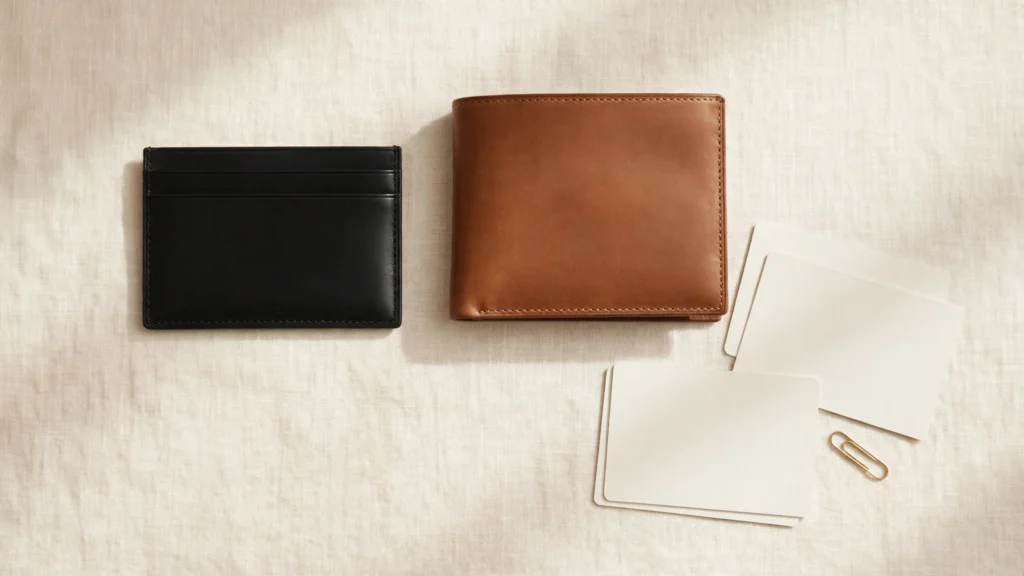
Quick Decision If you carry eight or fewer cards and almost no cash, a cardholder is the better fit: the flattest thing you can carry, it disappears into a front pocket and every card is within one pull. If you carry cash most days, coins, or more than about eight cards, a wallet is the […]
Every watch on your wrist keeps time in one of two ways: a battery sending current through a vibrating quartz crystal, or a wound spring driving gears that your wrist keeps wound. Quartz is more accurate and asks less of you. An automatic is a small machine you wear, and it rewards regular wear and […]
A leather wallet and a metal wallet are not two versions of the same thing. One is a soft container that folds, stretches and ages with you; the other is a rigid frame that holds a fixed stack of cards and refuses to change shape. Both carry cards. Almost everything else — how much they […]
A front pocket wallet only works if it fits the pocket it lives in. The wallet, the cards and the cash inside it, and the pocket itself all have to agree — and the agreement is measured in inches, not in marketing words. This guide shows how to measure your pocket, check a wallet’s loaded […]