

Watch Size Guide: Case Diameter, Lug-to-Lug and Wrist Fit
Quick Decision
Measure two numbers on your wrist — the circumference and the flat width across the top — then check three numbers on the listing, in this order: lug-to-lug first, thickness second, diameter third. If the lug-to-lug is longer than the flat width of your wrist, the lugs overhang and the watch will look too big no matter what the diameter says. For most adult wrists that points to a 36–40 mm case, but the lug-to-lug is the number that decides it, not the diameter.
How this guide was researched. We checked the search results for “watch size guide” on 13 November 2026: the dominant intent is a sizing guide, led by Dial & Lume, WatchScanning, TrueFacet, and WatchRanker. The two model dimensions in this guide come from the maker’s own pages and specification sheets (Seiko’s SSK001 product page, read directly, and the SRPG35 specification sheet as listed by an authorized Seiko retailer, with Seiko’s own page confirming the case diameter). Size ranges are one publisher’s recommendations for narrowing a search, not an industry standard — sources disagree by a few millimetres, and the text says so where it matters. We did not test or wear any watch hands-on, and no prices are given.
Contents
Measure Your Wrist
Every size decision in this guide starts from two measurements you take yourself, in two minutes, with a soft tape measure. If you do not have one, a strip of paper and a ruler works the same way: wrap the paper, mark where it closes, then measure the strip flat.
Circumference — sizes the strap. Wrap the tape around your wrist just past the wrist bone, at the spot where the watch case will actually sit. Keep it snug but not tight: you should be able to slide a finger underneath. This number tells you what strap length or bracelet sizing you need. It tells you nothing about what case will look right.
Flat width — sizes the watch. This is the measurement most buyers skip, and it is the one that matters. Lay a ruler straight across the flat top of your wrist, from where it starts to curve down on one side to where it curves down on the other. That flat span is the landing zone for the watch: if a watch’s lug-to-lug distance is longer than this width, the lugs overhang the curve of your wrist.
Write both numbers down in millimetres, since watch specifications use millimetres. Measure in the evening if you can: wrists swell slightly with heat and activity through the day, so an evening measurement is usually the more honest one to size against. And measure the wrist you will wear the watch on — left and right wrists are rarely identical.

Diameter vs Lug-to-Lug
Every watch listing leads with case diameter, and it is close to the least useful number on the page. Diameter is the horizontal measurement across the face of the watch, from 9 o’clock to 3 o’clock, and it is generally measured excluding the crown — sometimes excluding a protruding bezel as well. It sets the visual weight of the dial, and it is the easiest first filter. It does not tell you whether the watch fits your wrist.
Lug-to-lug does. It is the straight-line distance from the tip of the top lugs to the tip of the bottom lugs — the full length of the watch running along your arm, including the strap attachment points. It is the figure that decides whether the watch sits on your wrist or hangs off it. A 38 mm watch with long, straight lugs can measure 48 mm lug-to-lug; a 40 mm watch with short, downturned lugs can measure 45 mm. The second wears smaller than the first despite the larger case, which is exactly why diameter alone answers nothing.
The two named models below prove the point with maker-published dimensions, not estimates. The Seiko 5 Sports GMT SSK001 has the larger case at 42.5 mm — and the shorter lug-to-lug at 46.0 mm. The Seiko 5 Sports Field SRPG35 has the smaller case at 39.4 mm — and the longer lug-to-lug at 48.1 mm. Judged on diameter alone, the SRPG35 looks like the smaller watch. Judged on lug-to-lug, it is the longer one, and on a wrist whose flat width is under 48 mm it is the one that overhangs.
Swipe to compare all columns →
| Model (maker-published dimensions) | Case diameter | Thickness | Lug-to-lug | Distance between lugs |
|---|---|---|---|---|
| Seiko 5 Sports GMT SSK001 | 42.5 mm | 13.6 mm | 46.0 mm | 22 mm |
| Seiko 5 Sports Field SRPG35 | 39.4 mm | 13.2 mm | 48.1 mm | 20 mm |
Dimensions as published by the maker: SSK001 from Seiko’s own product page; SRPG35 from Seiko’s specification sheet as listed by an authorized retailer, with Seiko’s own page confirming the 39.4 mm case. These two models are examples of how the numbers relate — not a ranking, and not a claim about any other model.
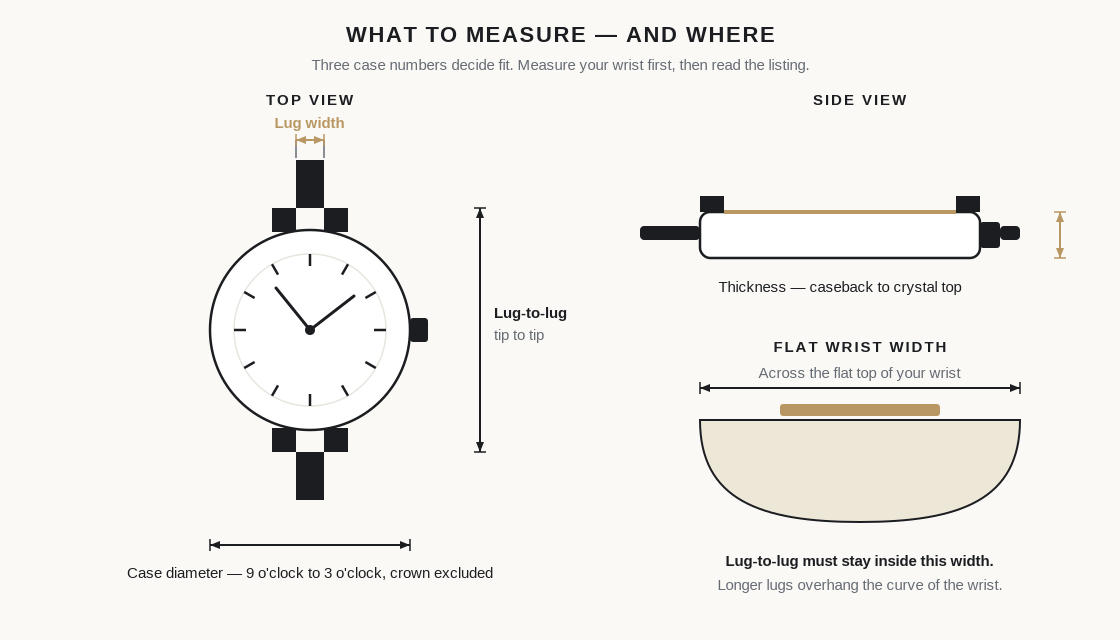
Diagram text equivalent. Top view: case diameter is measured across the case from 9 o’clock to 3 o’clock, with the crown outside the measurement; lug-to-lug runs from the tip of the top lugs to the tip of the bottom lugs; lug width is the gap between the lugs. Side view: thickness runs from the caseback to the top of the crystal. Wrist cross-section: the flat width is measured across the flat top of the wrist, and a watch’s lug-to-lug must stay inside that width — longer lugs overhang the curve of the wrist.
Two details soften the rule without breaking it. Curved or downturned lugs follow the contour of the wrist, so a watch with a stated 50 mm lug-to-lug and curved lugs can wear like a 47 mm flat-lug watch. And case shape matters: a cushion case, a wide bezel, or a large dial opening can make the same diameter read bigger or smaller on the wrist. Neither detail changes the check itself — compare the lug-to-lug with your flat wrist width, and treat the result as the starting point, not the verdict. The final check is always the watch on your wrist, or a photo of it on a wrist of a stated size.
Thickness and Case Shape
Thickness is the dimension buyers notice last and feel first. It is measured from the caseback to the top of the crystal, and it does two jobs: practically, it decides whether the watch slides under a shirt cuff; visually, thickness relative to diameter decides whether the watch looks like a watch or like a puck. A 38 mm case at 10 mm thick reads as elegant; the same diameter at 14 mm reads as chunky.
As rough guidance, dress watches are typically 7–10 mm thick, and many dive watches are commonly 13–16 mm — dive watches are thick because water resistance needs case wall and a thick crystal, and dress watches are thin because they are meant to disappear under a cuff. Cases above about 12 mm are more likely to catch on a cuff, and above about 13 mm you should assume the watch will not go under a shirt cuff comfortably. Both figures are general descriptions from a sizing guide, not specifications for every model: a thick case can still work on a broad wrist or with casual clothing, while a thin case can be uncomfortable if its lugs extend beyond the wrist.
Case shape changes how those numbers wear. A wide bezel makes the dial opening smaller than the diameter suggests, so the watch reads smaller than its number. A cushion or tonneau case spreads its width differently from a round case of the same diameter. A crown at 4 o’clock, like the SSK001’s, sits further from the back of the hand than a crown at 3 o’clock. None of these details appears in the headline diameter — which is why the listing’s full dimension block, not its title, is the document that matters.
Strap Fit and Adjustment
Band fit is a separate question from case fit, and it is the part you feel all day. A strap that matches your circumference can still be incompatible with the case, or leave the clasp poorly positioned. Confirm four things for the exact reference before you buy: the lug width, the attachment system, the strap length, and the clasp adjustment.
Lug width is the strap width. Lug width is the distance between the lugs where the strap attaches — a different measurement from lug-to-lug, and the two are easy to confuse. A watch with 22 mm between the lugs takes a 22 mm strap; a watch with 20 mm takes a 20 mm strap. The SSK001’s 22 mm and the SRPG35’s 20 mm are both printed on their specification sheets. As a visual starting point, a proportional band is roughly half the case diameter, but construction and personal style can change the result — follow the maker’s specified lug width rather than forcing a generic strap.
Length is sized separately. A leather strap comes in lengths, and a metal bracelet is sized by adding or removing links, with fine adjustment at the clasp. Some makers publish bracelet size bands for their own models — Breitling, for example, lists Small at 135–160 mm, Standard at 160–190 mm, and Large at 190–215 mm of wrist — but those bands are that maker’s guidance and should not be assumed to fit another brand’s bracelet or a different case family. If you are between sizes on a maker’s own chart, the usual advice is to choose the smaller size; a strap that is slightly short can often be adjusted, while one that is far too long cannot be fixed by the clasp alone.
Fit is also a matter of how the watch is worn, and it is worn every day. A watch that fits is one item in a daily carry that works without thinking about it — our everyday carry essentials guide plans the rest of what you carry around it, so the watch, wallet, and keys stop competing for the same pocket and wrist.
Read Product Dimensions
You cannot try the watch on when you buy online, so use the listing properly. The numbers live in the maker’s specification block — Seiko, for example, lists “Case Size” as thickness, diameter, and lug-to-lug, plus “Distance between lugs” — and a listing that omits them is telling you something. Work through the checklist before you commit.
Swipe to compare all columns →
| Check | How to check | What it decides |
|---|---|---|
| Lug-to-lug published | Find it in the maker’s specification block | Whether the watch fits your flat wrist width at all |
| Thickness published | Same specification block, caseback to crystal | Whether it clears your shirt cuff |
| Lug width published | “Distance between lugs” on the same page | Which strap width the watch takes |
| Wrist shot with a stated size | Look for a review photo captioned with a wrist size | How the watch actually wears on a wrist like yours |
| Numbers missing | Ask the retailer or authorized dealer before ordering | Whether the fit question is still open — do not estimate it from the diameter |
| Card cutout test | Cut card to the stated diameter and lug-to-lug, lay it on your wrist | A ten-second visual check of the footprint |
A maker that will not state lug-to-lug or thickness is a maker whose watch you are buying blind, and that is worth knowing before rather than after. Treat an unlisted lug-to-lug as an unresolved fit question, not as permission to estimate from the diameter. And distrust product photography on its own: a photo on a mannequin arm tells you nothing about scale, while a review photo captioned “on a 6.75-inch wrist” tells you a great deal.
Make a Fit Shortlist
Put the numbers together in order, and the shortlist builds itself.
Step 1 — your numbers. Write down your wrist circumference and your flat wrist width, both in millimetres. The circumference sizes the strap; the flat width is the ceiling for lug-to-lug.
Step 2 — a diameter shortlist. Use the ranges below only as a starting point for narrowing a search. They come from one publisher’s recommendations, not an industry standard, and other guides differ by a few millimetres on the same wrists — which is why the next step, not this table, is the filter that matters.
Swipe to compare all columns →
| Wrist circumference | Starting case diameter | Approximate maximum lug-to-lug |
|---|---|---|
| Under 15 cm | 32–36 mm | About 44 mm |
| 15–16 cm | 34–38 mm | About 47 mm |
| 16–17 cm | 38–41 mm | About 50 mm |
| 17–18 cm | 40–43 mm | About 52 mm |
| Over 18 cm | 42–46 mm | About 55 mm |
Starting ranges from Kensington Watches, via WatchRanker: recommendations for narrowing a search, not population statistics or an industry standard. Bezel width, dial opening, lug curvature, and thickness alter how a case wears.
Step 3 — filter by lug-to-lug. Keep only the watches whose lug-to-lug is at or below your flat wrist width. This is the step that removes most wrong sizes: a 42.5 mm case with a 46.0 mm lug-to-lug can fit a wrist that a 39.4 mm case with a 48.1 mm lug-to-lug overhangs.
Step 4 — check thickness against your clothes. If you wear shirts with cuffs, keep the thickness under about 12–13 mm, or check the cuff clearance before you commit. If you do not, thickness is a question of visual bulk, not of fit.
Step 5 — check the strap. Confirm the lug width, the strap or bracelet length for your circumference, and the clasp adjustment. A watch that fits the case but cannot be sized to your wrist is still a watch you will not wear.
Step 6 — see it on a wrist. Cut the card rectangle to the stated diameter and lug-to-lug and lay it on your wrist, or find a wrist shot with a stated wrist size. If you are used to large sports watches and considering a 36 or 38 mm case, expect roughly a week of it feeling small before you stop noticing — and buy the size the design calls for, kept inside the limits your wrist sets.
Once the watch fits, it joins the rest of what you carry every day. Our everyday carry essentials guide builds the routine around it — wallet, keys, and the few items that earn a pocket — so the shortlist ends with a watch that fits your wrist and a carry that fits your day.
Conclusion
Measure your wrist first, in millimetres, in the evening: circumference sizes the strap, and the flat width across the top is the ceiling for lug-to-lug. Check lug-to-lug before diameter, then thickness against your cuffs, then lug width for the strap. A 42.5 mm case with a 46.0 mm lug-to-lug can fit a wrist that a 39.4 mm case with a 48.1 mm lug-to-lug overhangs, so let the numbers, not the diameter, build the shortlist. Cut a card to the stated diameter and lug-to-lug, lay it on your wrist, and choose the size that stays inside your flat width.
FAQ
What size watch should I wear for my wrist?
Measure the flat top of your wrist rather than its circumference, and keep the watch’s lug-to-lug distance inside that width. For most adults that means a 36 to 40 mm case; wrists under about 6.5 inches around are usually happiest at 36 to 38 mm. Diameter alone tells you very little — the lug-to-lug and the thickness decide the fit.
What is lug-to-lug, and why does it matter more than case diameter?
Lug-to-lug is the distance from the tip of the top lugs to the tip of the bottom lugs — the full length of the watch along your arm. It determines whether the watch sits within the flat of your wrist or overhangs the curve. A 38 mm watch with long lugs can wear larger than a 40 mm one with short ones, which is why diameter alone answers nothing.
How do I measure my wrist for a watch?
Two measurements. Wrap a soft tape measure around your wrist just past the bone for circumference, which sizes the strap. Then measure straight across the flat top of your wrist from edge to edge — that width is the number a watch’s lug-to-lug should stay inside. A strip of paper and a ruler works if you have no tape, and an evening measurement is the more honest one, since wrists swell slightly through the day.
Is a 40 mm watch too big?
Not by itself. 40 mm sits comfortably in the middle of the modern range and suits most adult wrists, provided the lug-to-lug is proportionate. A 40 mm dive watch with a broad bezel and long lugs wears far larger than a 40 mm dress watch, which is why the diameter on its own answers nothing.
Does watch thickness matter?
Yes, in two ways. A thick watch will not slide under a shirt cuff, which matters if you wear one — above about 13 mm, assume it will not fit comfortably. And thickness relative to diameter decides whether the watch looks balanced: a 38 mm case at 14 mm thick reads as a puck, while the same diameter at 10 mm reads as a proper dress watch.
What if the maker doesn’t publish lug-to-lug?
Treat it as an unresolved fit question, not as permission to estimate from the diameter. Ask the retailer or authorized dealer for the figure before ordering. A maker that will not state lug-to-lug or thickness is selling a watch you would be buying blind.
Sources
- Seiko Watch Corporation — SSK001 product specification (diameter 42.5 mm, thickness 13.6 mm, lug-to-lug 46.0 mm, distance between lugs 22 mm). https://www.seikowatches.com/us-en/products/5sports/ssk001
- Seiko Watch Corporation — 5 Sports Field series (SRPG35 resized to a 39.4 mm case). https://www.seikowatches.com/global-en/products/5sports/special/heritage_in_motion/field_series/
- Seiko Watch Corporation — Seiko 5 Sports SRPG35K1 specification (diameter 39.4 mm, thickness 13.2 mm, lug-to-lug 48.1 mm, lug width 20 mm). https://www.seikowatches.com/us-en/products/5sports/srpg35
- Dial & Lume — “Watch Size Guide (2026): Lug-to-Lug, Diameter and What Actually Fits.” https://dialandlume.com/learn/watch-size-guide
- WatchRanker — “Luxury Watch Size Guide: Find the Right Case, Lug-to-Lug and Bracelet Fit” (Kensington ranges, Victorinox and Watches of Switzerland guidance, Breitling bracelet bands). https://watchranker.com/how-to-choose-the-right-luxury-watch-size-for-your-wrist/
- Watch Direct — “Lug to Lug: What It Means and Why It Matters.” https://watchdirect.com.au/blogs/news/lug-to-lug-what-it-means-and-why-it-matters-when-buying-a-watch
- Chronos Pride — “Watch Size Calculator” (wrist measurement method; evening measurement). https://chronospride.com.au/watch-size-calculator/
- WatchScanning — “Watch Size Guide: How to Find Your Perfect Fit.” https://www.watchscanning.com/guides/watch-size-guide/
Related Posts
Quick Decision If you carry eight or fewer cards and almost no cash, a cardholder is the better fit: the flattest thing you can carry, it disappears into a front pocket and every card is within one pull. If you carry cash most days, coins, or more than about eight cards, a wallet is the […]
Quick Decision If you pay by card and phone and carry one to three cards, a card sleeve or a money clip is enough. If you carry four to eight cards plus a few folded bills, a slim bifold or a pop-up wallet fits. If you carry nine or more cards, a minimalist wallet will […]
Every watch on your wrist keeps time in one of two ways: a battery sending current through a vibrating quartz crystal, or a wound spring driving gears that your wrist keeps wound. Quartz is more accurate and asks less of you. An automatic is a small machine you wear, and it rewards regular wear and […]

A leather wallet and a metal wallet are not two versions of the same thing. One is a soft container that folds, stretches and ages with you; the other is a rigid frame that holds a fixed stack of cards and refuses to change shape. Both carry cards. Almost everything else — how much they […]

A front pocket wallet only works if it fits the pocket it lives in. The wallet, the cards and the cash inside it, and the pocket itself all have to agree — and the agreement is measured in inches, not in marketing words. This guide shows how to measure your pocket, check a wallet’s loaded […]