

Cardholder vs Wallet: Which Makes More Sense for You?
Quick Decision
If you carry eight or fewer cards and almost no cash, a cardholder is the better fit: the flattest thing you can carry, it disappears into a front pocket and every card is within one pull. If you carry cash most days, coins, or more than about eight cards, a wallet is the better fit: a bifold keeps bills flat and gives each card its own slot, and a slim wallet sits in the middle for eight to twelve cards and a little cash. Decide with two counts, not with the product photos: count the cards you actually used in the last seven days, then count the cash and coins you carry.
How this guide was researched. We checked the search results for “cardholder vs wallet” on 13 November 2026: the dominant intent is a straight format comparison, led by wallet makers’ own guides (Von Baer, Vaultskin, Hörner, The Brik, JJ Leather Crafts). Card and banknote dimensions come from the standards and issuing authorities (ISO/IEC 7810 for cards, the European Central Bank’s banknote decision, the US bill specification); capacity ranges are the typical ranges those guides report, not universal specifications. We did not test any wallet hands-on, and no prices are given: prices change, and a price says nothing about whether a format fits your pocket.
Contents
Define the Formats
The two formats answer different questions, and the labels are the first thing to get straight — because none of them is a standard. A cardholder is the most reduced wallet there is: a flat sleeve or pocket built for cards, with at most a slot for a couple of folded notes, and stripped of everything else. It typically holds around four to eight cards and sits just a few millimetres thick, so it all but disappears in a front pocket or a jacket — usually with no coin pocket and little room for cash. That is the point: it is the format for someone who pays by card or phone almost all the time and wants the flattest possible thing to carry.
A wallet in the classic sense folds. A bifold folds once down the middle and opens to two inner faces, with slots for cards and a long pocket for notes, usually holding around six to nine cards plus a coin pocket. A trifold folds twice into three inner faces, so it carries more — often nine to eleven cards — and looks more compact when closed but sits a little thicker. Both are the generous end of the range, for anyone who still deals in cash, coins and the occasional receipt.
Between them sits the slim wallet, the format most often misunderstood. It rarely means a thin leather card sleeve today; it usually means a pop-up card wallet — a card-sized case with a spring-loaded compartment. Press a lever or slider and your cards fan out in a staggered row for quick one-handed access: up to about eight cards in the quick-access slide, plus a few more and some folded notes in inner pockets, around thirteen in total. The word slim describes the footprint, not the thickness — because the footprint stays card-sized, a slim wallet gains height as you fill it, and a fully loaded one can reach around three centimetres tall.
The honest limit of every label is the maker: one maker’s cardholder holds six cards, another’s holds sixteen. “Slim”, “minimalist” and “card case” are marketing words, not measurements — read the stated capacity for the exact model and count your own cards against it.
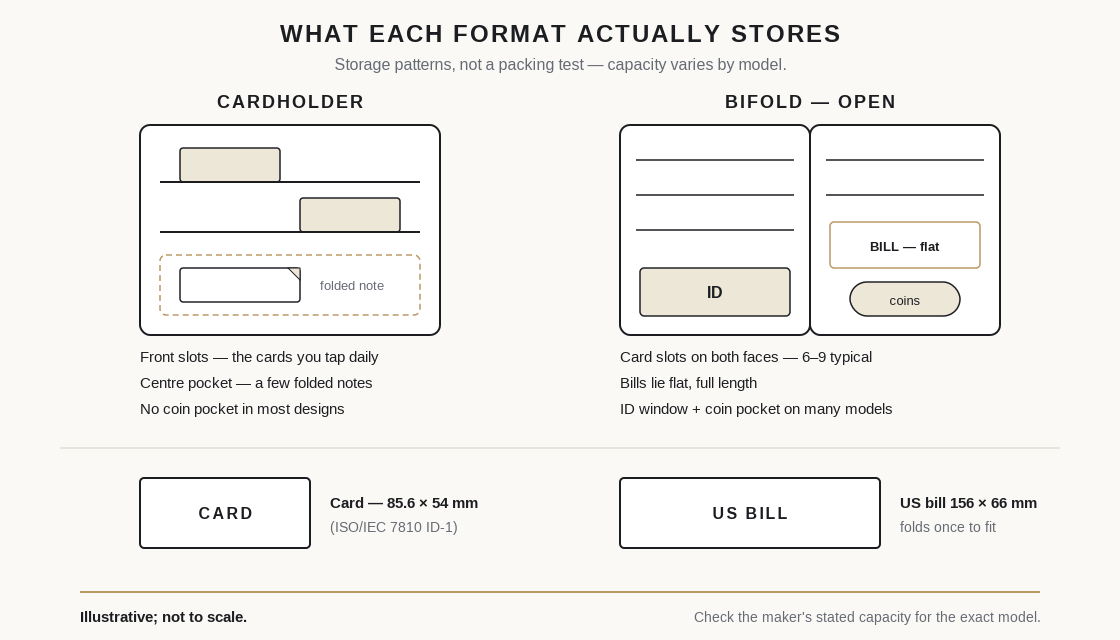
Diagram text equivalent. Left, a cardholder: two front slots holding cards, and a dashed centre pocket holding a folded note; it has no coin pocket in most designs. Right, a bifold open on two inner faces: card slots on both faces (6–9 typical), an ID window on the left face, and on the right face a bill pocket holding a note flat plus a coin pocket. Below, a card placeholder (85.6 × 54 mm, ISO/IEC 7810 ID-1) and a US bill placeholder (156 × 66 mm, folds once to fit a cardholder).
Card and Cash Capacity
Capacity is where the two formats separate, and it is also where product pages mislead most. A slot count is not a capacity: a cardholder described as holding six cards does not necessarily have six separate slots, and a bifold with twelve slots is useful only if its compartments stay accessible and do not stretch. The table below gives the typical ranges the wallet guides report — treat them as the centre of each format, not as a promise for any single model.
Swipe to compare all columns →
| Format | Cards (typical) | Cash | ID and coins | Best pocket |
|---|---|---|---|---|
| Cardholder | 4–8 | A few folded notes | No ID window on most; no coin pocket | Front pocket |
| Slim wallet | ~8 quick-access, ~13 total | Folded notes in inner pockets | Sometimes an ID slot; rarely coins | Front pocket |
| Bifold | 6–9 (up to ~10) | Bills flat, full length | ID window on many; coin pocket often | Jacket, bag, back pocket |
| Trifold | 9–11 | Bills folded in thirds | ID window; coin pocket often | Jacket or bag |
Typical ranges reported by wallet guides (Hörner, Vaultskin, Von Baer, The Brik, Arbor Trading Post, JJ Leather Crafts), not universal specifications. Check the exact model’s stated capacity.
Cards themselves set the floor. A payment card follows the ISO/IEC 7810 ID-1 format — 85.60 × 53.98 mm, 0.68–0.84 mm thick — so eight cards stack to about 5.4–6.7 mm of plastic before any leather is added. That is the thinnest a loaded eight-card cardholder can ever be; the leather, stitching and lining sit on top. Count your cards, multiply by roughly 0.8 mm each, and you have the honest minimum thickness of the format.
Cash is the harder constraint, because notes are bigger than cards and their size depends on the currency. Every US bill is the same size — 6.14 × 2.61 inches (156 × 66.3 mm), unchanged since 1929 — about 1.8 times as long as a payment card, so a bill must fold at least once to fit a cardholder, twice for a tight stack. Euro notes vary by denomination, from €5 at 120 × 62 mm to €200 at 153 × 77 mm, so the fold depends on which notes you carry. A cardholder handles a few folded notes, not a day of cash; a bifold’s long pocket keeps bills flat at full length — the one thing it does that no card-sized format can copy.
Coins decide the format more bluntly than cards do. Most cardholders have no coin pocket at all, and a slim wallet rarely adds one. If coins are a daily thing — a coin-heavy currency, a transit system that still takes them, a parking meter — you need the coin pocket of a classic wallet, or a separate coin pouch that defeats the point of going slim.
Access and Organization
A cardholder wins on access and loses on separation: every slot is visible, so the card you want is one pull away — but there is nowhere to hide the card you rarely use, and it may sit behind two others. A bifold separates everything — each card in its own slot, an ID window you can show without removing the card, cash in its own pocket. That separation is useful only if the sections do not become storage: a bifold with twelve slots invites twelve cards, and overstuffed slots stretch over time until cards slide out on their own.
The slim wallet trades searching for speed: the pop-up fan puts every card in a staggered row at one press, the fastest access of the three formats — but the mechanism is both the heart of the wallet and the part most likely to wear out, so work the slider before you buy. A cardholder has no mechanism to wear out; a bifold’s slots stretch instead.
Two checks settle the question in a shop, with your own cards, in under a minute. First, the shut test: load your real cards and close it. If the cardholder gapes or the wallet will not lie flat on the counter, it is already at capacity, and capacity on day one becomes strain by month three. Second, the shake test: hold it closed and give it one firm shake. A card that slides under a shake is a card that can work its way out on a café table or a train seat. Exposure is not the risk — a card peeking from a slot is not less secure than a card buried in a bifold. Retention is.
RFID shielding deserves a straight answer rather than a scare. Shielding is a lining that blocks the radio signal your contactless cards use, so they cannot be read while tucked away — and it stops working the moment the card leaves the wallet. Contactless cards (ISO/IEC 14443, 13.56 MHz) are designed for reads of roughly 10 cm, so an unauthorised reader has to be within about that distance, and modern cards transmit a one-time encrypted token per payment rather than the raw card number, which makes quietly skimming a usable card in a crowd unlikely. Shielding does nothing about breached databases, phishing, or a card handed to a waiter. Treat it as a low-cost bit of peace of mind, not the headline feature: build quality and the right format matter far more.
Pocket Footprint
The pocket decides as much as the cards do. A cardholder’s footprint is barely larger than the card itself — only slightly larger than the 85.6 × 54 mm card — so it disappears into a front trouser pocket or a jacket and does not print through fitted clothing. A slim wallet keeps the same card-sized footprint, which is why it suits the same pocket, but it gains height as you fill it, so a very full one can still show a bulge in a tight pocket. If front-pocket carry is the priority, keep the card count modest.
A bifold is wider and it folds, so every extra card counts double once it closes: two layers of leather, a stack of cards and a few bills, folded in half, get thick fast. One maker’s bifold measures roughly 11 × 9 cm closed — an example, not a standard — and it rides most happily in a jacket pocket or a bag rather than a tight front pocket. In a back pocket it is the classic complaint: you sit on it all day, the slots stretch, and the pocket seam wears through. If the problem is the lump in your back pocket, do not buy a thinner bifold — move to a front-pocket format.
Travel and Backup Needs
Travel is where a cardholder sized for home usually fails, because the count rises. A trip adds cards a normal day never needs — a transit card, a hotel key, a backup payment card, sometimes a second ID — so add two to four cards to your home count before you judge the format, and add the cash. Foreign notes come in different sizes (euro notes run from 120 × 62 mm to 153 × 77 mm by denomination), and a bifold’s flat bill pocket absorbs mixed sizes without a second thought, while a cardholder makes you fold each one and hope the stack still closes.
Travel also adds the unplanned: the parking ticket, the notes from a cash machine abroad, the cards you only use in one country, the receipts you need to keep. A traditional wallet absorbs those without a decision; a cardholder forces one every time. If you carry cash every day while travelling, neither slim option is right for you — a full bifold you already own beats a cardholder you will resent by the second week.
One habit is worth keeping whatever the format: a backup card kept apart from the main wallet is only a backup if it is actually apart — in a bag or a jacket, not in the next slot of the same wallet. Decide what goes in the pocket and what goes in the bag before the trip, not at the gate. Our everyday carry essentials guide walks through that split — what stays on you, what lives in the bag, and what can stay home.
Who Should Choose Each
Run the two counts, then read the row that matches — the brand, the leather and the shielding come after.
Swipe to compare all columns →
| Use case | Best fit | Why |
|---|---|---|
| Tap-to-pay daily, 4–6 cards, no cash | Cardholder | Flattest, fastest access, disappears in a front pocket |
| 8–12 cards, a little cash, front pocket | Slim wallet | More capacity at the same card-sized footprint |
| Cash daily, coins, receipts | Bifold | Bills flat, coin pocket, ID window, room to absorb the day |
| Travel, mixed currencies, many cards | Bifold or trifold | Absorbs the unplanned without a decision each time |
| Formal or jacket days | Cardholder or slim wallet | No back-pocket bulge under a jacket |
| Everything lives in a bag | Bifold or trifold | Capacity beats slimness when the pocket is a bag |
Choose a cardholder if you can count your essential cards on one hand, you rarely carry cash, and your back pocket is officially retired. Buy for the cards you used in the last seven days, plus one — not for the number of slots you admire.
Choose a slim wallet if you carry eight to twelve cards and a little cash and want the fastest one-handed access — and accept that a full one gains height. Keep the count modest in a tight pocket.
Choose a bifold or trifold if you carry cash every day, need coins and an ID window, travel with mixed currencies, or simply want one reliable home for everything and do not mind the bulk. If you genuinely use the cash and coin space, that bulk is a fair price; if you do not, you are carrying air.
If you land between two formats, the hybrid is usually the honest answer: a slim wallet for the cardholder lover who needs a little cash room, or a slim bifold for the bifold user who wants a smaller footprint. And if the wider question is what belongs in your pockets at all, the next step is the minimalist wallet guide, which builds the choice around the cards and cash you actually carry.
Conclusion
If you carry eight or fewer cards and almost no cash, a cardholder is the better fit: the flattest option, with every card within one pull. If you carry cash most days, coins, or more than about eight cards, a wallet is the better fit: a bifold keeps bills flat and gives each card its slot, and a slim wallet sits in the middle for eight to twelve cards and a little cash. Count the cards you used in the last seven days and the cash you handle, and choose the format that holds that load without stretching or overflowing.
FAQ
How many cards should a cardholder hold?
The number you used in the last seven days, plus one. Most people use three or four cards in a normal week, so a 4–6 card capacity serves most daily carry well. Past about eight cards a cardholder stops being slim and starts to bulge — the cue to move up to a slim wallet rather than fight the format.
Can a cardholder hold cash?
A few folded notes, yes; daily cash, no. A folded stack adds thickness alongside the cards — a holder with six cards and several folded notes feels different from the same holder with four cards alone. If cash is part of your daily routine, a bifold’s flat bill pocket is the honest answer.
Is a cardholder less secure than a wallet?
Exposure is not the risk; retention is. A card peeking from a slot is not less secure than a card buried in a bifold — a card that slides out under a firm shake will eventually slide out on a train seat. RFID shielding only blocks close-range wireless reads while the card sits inside the wallet; it does nothing about breaches or phishing.
What is the difference between a cardholder and a slim wallet?
A cardholder is the minimum: a flat sleeve for a few cards and maybe a folded note, and almost nothing else. A slim wallet today usually means a pop-up card wallet — a card-sized case that fans the cards out on a press — or a slim bifold. It carries more cards and a little cash, with faster one-handed access, but builds more height when full. In short, a cardholder is the minimum and a slim wallet is the practical middle.
What if I carry cash every day?
Choose a bifold. Bills lie flat at full length, there is a coin pocket, and the format absorbs receipts and the unplanned without a decision each time. A cardholder will fight you by the second week — folded notes in the centre pocket work for the odd bill, not for a daily habit.
Sources
- Hörner — “How to Choose a Wallet: Slim vs Bifold vs Cardholder.” https://www.hoernerco.com/guides/how-to-choose-a-wallet
- Vaultskin — “Cardholder vs wallet: three checks with your own cards.” https://vaultskin.com/blogs/news/cardholder-vs-wallet-which-to-carry
- Von Baer — “Card Holder vs Wallet: How To Choose in 2026.” https://vonbaer.com/blogs/blog/card-holder-vs-wallet?srsltid=AfmBOorghzOsje0zgk2Zuc0jC-SNzkisb8oYx-5fCnLiElKrUiHUxOVa
- The Brik — “Cardholder vs Wallet: Which One Should You Carry?” https://www.the-brik.com/guides/cardholder-vs-wallet
- JJ Leather Crafts — “Bifold vs Long Wallet vs Card Holder: A Data-Backed Guide to Choosing.” https://www.jjleathercrafts.ca/blogs/news/bifold-vs-long-wallet-vs-card-holder-a-data-backed-guide-to-choosing-right
- Arbor Trading Post — “Slim Wallet vs. Bifold vs. Trifold: Choosing the Right Style for Your Life.” https://arbortradingpost.com/slim-wallet-vs-bifold-vs-trifold/
- Everyman — “Bifold leather wallet guide: how to choose one, and when to go slimmer.” https://everyman.co/blogs/news/mens-leather-wallet-bifold-buying-guide
- ISO/IEC 7810 — Identification cards, physical characteristics (ID-1 format, 85.60 × 53.98 mm; card thickness 0.68–0.84 mm). https://en.wikipedia.org/wiki/ISO/IEC_7810
- ISO/IEC 14443 — Identification cards, contactless proximity cards (13.56 MHz). https://en.wikipedia.org/wiki/ISO/IEC_14443
- European Central Bank — Decision ECB/2013/10 on euro banknote denominations and specifications. https://eur-lex.europa.eu/eli/dec/2013/211(1)/2021-01-04
- US dollar bill dimensions (all denominations 6.14 × 2.61 in; specification set by the Bureau of Engraving and Printing). https://sizesvisualizer.com/us-dollar-bill/
Related Posts
Quick Decision Measure two numbers on your wrist — the circumference and the flat width across the top — then check three numbers on the listing, in this order: lug-to-lug first, thickness second, diameter third. If the lug-to-lug is longer than the flat width of your wrist, the lugs overhang and the watch will look […]
Quick Decision If you pay by card and phone and carry one to three cards, a card sleeve or a money clip is enough. If you carry four to eight cards plus a few folded bills, a slim bifold or a pop-up wallet fits. If you carry nine or more cards, a minimalist wallet will […]
Every watch on your wrist keeps time in one of two ways: a battery sending current through a vibrating quartz crystal, or a wound spring driving gears that your wrist keeps wound. Quartz is more accurate and asks less of you. An automatic is a small machine you wear, and it rewards regular wear and […]
A leather wallet and a metal wallet are not two versions of the same thing. One is a soft container that folds, stretches and ages with you; the other is a rigid frame that holds a fixed stack of cards and refuses to change shape. Both carry cards. Almost everything else — how much they […]

A front pocket wallet only works if it fits the pocket it lives in. The wallet, the cards and the cash inside it, and the pocket itself all have to agree — and the agreement is measured in inches, not in marketing words. This guide shows how to measure your pocket, check a wallet’s loaded […]