

Leather vs Metal Wallets: Everyday Trade-offs Explained
A leather wallet and a metal wallet are not two versions of the same thing. One is a soft container that folds, stretches and ages with you; the other is a rigid frame that holds a fixed stack of cards and refuses to change shape. Both carry cards. Almost everything else — how much they hold, how you get a card out, how they wear, how they treat cash — follows from that one difference. This guide compares leather and metal wallets on structure, capacity, weight, wear, cash and everyday use, and ends with a short decision check so you can pick by what you actually carry, not by which material sounds tougher.

Quick Decision
Carry few cards and almost no cash: a metal plate wallet keeps the stack thin, rigid and the same size every day, and a solid shell can shield contactless cards when they are fully enclosed. Carry many cards, folded notes and coins: leather holds more, organises it into slots and compartments, and softens with use — but the slots stretch, the stitching wears and the fold is where it fails first. There is no universal winner: the material sets the feel and the failure mode, while the design — bifold, plate, elastic, clip — sets the capacity and how fast you can reach a card. Check the specific wallet’s stated card capacity, weight and RFID claim before buying; none of those follows from the material name alone.
How this guide was put together. LanPicks does not test wallets hands-on. The comparison in this guide comes from published wallet guides and leather-care guides from makers and retailers, checked on 13 November 2026, and every figure that names a specific wallet — dimensions, weight, card count — is quoted from the retailer or maker page that lists it. Lifespans and RFID-blocking percentages claimed by manufacturers are treated as the maker’s claims, not as LanPicks measurements, and this guide does not repeat them as facts. The hero image is an AI-generated editorial illustration; the construction diagram is an original conceptual drawing, not a measurement. See our Editorial Policy.
On this page
Material vs Overall Construction
Start with what the words actually cover, because “leather” and “metal” are each a family, not a single material. Leather runs from full-grain — the hide’s top layer, kept intact, which develops a patina with handling — down through top-grain and “genuine leather” to bonded leather and PU, which look like leather on day one and age much faster. Metal runs from a thin aluminium plate to a stainless-steel tactical frame, and the weight and feel change completely between them. A cheap leather bifold and a full-grain one can differ from each other more than either differs from a metal wallet — so the material word on the listing is the beginning of the check, not the end of it.
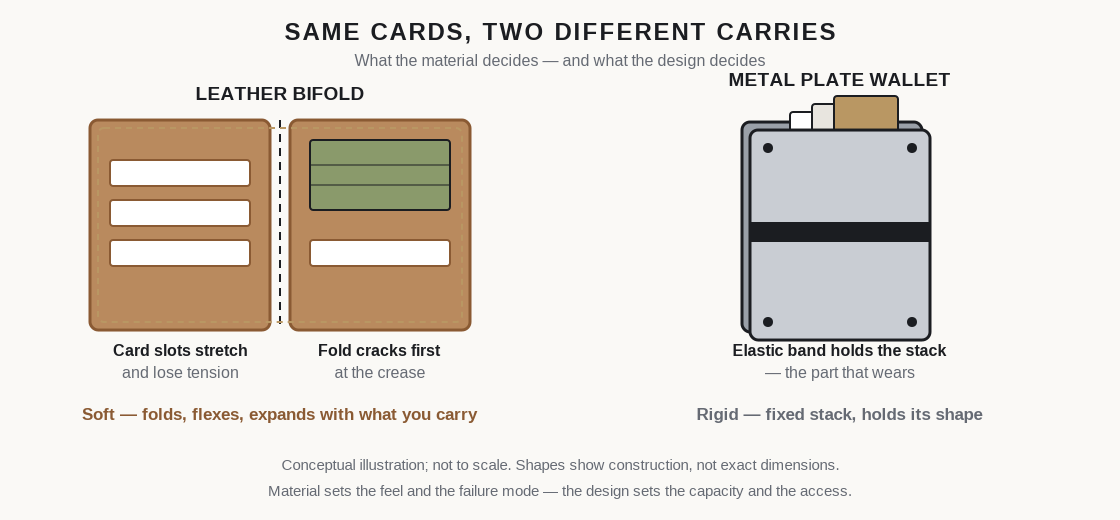
The second thing to separate is material from design. A metal wallet is usually a plate wallet: two metal plates, each large enough to cover a credit card, holding the stack between them with elastic or screws, with cards sliding out on a thumb push. That form became the default image of a metal wallet after the Ridge Wallet’s debut in 2013, and most metal wallets on the market are variations on it — sometimes a box or “tactical” version that adds tools or extra features. A leather wallet is usually a bifold, a cardholder or a long wallet: folded hide, stitched slots, a bill compartment. And the line blurs — some wallets put leather over a metal frame, such as a stainless-steel frame wrapped in oil-tanned leather. When a wallet mixes both, judge each half on its own: the leather for feel and slots, the frame for rigidity and weight.
Table 1 is the point of this section in one view: for each decision that matters, what the material decides and what the design decides.
Swipe to compare all columns →
| Decision | What the material decides | What the design decides |
|---|---|---|
| Feel in hand | Leather: warm, softens with use. Metal: cold, hard, precise. | Edge finish, corner radius and surface texture. |
| Shape over time | Leather stretches and sags as slots loosen. Metal holds its shape. | A fold adds a crease that cracks; a rigid frame cannot sag. |
| What wears first | Leather: stitching, slots, fold. Metal: elastic, screws, coating. | Replaceable bands and screws extend a metal wallet’s life; stitched slots cannot be re-tightened. |
| How much it holds | Leather is flexible — slots expand, then overstuff. Metal is fixed — the stack size is set by the plates. | Bifold, cardholder or plate-and-band sets the actual count. |
| How you reach a card | Leather: flip open, pick from a slot. Metal: fan or slide the stack out. | Ejector, thumb push, accordion or open fan. |
| Weather and sweat | Leather absorbs moisture, stains and stiffens if soaked. Metal is mostly unaffected by rain and sweat. | A closed shell protects cards better than an open frame. |
| RFID blocking | Leather alone: none — blocking needs an added lining. Metal: a fully enclosed shell can shield; an open frame may not. | Whether the cards sit fully inside the shield decides it — check the specific wallet’s claim. |
The practical consequence is simple: never buy on the material word alone. Read the listing the way Table 1 reads it — what is the grade of the leather or the metal, what is the construction, and which parts wear and can be replaced. A full-grain bifold with tight stitching and a plate wallet with replaceable elastic are both honest products; a thin “genuine leather” bifold and a metal wallet with a glued-on band are both likely to disappoint, for opposite reasons.
Capacity and Access
Capacity is where the two materials part company most clearly. A metal plate wallet holds a handful of cards — guides put the usual range at about 4 to 12, and the best-known plate wallet, the Ridge, lists 1 to 12 cards with its elastic expanding to match the stack. That fixed capacity is the point: the wallet cannot grow, so it forces a one-time cleanout of the cards you never use. Whether that feels like discipline or a restriction depends entirely on how many cards you actually carry. A leather bifold has no fixed limit in the same way — the slots flex, the bill compartment takes folded notes, and some designs add an ID window or a coin pouch — so it holds more, and it also invites overstuffing. One maker’s comparison lists 6 to 20 or more cards for leather wallets, but treat that as a manufacturer figure, not a promise: the count depends on the design, the leather and how much you are willing to stretch it.
Access is the other half of capacity. Leather is open access: flip the wallet open, pick a card from its slot. That is fast when you know which slot holds the card, and slower when the slots are full and the cards sit tight. Metal is stack access: the cards sit in one pile, and you fan or slide them out — by thumb push on a plate wallet, or by a lever or ejector on some designs. Finding a card in the middle of the stack takes longer than pulling it from a labelled slot, and one Ridge owner quoted by a retailer guide found card selection slower than with their old leather wallet. The guides also disagree on whether stacked cards damage each other: one maker’s guide says fixed compartments keep cards from rubbing, while a retailer guide warns that tightly stacked cards can rub and advises keeping grit out, avoiding overloading and using the maker’s intended capacity. Both can be true of different designs — the honest advice is to check the specific wallet, not the material.
Pocket placement follows from the shape. A metal plate wallet is built for the front pocket: rigid, flat and thin, it carries smaller than a soft wallet that has been overstuffed, and a loaded bifold is typically thicker than a loaded metal wallet. Do not sit on a metal wallet in a back pocket — it is rigid, it will not mould to you, and it concentrates the pressure. A leather bifold in a back pocket is the classic overstuffed lump that grows with every receipt. If you carry in the front pocket either way, the difference is thickness when loaded, not thickness when empty — and that is a capacity question, not a material one.
Weight and Edges
Weight is the claim most often stated backwards. Metal sounds heavy and leather sounds light, but the numbers depend on the design and the metal. A small aluminium plate wallet can weigh less than a large leather bifold, while a steel tactical wallet can weigh much more — so compare the specified weight of the models you are considering, not the material word. For orientation, the figures a retailer guide lists for named models are: the aluminium Ridge at about 2 oz empty, the aluminium Axwell at 2.6 oz, and the stainless-steel Trayvax Element at 5 oz. Those are the specific wallets’ stated weights. A leather bifold’s weight is harder to quote because it grows with its contents — the wallet itself is light, but a full one is not.
Edges matter more than weight for everyday comfort. Leather is soft and pliant, so it moulds to the pocket and rarely catches. Metal is rigid, and that rigidity has two costs: it can snag on clothing, and it holds temperature — uncomfortably hot after sitting in the sun, and cold as an ice cube on a winter day. Smooth, rounded edges help; exposed screws, rough edges or tactical attachments can catch on fabric, so look at the edge finish and the thickness of the loaded wallet, not just the empty weight. And because metal does not flex, a plate wallet with sharp corners will announce itself in a tight pocket in a way a soft bifold never does.
Wear and Maintenance
Every wallet fails somewhere; the material decides where. Leather fails at the seams: stitching wears, card slots stretch loose and lose their tension, and the fold cracks — a daily-carry leather wallet typically lasts a few years before one of those gives out. That is not a verdict on all leather: full-grain leather keeps the hide’s top layer, develops a patina and ages into character, while cheaper leather ages badly — as one maker’s guide puts it, cheap leather ages like fruit, not wine. The grade and the stitching decide how long a leather wallet lasts far more than the word “leather” does.
Metal fails cosmetically long before it fails structurally. An aluminium body accumulates fine scratches and worn anodising at the corners, but it keeps working — the body outlasts the elastic parts, which is why serviceability matters: bands, screws and keyrings that can be replaced are what keep a metal wallet in use, and a structural failure of the body is usually a warranty matter. The same rule covers both materials: elastic, stitching, hinges and replacement parts often decide how long the whole wallet lasts, so check which parts wear and whether they can be replaced before you buy.
Maintenance follows the same split. Leather asks for a little care: clean it before you condition it, condition it thinly — once or twice a year is plenty for most people, two to three times for a wallet that lives in a hot pocket — and let the leather tell you when it is dry rather than following a fixed calendar. The most common mistake is over-conditioning: too much conditioner darkens the leather and softens it more than intended, which matters most on a slim holder that needs to keep its shape. If a leather wallet gets soaked, let it dry slowly at room temperature, stuffed lightly so it holds its shape, and never near a heater or in the sun. Skip kitchen and barn oils — neatsfoot, coconut and olive oil over-soften, can turn rancid or stain. Metal asks for much less: check the elastic and the screws, keep grit out of the stack, and do not use abrasive polish on coated plates. That is the whole routine — but “less care” is not “no care”, and a band that has lost its tension will not hold a stack no matter how good the plates are.
Cash and Mixed Carry
Cash is the clearest practical difference in this guide, and the one most buyers discover too late. Leather handles cash natively: notes lie flat in a bill fold, and some designs add a coin pouch. Metal handles folded bills under a band or a clip, and handles coins not at all. If you pay cash often, carry tips, or keep coins for parking and transit, that is a real difference — not a minor one — and it points to leather regardless of what you think of the materials.
Mixed carry tips the other way. A metal plate wallet often has an attachment point for keys, which suits a carry where the keys ride with the wallet rather than loose in the pocket. A leather bifold keeps everything inside — cards, notes, ID, the odd receipt — but grows thick as it does. One detail worth checking on either design: if the wallet blocks RFID, make sure a tap badge or transit card has a slot that stays unshielded, or it will not tap through the wallet. A wallet that protects your cards perfectly and blocks your transit card at the gate has solved the wrong problem.
Choose by Priorities
There is no best material — there is a best match for what you carry and how you live with it. Table 2 turns the comparison into a decision: find the row that describes your priority, and it points to the material to lean toward, with the reason attached. If two rows point in opposite directions, the higher row on your own list wins.
Swipe to compare all columns →
| If you prioritise… | Lean toward | Because |
|---|---|---|
| Fewest cards, thinnest pocket | Metal plate | The fixed stack stays thin and never grows. |
| Many cards, paper and coins | Leather bifold | Slots, bill fold and pouch expand with the load. |
| Cash-heavy days | Leather | Notes lie flat; coins have a home. |
| Rain, sweat and outdoor use | Metal | Moisture is mostly irrelevant to anodised metal. |
| Soft feel and aging character | Leather, full-grain | Patina improves with use — check the grade first. |
| Same size every day | Metal | Fixed capacity enforces the cleanout. |
| Built-in card shielding | Metal, fully enclosed | Only if the specific wallet states it blocks RFID — an open frame may not. |
| Lowest maintenance | Metal | Check elastic and screws; no conditioning routine. |
Before you buy, run the five checks this guide keeps coming back to: the specific wallet’s stated card capacity, not the material’s reputation; the loaded weight and thickness, not the empty figures; the RFID claim in the maker’s own words, and whether the cards sit fully inside the shield; which parts wear and whether they can be replaced; and, for leather, the grade — full-grain behaves differently from every grade below it. A wallet is also one item in a pocket system: if you are rebuilding what you carry every day, plan the whole pocket first — our everyday carry essentials guide shows how to decide what earns a slot and what stays home.
FAQ
Do metal wallets block RFID?
Sometimes — and the material alone does not settle it. A solid metal shell can shield contactless cards when the card is fully enclosed, but an open design that leaves cards exposed may not. Leather on its own does not block RFID; blocking comes from an added lining, which varies by maker and can degrade. If RFID matters to you, buy a wallet whose maker states that it blocks it, and check that a transit card you need to tap has an unshielded slot.
Which lasts longer, leather or metal?
The metal body lasts longer — it scratches and wears at the corners but keeps working, while leather’s stitching, slots and fold wear out in a few years of daily carry. But a wallet is a system, not a body: elastic, screws, stitching and hinges often decide how long the whole wallet lasts. A metal wallet with replaceable bands can outlast a leather wallet with failing stitching, and a well-made full-grain bifold can outlast a metal wallet whose elastic cannot be replaced. Check the wear parts, not just the material.
Can a metal wallet hold cash and coins?
Folded bills, yes — under a band or a clip. Coins, no: a plate wallet has nowhere to put them. Leather handles cash natively, with notes lying flat in a bill fold and a coin pouch on some designs. If you pay cash often, that difference alone can decide the purchase.
Will a metal wallet set off airport security?
It may. A plain metal cardholder can go through security, but it can set off the metal detector, so take it out and put it in the tray with your watch and keys. A wallet with a blade is a different matter: knife-bearing multitools must go in checked bags, and the screening officer makes the final decision.
How often should I condition a leather wallet?
Thinly, once or twice a year for most people, up to two or three times for a wallet that lives in a hot pocket — and let the leather tell you: condition when the surface looks dry or feels tight, not on a fixed calendar. Clean it first, apply a thin, even layer of a leather-specific conditioner with a soft cloth, let it absorb, then buff off the excess. Over-conditioning is the most common mistake: too much darkens the leather and softens it more than intended.
Conclusion
Pick by failure mode and by carry, not by material reputation. If you carry five cards and a folded note, a metal plate wallet will stay the same size for years and ask for almost no care. If you carry twelve cards, cash and coins, leather will hold it — and ask for a little conditioning in return. Count what you actually carry before you choose, then check the specific wallet against the five checks above: stated capacity, loaded weight, the RFID claim in the maker’s words, replaceable wear parts, and the leather grade. The right wallet is the one whose failure mode you are willing to live with.
Sources
- The Wallet Shoppe — Metal Wallets Pros & Cons (plate vs tactical types; Ridge/Axwell/Trayvax stated dimensions, weights and card counts; comfort, care and RFID FAQ; TSA note) — accessed 13 November 2026
- The Brik — Metal Wallet vs Leather Wallet: An Honest Take (failure modes; capacity discipline; cash and coins; weather; pick-by-failure-mode framing) — accessed 13 November 2026
- GSTAR Technology — Hard-Shell Metal Cases Vs. Soft-Shell Leather Wallets: The 2026 Expert Guide for Brands And Buyers (manufacturer comparison; capacity ranges; RFID lining note) — accessed 13 November 2026
- Bull Guard — Best Mens Metal Wallet: 2026 Buyers Guide (metal wallet definition; 4–12 card range; Faraday cage principle) — accessed 13 November 2026
- Wingback — How to Care for a Leather Wallet & Re-oil It (full-grain vegetable-tanned care; condition once or twice a year; over-oiling darkens and softens) — accessed 13 November 2026
- Old Town Leather Goods — Leather Wallet Care: What Actually Works (clean before conditioning; condition two to three times a year; dry slowly at room temperature) — accessed 13 November 2026
- Gentcreate — How to Condition a Leather Wallet the Right Way (thin passes two to three times a year; condition when the leather signals dryness; avoid kitchen oils) — accessed 13 November 2026
- GSTAR Technology — Differences Between Gifting A Metal Wallet Vs. Gifting A Traditional Leather One (rigid card protection; RFID lining in leather; patina and organisation) — accessed 13 November 2026
Related Posts
Quick Decision Measure two numbers on your wrist — the circumference and the flat width across the top — then check three numbers on the listing, in this order: lug-to-lug first, thickness second, diameter third. If the lug-to-lug is longer than the flat width of your wrist, the lugs overhang and the watch will look […]
Quick Decision If you carry eight or fewer cards and almost no cash, a cardholder is the better fit: the flattest thing you can carry, it disappears into a front pocket and every card is within one pull. If you carry cash most days, coins, or more than about eight cards, a wallet is the […]
Quick Decision If you pay by card and phone and carry one to three cards, a card sleeve or a money clip is enough. If you carry four to eight cards plus a few folded bills, a slim bifold or a pop-up wallet fits. If you carry nine or more cards, a minimalist wallet will […]
Every watch on your wrist keeps time in one of two ways: a battery sending current through a vibrating quartz crystal, or a wound spring driving gears that your wrist keeps wound. Quartz is more accurate and asks less of you. An automatic is a small machine you wear, and it rewards regular wear and […]
A front pocket wallet only works if it fits the pocket it lives in. The wallet, the cards and the cash inside it, and the pocket itself all have to agree — and the agreement is measured in inches, not in marketing words. This guide shows how to measure your pocket, check a wallet’s loaded […]