

Baseball Cap Fit Guide: Crown, Closure and Head Size
A baseball cap that fits comes down to three checks, in this order: measure your head, read the brand’s size chart, and check the crown depth. Most people do only the first one — and then wonder why a cap in the right size still sits too high, pinches after an hour, or looks bulky. Circumference decides whether a cap goes on. Crown depth decides whether it sits right. Get both numbers, and the closure choice becomes easy.
Quick Decision
Measure once, properly: a soft tape just above your eyebrows and ears, level, snug but not tight, with your hair as you normally wear it — measure twice and keep the larger number. Convert it to a hat size (circumference in inches divided by 3.14), then confirm it against the specific brand’s size chart, because charts are not standardised and the same measurement can mean different sizes at different brands. Check crown depth separately: if a cap in the right size sits too high or feels tight at the top, the crown is too shallow — look for a mid- or high-profile style instead. Choose the closure by range: fitted if you know your exact size and want the cleanest look; snapback or strapback if you want adjustment, with a strapback offering the widest range; stretch-fit only if your measurement falls inside its stated range. Between two fitted sizes, size up — a slightly large cap can be taken in, a small one cannot. And never assume “one size fits most” means your size: check the range on the listing.
How this guide was put together. LanPicks does not test caps hands-on. The measuring steps, size chart and closure comparisons here come from published cap sizing guides and a cap-type reference, checked on 14 November 2026. The size chart is a general starting reference — brand charts differ, and where the sources themselves disagree, this guide says so rather than picking one number. No prices, no wear-test results and no fit guarantees appear here, because none of the sources verified them as measurements. The hero image is AI-generated; the diagram is an original conceptual drawing, not a measurement. See our Editorial Policy.
On this page
Measure Your Head
Everything in this guide starts from one number: your head circumference. It takes two minutes to measure, and it is the only number that matters for size — but only if you measure it the way a cap actually sits.
Use a flexible soft tape — the fabric or plastic kind used in sewing. A rigid metal tape cannot wrap around a head accurately, and a phone app or a guess is not a substitute. If you have no soft tape, a piece of string works: wrap it around your head, mark the overlap point, then measure the string against a flat ruler.
Wrap the tape just above your eyebrows and ears — about one finger-width above them — running it around the widest part of the back of your head. Keep it level: if it tilts down at the back, your measurement will read larger than it should. The tape should be snug against your head but not pulled tight; you should be able to slide one finger underneath it comfortably. Pulling it tight is the most common measuring mistake, and it gives you a number that is too small — which gives you a cap that pinches.
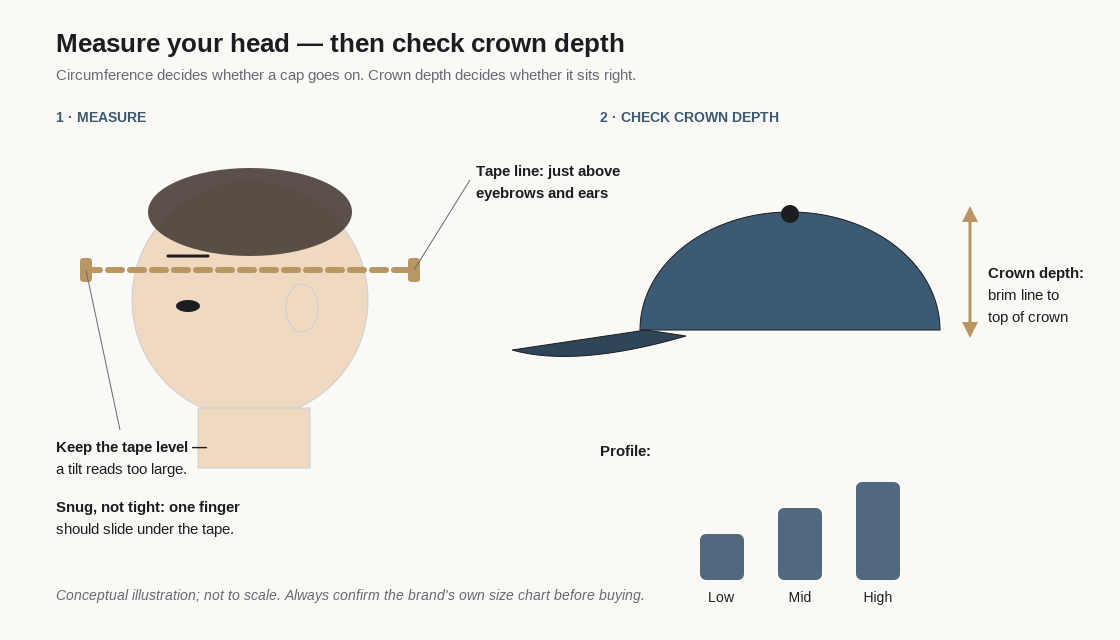
The diagram above shows the two checks side by side. On the left, the tape line runs just above the eyebrows and ears, level around the head, snug enough to stay in place but loose enough for one finger underneath. On the right, crown depth is the vertical distance from the brim line to the top of the crown, shown with low, mid and high profile bars. The diagram carries no numbers — your measurement goes in the worksheet at the end of this guide.
Measure twice, and if the two readings differ, use the larger number — the tape can shift slightly between attempts, and it is always better to have a touch more room than not enough. Measure with your hair as you normally wear it. This is the step almost every sizing guide skips, and it matters: if you wear your hair in locs, a bun, an afro or any style that adds volume under the cap, measuring against a bare scalp will give you a number that is too small. If your hair adds meaningful volume, consider sizing up by half a size. Write the number down in both centimetres and inches — different brands use different units on their charts, and having both saves you the conversion when you are shopping.
Read the Brand’s Size Chart
Your measurement becomes a hat size through a formula from traditional hat-making: take your head circumference in inches and divide it by pi (3.14). A size 7⅜, for example, corresponds to a head circumference of roughly 23⅛ inches. Once you understand that, the fraction on the label stops feeling arbitrary — it is just a precise way of expressing your head’s diameter.
Use the general chart below as your starting reference. Then — and this is the step that matters — confirm the number against the specific brand’s chart before you buy.
Swipe to compare all columns →
| Head circumference (cm) | Head circumference (in) | Hat size | Size label |
|---|---|---|---|
| 54.0 | 21¼ | 6⅞ | XS |
| 55.8 | 22 | 7 | S |
| 57.2 | 22½ | 7¼ | S/M |
| 58.4 | 23 | 7⅜ | L |
| 59.7 | 23½ | 7½ | L/XL |
| 60.6 | 23⅞ | 7⅝ | XL |
| 61.9 | 24⅜ | 7¾ | XL |
| 63.5 | 25 | 8 | XXL |
The reason for the second check is that brand size charts are not standardised. The same head circumference can land you in different sizes depending on the manufacturer — New Era reads differently from Yupoong, and Flexfit uses its own stretch-fit categories entirely. The sources for this guide disagree with each other on the details: one sizing guide puts 7⅜ at 58.4 cm, another puts it at 59 cm. Neither is wrong; they are different brands’ charts. A general chart gets you close, but the brand’s own chart is the final word before you buy.
As a reference point, the most widely worn men’s hat size is 7⅜ — a head circumference of around 23 inches (58.4 cm), classified as a Large in most brand charts. For women, the average sits at 7¼. These are useful landmarks, but your measurement is always the number that matters. Most adults fall between 54 cm and 62 cm, which is exactly the range an adjustable snapback is built to cover. If your head is under 55 cm or above 62 cm, standard retail sizing becomes genuinely difficult — most high-street stores and online brands do not stock outside this range in meaningful depth, and specialist hat retailers are worth seeking out rather than forcing a standard size that will never sit right.
Crown Depth and Structure
Crown depth is the vertical height of the cap from the brim line to the top of the crown. It has nothing to do with circumference. Two caps can be identical in size — the same number on the label, the same internal measurement — and feel completely different because one has a shallow crown and the other sits tall. This is the fit variable that most sizing guides ignore entirely, and it is the reason a correctly-sized cap can still look wrong on your head.
A crown that is too shallow for your head creates immediate pressure at the top: the cap sits perched rather than settled, and it tends to ride up throughout the day. This is a particularly common issue for people with larger heads who are already at the upper end of standard sizing, and for anyone with high hair volume. A crown that is too deep has the opposite effect: the cap sinks down, covers more of the forehead than it should, and looks bulky rather than structured. If a cap sits too high or “floats” on your head, crown depth is the issue — not the closure.
Profile is the word brands use for crown height: low, mid or high. Low-profile caps have a shorter crown — typically unstructured, with a softer shape that sits closer to the head. They suit smaller heads well and create a more understated, casual silhouette; if standard caps look oversized on you, a low-profile style is worth trying regardless of whether the circumference size is correct. High-profile caps have a taller, more structured crown — the New Era 59FIFTY is the clearest example. They suit larger heads and create the classic baseball-cap look most people picture. If you have a larger head and find caps look flat or compressed, a high-profile structured cap is almost certainly the answer.
Structure is a separate choice from profile. Structured crowns have a stiffener, usually buckram, behind the front panels, which keeps the crown upright instead of collapsing toward the head; they also give a flat, stable surface for embroidery. Unstructured crowns have no stiffener and follow the shape of the head, which reads as relaxed rather than uniform — the classic “dad hat” is an unstructured, low-profile cap with a soft crown and a pre-curved brim. A structured cap holds its shape in a bag; an unstructured one packs flatter and softens with wear.
The practical rule: if a cap looks off despite being the right circumference size, crown depth is the variable to investigate next. Check the product description for “low-profile” or “high-profile” before buying — most brands include this detail, but it rarely appears on size charts. And if you are at the larger end of the size range, a high-profile style is the safer pick, because a shallow crown is the most likely reason a large cap still feels wrong.
Closure Options
Once you know your size and your crown, the closure decides how much flexibility you have — and whether the cap can adjust to you, or has to be exactly right from the start.
Swipe to compare all columns →
| Closure | How it adjusts | Fit control | Best for | Watch for |
|---|---|---|---|---|
| Snapback | Plastic snap, discrete steps | High | Most heads; sharing caps; between fitted sizes | Can feel rigid; snap visible from behind |
| Strapback (buckle) | Fabric strap with metal buckle | High — widest range | Larger or smaller heads; premium look | Strap can slide loose; buckle edges |
| Strapback (Velcro) | Velcro tab | Medium | Fast on/off; high-activity wear | Can catch lint over time |
| Stretch-fit / Flexfit | Elastic sweatband, no closure | Medium (range-based) | Comfort-first casual wear | Range varies; not universal despite the name |
| Fitted (no closure) | None — cut to one size | Very high, if sized correctly | Teams; cleanest silhouette; collectors | Requires an exact size; no adjustment |
A snapback uses a plastic snap closure at the back that adjusts in discrete increments. Most snapbacks comfortably cover sizes 7 through 7¾, which makes them a practical choice if you fall between fitted sizes or share caps. The flat brim is part of the traditional snapback look, though curved-brim versions exist. The adjustment range is good, but the snap closure is visible from behind, which some wearers prefer to avoid.
A strapback replaces the plastic snap with a fabric or leather strap and a metal buckle or slide, or a Velcro tab. Of all the adjustable options, strapbacks offer the widest adjustment range — useful for heads at the larger or smaller end of the standard spectrum. The buckle version in particular reads as more premium, and the strap can carry a small woven label. Velcro is the fastest to adjust and the easiest to take on and off, but it can catch lint over time and looks more utilitarian.
Stretch-fit caps — Flexfit is the best-known, produced by Yupoong — use an elastic sweatband that stretches to accommodate a range of head sizes within a band. They are typically sold in S/M and L/XL rather than fractional sizes, and they have a smooth back with no hardware. The catch is the range: one-size-fits-all Flexfit caps fit head circumferences of approximately 56 to 59 cm, corresponding to sizes 7 through 7⅜. If your head falls outside that range, “one size fits all” is not actually universal, and an adjustable cap with a full closure range will serve you better.
A fitted cap has no closure at all. It is cut to one exact size, which gives the cleanest silhouette — no hardware at the back, no visible strap — and it relies on a shaped sweatband for fit. Fitted caps usually run 6⅞ to 7⅝ in US sizing, and New Era’s fitted range runs from 6⅞ up to size 8. The trade-off is precision: you need to know your size with confidence before buying, and a wrong size means an exchange, not an adjustment.
Check Adjustment Range
“One size fits most” is a range, not a promise. Before you buy an adjustable cap, check the range on the listing and compare it with your measurement — do not assume it covers you.
Adjustable caps generally cover roughly 21.5–24 inches (55–61 cm) through the snap or strap, and a typical adjustable snapback range is about 54–62 cm. But those are rough guides, and they differ by maker: one brand’s adjustable closure may top out at 61 cm while another reaches 62 cm, and a stretch-fit “one size” may only cover 56–59 cm. If your measurement sits at the outer edge of what an adjustable cap can cover, a strapback with the maximum adjustment range is the safest choice — it has the widest range of any adjustable closure.
If your measurement lands between two fitted sizes, the answer is always the larger size. A cap that is slightly too large can be brought in — hat size reducer foam tape, applied inside the sweatband, can take in up to half a size, and it is inexpensive and invisible once the cap is on. A cap that is too small cannot be made larger, and wearing it tight enough to stay in place will leave marks and become uncomfortable within an hour. One more consideration for fitted caps: if you are choosing wool or cotton, buy slightly larger than your measurement suggests, because both materials can shrink with heat and moisture. This does not apply to adjustable caps, where the closure compensates for minor changes.
For adjustable caps, the between-sizes problem is largely irrelevant — the closure handles the variation. The practical check is different: start looser than you think you need, put the cap on, and tighten one notch at a time until it sits snug without pinching. If you are between notches on a snapback, go one notch looser. Then check the fit the way you will actually wear it: the brim roughly two finger-widths above the eyebrows with a slight downward angle, snug above the ears, secure enough that it does not shift when you turn your head or walk in the wind, but not so tight that it leaves a mark or gives you a headache after an hour. Re-check the fit after the first wash, too — a structured cotton cap can feel slightly stiff out of the box and relax into your head shape after a few wears.
Fit Checklist
Before you buy, fill in the worksheet. It takes two minutes and prevents the most common online-cap mistake: ordering the right circumference in the wrong crown, or a “one size” that does not cover your head.
Swipe to compare all columns →
| Check | Your answer | What to do with it |
|---|---|---|
| Head circumference | Your measurement (cm + in) | Convert to a hat size; keep the larger reading if you measured twice |
| Brand’s size chart | Brand’s size for your measurement | Use the brand’s number, not the general chart |
| Crown / profile | Low, mid or high (from the listing) | High profile for larger heads; low profile if standard caps look oversized |
| Closure | Snapback / strapback / stretch-fit / fitted | Fitted only if you know your exact size |
| Adjustment range | Stated range on the listing | Your measurement must fall inside it — not at its edge |
| Try-on result | Snug, no marks, stays put | Brim two finger-widths above the eyebrows; no red marks after an hour |
Once the worksheet is done, run the checklist: measured with a soft tape, level, snug, with your usual hairstyle; measurement recorded in centimetres and inches; hat size converted and confirmed against the brand’s own chart; crown depth and profile checked in the listing; closure chosen by the adjustment range you need, not by looks alone; if fitted, sized up when between sizes; if adjustable, started loose and tightened one notch at a time.
If something still feels wrong, the symptom usually names the cause. A cap that sits too high or “floats” has a crown that is too shallow or a profile that is too low for the head — choose a deeper crown, often a mid-profile style, or a different cap. Tight forehead pressure means the band tension is too high or the crown is too shallow — move to an adjustable cap with a wider range and avoid shallow silhouettes. A cap that slips in wind or during movement is too loose or the closure is not secure — tighten it and confirm it stays put when you turn your head. And if a ponytail does not fit comfortably, the closed crown is blocking your hair: a visor, or a cap style designed for hair volume, fits better than forcing a standard crown.
FAQ
What does a hat size like 7⅜ actually mean?
The number comes from dividing your head circumference in inches by pi (3.14). A size 7⅜ corresponds to a head circumference of approximately 23⅛ inches. Once you understand the formula, baseball cap sizing becomes straightforward — the fraction is just a precise way of expressing your head’s diameter.
Can I wear a one-size-fits-all cap if I have a big head?
Probably not comfortably. One-size caps — including most Flexfit one-size styles — are designed for head circumferences of roughly 56 to 59 cm. If your head is larger than that, the cap will feel tight and sit too high. A snapback or strapback adjustable cap with a wide closure range is the better option for larger heads.
Does my hairstyle affect what cap size I need?
Yes, and this is one of the most overlooked variables in cap sizing. If you wear locs, a bun, a large afro or any style that adds height or volume under the cap, measuring against a bare scalp will give you a number that is too small. Always measure with your typical hairstyle in place, and consider sizing up half a size if your hair adds meaningful volume.
Should I size up or down if I am between two fitted cap sizes?
Always size up. A cap that runs slightly large can be adjusted with hat size reducer tape placed inside the sweatband — a simple fix that takes in up to half a size. A cap that is too small has no equivalent solution and will be uncomfortable to wear.
How tight should a baseball cap be?
Snug enough that it does not shift when you turn your head or walk in the wind, but not so tight that it leaves a mark or gives you a headache after an hour. The brim should sit roughly two finger-widths above the eyebrows, with the visor at mid-forehead. If it leaves an impression on your skin, size up.
What if the size is right but the cap still looks wrong?
Check the crown depth. A cap with the right circumference but the wrong crown height will look off and feel wrong regardless of how accurate your measurement was. Look for “low-profile” or “high-profile” in the product description: a shallow crown sits perched and rides up, a deep crown sinks and covers too much forehead. Change the profile, not the size.
Conclusion
Getting a baseball cap to fit comes down to one accurate measurement and two checks most buyers skip: the brand’s own size chart, and the crown depth. Measure at the right position, keep the tape snug without pulling it tight, and measure with your hair as you actually wear it. From there, the fractional size chart becomes a tool you can use with confidence rather than a source of confusion. And if your measurement lands between two sizes, size up — reducer tape solves the rest. The one thing the number on the chart cannot tell you is whether the crown depth suits your head, so treat that as a separate check every time a cap looks right on paper and wrong on your head.
Sources
- Hewore — Baseball Cap Sizing: Step-By-Step Guide & Chart (measuring method, size chart, crown depth, closures, between-sizes guidance; accessed 14 November 2026)
- Promotion Choice — Baseball Cap Sizing Guide: Fit, Rules & Common Mistakes Explained (fit definitions, closure decision table, common fit problems; accessed 14 November 2026)
- Patriot Caps — Cap Size Guide: How to Measure Your Head (measuring steps, adjustable range 54–62 cm, snapback adjustment; accessed 14 November 2026)
- Leeline Promotion — 8 Baseball Cap Types: Decoration Area, Fit & Closure Charts (crown structure, profile, closure types, fitted size range; accessed 14 November 2026)
Related Posts

Quick Decision Start with your item list, not the liter number. A 2L bag covers phone, wallet, keys, and earbuds for most days. Go to 3L when a passport, a portable charger, and a sunglasses case join the list. Choose 5L only when a small bottle or a light layer has to come too. Liters […]

Quick Decision Start with function, not with a shopping list. Pick one main accessory that solves a real need — a bag because you carry things, a cap because you are outside, a chain because the outfit needs one clear detail — and keep everything else quiet. Three starter pieces cover almost every day: a […]

If your daily load is a phone, keys, wallet and earbuds, a sling is enough — and it is the lighter, quicker format for that job. Add a tablet, a notebook and a charger, and you are at the edge of a sling: a larger sling or a small messenger both work. Add a laptop, […]
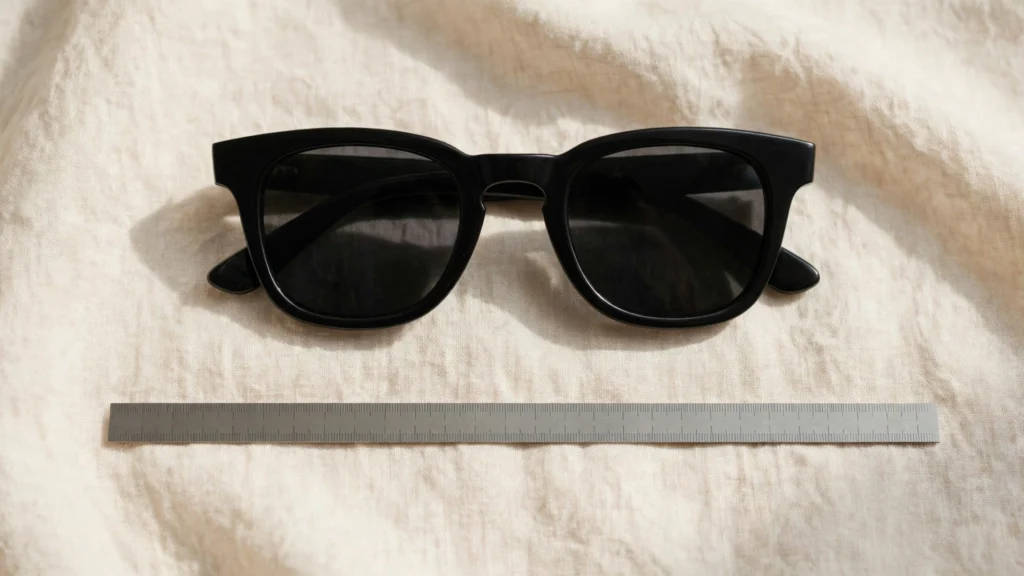
Most sunglasses fit or fail on three numbers printed inside the temple arm — lens width, bridge width and temple length, in millimetres, in that order. A pair marked 52-18-140 has 52 mm lenses, an 18 mm bridge and 140 mm arms. The number that actually decides whether a frame fits your face is a […]

The best everyday carry is personal. It should fit your routine, your pockets and your sense of style — without turning every outing into a packing project. Start with a few reliable essentials, then add only what earns its place. Start With What You Actually Carry Open your pockets and bag and lay everything out. […]