

How to Compare Vacuum Filters and Brushes Without Relying on Seller Claims
A replacement filter or brush listing is a claim, not evidence. The listing says “HEPA”, “OEM-quality”, or “lasts twice as long” — and none of those words can be checked from the listing page. This guide compares filters and brushes by evidence you can gather yourself: measure the old part, test the HEPA claim against the standard, and use your model’s manual for intervals. That is the whole method, and it works without trusting a single seller sentence.
Fit comes first, and it is a different question. Confirming that a part matches your model is covered in the companion guide on confirming robot vacuum replacement-part compatibility. This guide assumes the part fits and asks the next question: is it any good?

In this guide:
- The problem: the listing is the claim
- Measure the old part first
- Test the HEPA claim
- Use the manual’s intervals, not the seller’s
- OEM vs third-party by part type
- Red flags in a listing
- A short checklist before you order
- FAQ
- Sources
The problem: the listing is the claim
Every replacement part is sold on words the seller chose. A filter can be listed as “HEPA” with no grade, no test standard, and no part number. A brush can be listed as “OEM-quality” with no manufacturer part number to match against. A filter can be listed as lasting twice as long with no interval from any manual behind it. None of those claims can be verified from the listing, because the listing is the only source for them.
The way out is to stop comparing listings and start comparing parts. The old part in your hand is a physical fact: its frame shape, its arm count, its end caps, its bristle stiffness. The standard a filter grade refers to is a published fact: H13 means 99.97% of 0.3-micrometre particles captured. Your model’s manual is a manufacturer fact: it states the replacement intervals for that machine. Compare against those three things, and the seller’s words stop mattering.
Measure the old part first
Take the old part out before you order anything. Check it against the listing the way the fit guide describes: shape, size, mounting style — count the arms on the side brush, check the end caps on the main brush, compare the frame shape of the filter. That comparison does two jobs at once: it confirms the part fits, and it gives you the measurements the quality checks below need.
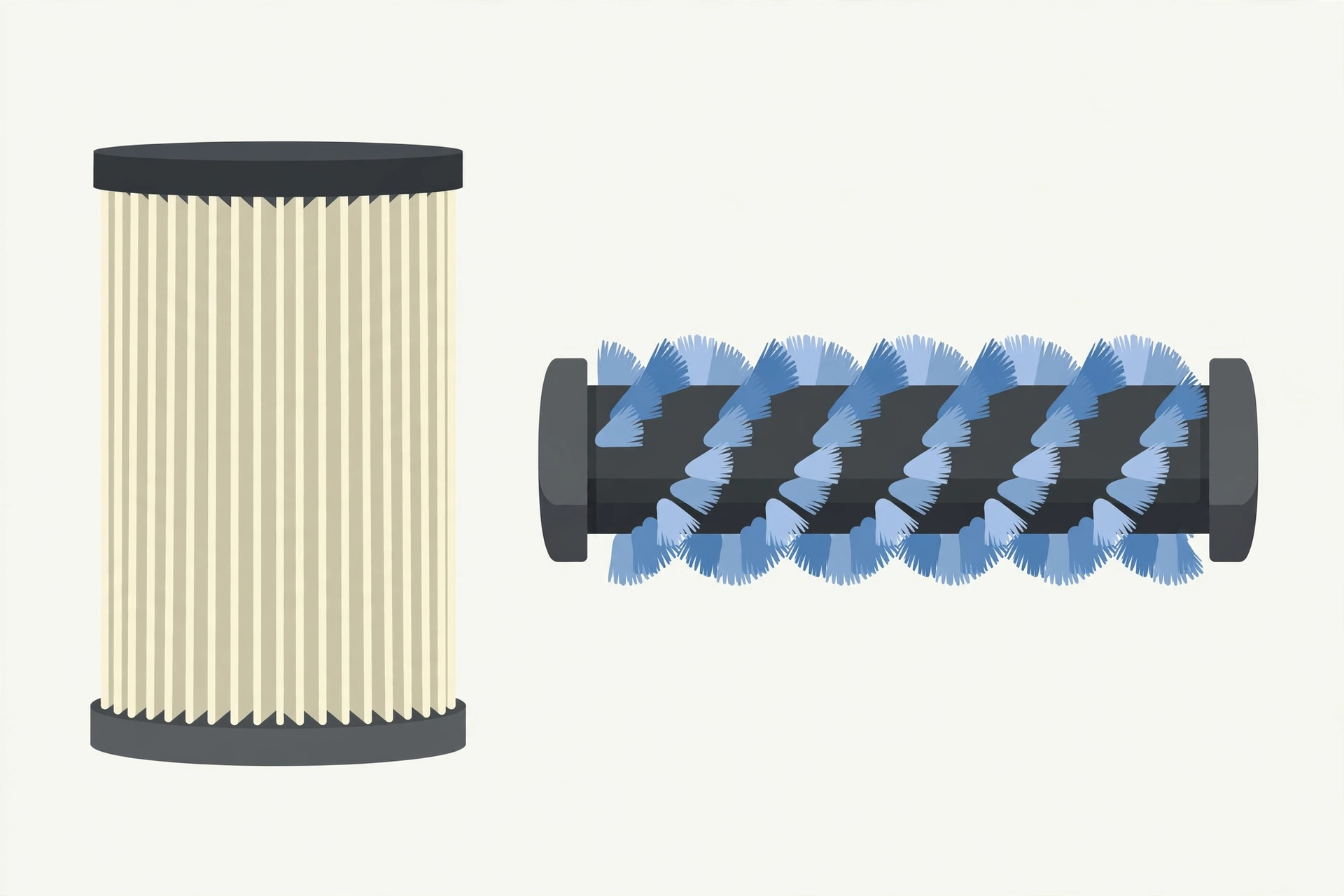
Then handle the old part. A main brush with worn or missing vanes, or bristles flattened against the roller, is a brush at the end of its life — rubber rollers last longer than bristle ones, but both wear out. A side brush whose bristles have deformed has a smaller sweep radius than a new one, and that shows up as dust left along edges and corners. A filter that looks grey or matted, or a sudden drop in suction right after emptying the bin, means the filter is due regardless of the calendar. These are wear signs you can see and feel, and they override any date on a schedule.
Test the HEPA claim
HEPA is a grade, not a material. An original HEPA filter meets the H13 standard: it captures 99.97% of particles at 0.3 micrometres. That is the number to ask for. A listing that says “HEPA” without a grade, a test standard, or a part number is making a claim that cannot be verified — the word is there, the evidence is not.
That is all this guide claims about third-party filters: an ungraded “HEPA” claim cannot be verified, and it should not be trusted as a grade. It does not say a specific third-party filter passes or fails H13 — that would need a test result nobody in the listing has shown. What the evidence does show is the direction of the risk: third-party filters can fit and look identical to the original while using lower-density media that lets more fine dust bypass the exhaust, and a clogged or degraded filter raises backpressure and chokes airflow. So the check is simple: a filter listing with a stated grade, a test standard, and a part number can be checked; a filter listing with only the word “HEPA” cannot.
Use the manual’s intervals, not the seller’s
Replacement intervals come from your model’s manual, not from a seller’s “lasts twice as long”. One manufacturer’s manual — for the Roborock Qrevo Master — puts the main brush at clean every two weeks and replace every 6 to 12 months, the side brush at clean monthly and replace every 3 to 6 months, and the washable filter at clean every two weeks and replace every 6 to 12 months, dried at least 24 hours before reinstalling. The same manual adds that the frequency of replacement may vary with the actual situation, and that abnormal wear means replacing immediately.
Published guides give similar ranges, not a single rule: filters every 1 to 3 months in one guide (which cites a Roborock maintenance guide at about every 2 months), a main brush roller every 6 to 12 months, a side brush every 3 to 6 months, and washable mop pads after roughly 30 washes; another guide puts a non-washable filter at 2 to 4 months and a washable filter at 6 to 12 months after multiple wash cycles. Treat those as ranges that vary by model and use. Your manual’s intervals are the ones that govern your robot, and the wear signs in the previous section override the calendar in either direction — a filter that is grey and matted is due now, and a brush that still sweeps clean is not.
OEM vs third-party by part type
Whether to buy original or third-party depends on the part, not on the brand of the listing. For filters — where filtration efficiency matters for indoor air quality — and for brush rolls — where the primary cleaning mechanism is at stake — the published guidance recommends original parts. Original HEPA filters meet the H13 standard, preserve suction, match the seals and tolerances, and protect the motor and the warranty; original batteries include a tuned battery management system. Original parts are also worth the extra cost for anything that touches a sensor housing, because they guarantee fit and sensor calibration.
For non-critical accessories, a vetted third-party part is a reasonable choice. The guidance is consistent on this: use vetted third-party parts only for non-critical accessories such as mops and side brushes, after checking fit, reviews, and return policy. The risk is narrower there — a side brush with shorter bristles sweeps a smaller radius, a brush roll with different bristle stiffness cleans differently — but it does not touch filtration, seals, or sensors. If you are choosing the machine itself rather than its parts, the robot vacuum buying guide covers that decision, and single-model checks such as the ILIFE A30 Pro buying guide and the ABIR K30 check show what a model-specific check looks like. Neither replaces the manual for your model when a part is due.
Red flags in a listing
Five signs that a listing cannot be checked, in any order: a “universal” fit claim with no model list; no model list at all; no part number to match against the manufacturer’s; a “HEPA” claim with no grade, test standard, or part number; and price as the only argument — a listing that says nothing except that it is cheaper. Any one of these means the listing has given you nothing to verify. A listing that names your exact model, gives a part number, states the filter grade with its standard, and states the intervals from a manual has given you four things to check — and a part that passes those four checks is a part you can order with confidence.
A short checklist before you order
- Take the old part out and measure it: filter frame shape and size, side-brush arm count, main-brush end caps and length, bristle stiffness by hand.
- Check the wear signs: grey or matted filter, suction drop after emptying the bin, worn or missing brush vanes, flattened bristles, deformed side-brush bristles.
- Read the HEPA claim: a grade, a test standard, and a part number — or it is an unverified claim. H13 means 99.97% at 0.3 micrometres.
- Use your model’s manual for intervals, not the seller’s. Ranges vary by model and use; the manual wins, and wear signs override the calendar.
- Decide original versus third-party by part type: original for filters and anything touching a sensor housing; vetted third-party only for non-critical brushes and mops, after checking fit, reviews, and return policy.
- Check the return policy before ordering, so a part that does not match the old one can go back.
FAQ
Is a third-party filter safe to use?
It depends on what can be verified, not on who made it. A third-party filter with a stated grade, a test standard, and a part number can be checked the same way an original one can. A third-party filter that says only “HEPA”, with no grade or standard, is an unverified claim — it can fit and look identical while using lower-density media that lets more fine dust bypass the exhaust. For filters, where filtration matters for indoor air quality, the published guidance recommends original parts; for non-critical brushes and mops, a vetted third-party part is reasonable after checking fit, reviews, and return policy.
What does H13 actually mean on a filter listing?
H13 is a filter grade: it means the filter captures 99.97% of particles at 0.3 micrometres. The number matters because it is a testable standard — a listing that states H13, a test standard, and a part number is making a claim you can check against the manufacturer’s specification. A listing that says only “HEPA” states no grade at all, and that claim cannot be verified from the listing.
My filter looks gray but suction seems fine — replace it?
Yes. A filter that looks grey or matted is due regardless of the calendar, and a clogged or degraded filter raises backpressure and chokes airflow even before suction drops noticeably. A sudden drop in suction right after emptying the bin is the same signal. Replace on the wear signs and your manual’s intervals, not on whether the robot still seems to work.
A “universal” brush kit says it fits my model — should I trust it?
No. A kit that claims to fit everything has confirmed nothing about your model — there is no universal brush mount, no universal filter frame, and no universal dust bag. Match your exact model code and compare the old part physically: frame shape, arm count, end caps, and size. A kit that names your exact code and matches the old part’s shape is a fit; a kit that only says “universal” is not.
Sources
- VacuumTips — OEM vs Compatible Robot Vacuum Parts Differences (original HEPA filters meet H13: 99.97% of 0.3 µm particles; third-party units can fit and look identical but often use lower-density media; original for critical parts — batteries, motors, HEPA filters; “use vetted third-party parts only for non-critical accessories (mops, side brushes) after checking fit, reviews, and return policy”; clogged filters raise backpressure and choke airflow).
- RobotVacHub — Best Robot Vacuum Accessories (2026): Filters, Mop Pads, Brushes & More (filters every 1–3 months, Roborock’s maintenance guide at about every 2 months; main brush rollers every 6–12 months; side brushes every 3–6 months; washable mop pads after roughly 30 washes; original parts worth the extra cost for anything that touches a sensor housing; a grey or matted filter, or a suction drop right after emptying the bin, means it is due regardless of the calendar).
- Roborock Qrevo Master User Manual — Routine Maintenance (via ManualsLib) (main brush: clean every 2 weeks, replace every 6–12 months; side brush: clean monthly, replace every 3–6 months; washable filter: clean every 2 weeks, replace every 6–12 months, dry at least 24 hours; “the frequency of replacement may vary with the actual situation”).
- Descent Analysis — Robot Vacuum Spare Parts: Brushes, Filters, and Replacement Intervals (main brush roll every 6–12 months, rubber rollers last longer than bristle; side brush every 3–6 months, bristles deform and reduce sweep radius; filter every 2–4 months non-washable, 6–12 months washable; “for filters (where filtration efficiency matters for indoor air quality) and brush rolls (where the primary cleaning mechanism is at stake), OEM parts are the recommended choice”).
- SourceVCP — Identify Robot Vacuum Replacement Parts by Model Name (physical-comparison method: shape, size, mounting style; count side-brush arms; check main-brush end caps; compare filter frame shape; “if your model is missing [from the compatibility list], ask the seller before you order”).
Related Posts
One rule decides whether a replacement part fits your robot vacuum: match the exact model number, not the name on the box. Two robots can share a name and take different filters, brushes, or dust bags, and a listing that names your series but not your exact model has not confirmed anything. This guide is […]

Three checks decide whether a small home appliance fits your home: the space it will actually work in, the voltage and frequency on its rating plate, and the plug and circuit it will run on. Skip any one of them and the appliance can arrive too tall for the shelf, rated for a different mains […]

Five accessory categories decide a travel creator kit: support, audio, light, power, and storage. Everything else is optional. The rule for packing is simple: every accessory you pack should solve a problem you will actually hit on your trip. A flexible tripod that steadies a shot on a rock earns its space; a second lens […]

Four checks decide a camera listing: the resolution, the autofocus, the stabilization, and the audio. In that order. Resolution tells you how much detail the camera records. Autofocus decides whether your subject stays sharp while you move. Stabilization decides whether walking footage is watchable. Audio decides whether anyone can understand you. A listing that states […]
Start with your phone — unless your content needs something a phone cannot give you. A modern phone can record interviews, tutorials, talking heads and full YouTube videos, and it is the tool you already own, already carry, and already know how to use. A dedicated camera earns its place when you need a bigger […]