

DIY Tool Buying Guide: Match the Tool to the Task and Accessory
Hero image: AI-generated editorial illustration; not an exact product depiction.
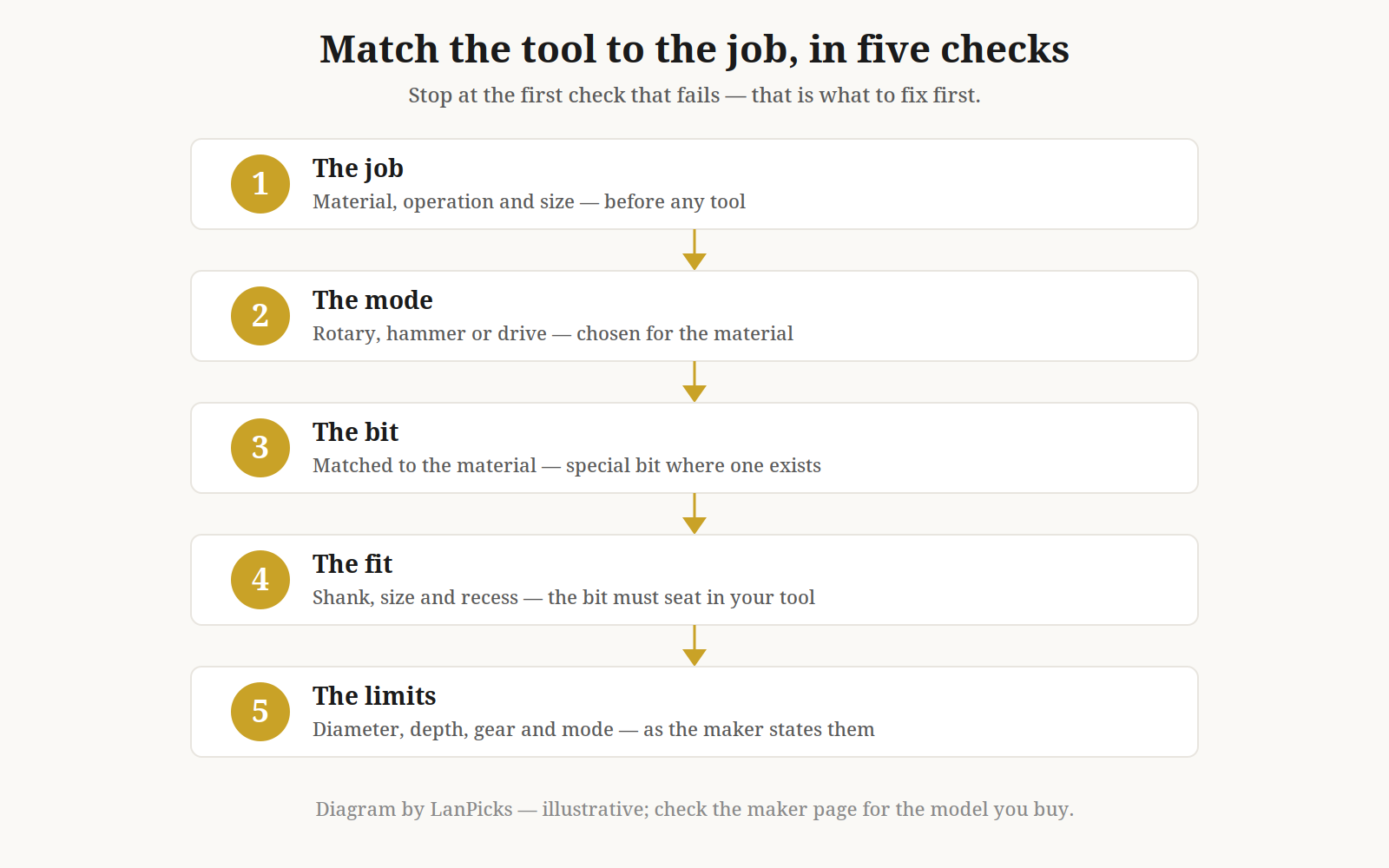
Choose a DIY tool by naming the job, the material and the required accessory before comparing power or kit size. A screwdriver is a sensible starting point for turning screws; a drill driver adds hole-making; an impact driver suits demanding fastening; masonry may require a hammer drill or rotary hammer rated for the material. The right category is only the first check: the exact bit, holder, capacity and instructions must also match.
This guide focuses on buying tools for common home drilling and fastening jobs. LanPicks has not tested the tools discussed here. The manufacturer sources below were checked on 21 November 2026; examples explain a decision process rather than rank products or claim hands-on performance.
Define the job before comparing tools
Write a short task description: “assemble this flat-pack cabinet with the supplied screws,” “make this diameter of hole in this timber,” or “install this bracket on this confirmed wall material.” Include the fastener profile and size, hole diameter and depth where applicable, available working space, and how often you expect to repeat the task.
Separate the operations. Making a hole and driving a screw into it may need different accessories and settings. A cable opening through a cabinet panel is not a reason to drill through a metal hinge: choose a clear, suitable location and identify what the bit will actually contact. If the material or fixing system is unknown, resolve that before selecting a drill and anchor.
Also decide whether you need to buy. For an occasional specialist job, compare borrowing or hiring an appropriate tool with buying and storing one. This is a cost-and-convenience decision, not a substitute for checking suitability.
Choose the tool type for the operation
Tool names vary between markets. Check the stated functions and manual rather than relying on a listing that uses “drill,” “impact” and “hammer” interchangeably.
Swipe horizontally to compare the choices.
| Your task | Category to consider | What to confirm |
|---|---|---|
| A few screws or controlled assembly | Manual screwdriver or matching hex key | Exact tip profile, size and access; assembly instructions |
| Small screws in permitted device maintenance | Precision driver or precision kit | Required profiles, reach and torque instructions; opening the device must be appropriate |
| Repeated light screwdriving | Cordless screwdriver | Supported bit holder and available control; do not assume drilling capability |
| General drilling plus screwdriving | Drill driver | Material and hole capacities, chuck range and settings |
| Repeated or demanding fastening | Impact driver | Fastener suitability and impact-rated accessories; distinct from an impact wrench |
| Holes in suitable masonry | Hammer/combi drill or rotary hammer, as the job requires | Exact substrate, required hole size, supported mode and accessory system |
Bosch distinguishes cordless screwdrivers, drill drivers, combi drills and SDS drilling tools in its category guide. A combi drill adds a hammer function, while a rotary hammer is a different tool category for more demanding masonry work. Do not infer capacity for concrete from the word “hammer” alone: compare the exact model’s material and hole-size specifications.
Bosch’s impact-driver guidance describes these tools primarily as fastening tools with a hex bit holder. Some suitable hex-shank drilling accessories can be used, but that does not make an impact driver the default choice for precise hole drilling. An impact driver’s rotational impacts are also different from a hammer drill’s action for masonry.
Match the accessory to the material and fastener
For drilling, read the accessory’s supported-material list. Wood, metal, masonry and tile accessories can have different cutting designs and permitted operating modes. A multipurpose label does not establish suitability for every stone, tile or layered surface. Check the exact accessory and tool instructions together, including cooling, speed or mode requirements where specified.
For screwdriving, match both the profile and the size. PB Swiss Tools distinguishes Phillips (PH) and Pozidriv (PZ); they are different cross-head systems. Buy the specified match rather than treating every cross-shaped recess as Phillips. The same principle applies to hex and star-shaped fasteners: identify the exact profile and size before selecting a kit.
A wall-fixing purchase adds another dependency: the anchor must be suitable for the substrate and intended load, and its maker specifies the drill diameter, hole depth and screw requirements. There is no single pilot-hole or anchor rule that covers every screw and wall. Use the fixing system’s instructions instead of copying dimensions from an unrelated example.
Check the holder, reach and working space
The cutting end can be right while the shank is wrong. Compare the bit’s stated shank with the tool’s holder or chuck specifications, including its accepted size range. A three-jaw chuck, a hex quick-change holder and an SDS system are different interfaces. Do not assume that the word “hex” or “SDS” proves compatibility with your exact tool.
Check accessory length and whether the tool can reach the work without the body, battery or holder colliding with the surrounding furniture. For recessed screws, the usable reach and shaft diameter matter as well as the tip. Choose adapters only when the tool and accessory makers permit the combination and its operating mode.
Compare capacity, control and what is included
After choosing a suitable category, compare exact models on the information relevant to your task:
- Capacity: the stated material and hole-size limits or fastening applications.
- Control: speed selection, trigger control, clutch or other settings described in the manual. A setting number is not automatically a calibrated tightening torque.
- Handling: size and weight with the intended battery, grip, and access to confined spaces.
- Kit contents: tool, battery, charger, bits, holder and case. A bare tool may omit essentials shown in a promotional image.
- Compatibility: the exact battery platform, approved charger and accessories. Similar voltage labels do not establish interchangeability.
- Ownership: manuals, locally applicable warranty terms, replacement accessories and storage needs.
If a fastening has a specified final torque, follow that requirement with the appropriate tool and method. A larger advertised torque figure does not by itself make a driver better for delicate assembly. Before use, read the tool and accessory safety instructions and arrange the required protective equipment and dust control for the actual task.
Three buying examples
Flat-pack furniture assembly
Start with the furniture instructions and supplied fasteners. A matching hand tool may cover the job; for repeated assembly, consider a suitable powered screwdriver only where the instructions permit it. Do not buy a hammer drill just because the furniture will later need a wall restraint. Identify that separate wall-fixing task first. Our home storage measuring guide covers the fit and anchoring checks to make before choosing the furniture.
A hole for a shelf bracket
Identify the wall material, bracket load and fixing system before comparing drill models. The fixing instructions determine the required hole and compatible anchor. A hollow block, solid brick, tile over a wall and concrete are different situations; do not automatically apply hammer action to all of them.
A small precision-driver kit
Check the exact bit profiles and reach needed, then confirm the listed kit actually includes them. A high piece count does not establish that the one bit you need is present. Our Wowstick Try 1P+ buyer checks show why conflicting listing specifications and unconfirmed kit contents need clarification before purchase. A precision kit is not a substitute for a general drilling tool.
Your before-buying checklist
- Name the operation, material, fastener or hole dimensions.
- Choose a tool category explicitly intended for that job.
- Confirm the exact accessory’s material and operating-mode suitability.
- Match the tip, shank, holder, reach and tool capacity.
- Check the full kit contents, power requirements, instructions and ownership costs.
If an essential specification is missing, ask the manufacturer or seller before ordering. Save the exact model and variant you checked; a similar-looking listing is not proof of an identical tool or kit.
FAQ
Should my first powered tool be a drill or an impact driver?
Choose from the work you expect to do. For general holes and light fastening, compare suitable drill drivers. For frequent demanding fastening, an impact driver may make sense. Check the model and accessory requirements; neither category is best for every task.
Is a hammer drill the same as an impact driver?
No. Hammer/combi drills provide a drilling mode for supported masonry applications; impact drivers deliver rotational impacts for fastening. Similar wording in a listing does not make their functions interchangeable.
Can I use a Phillips bit in any cross-head screw?
No. Identify the actual profile and size. Phillips and Pozidriv are distinct systems. Use the intended match rather than choosing a bit that merely enters the recess.
Will any bit fit my drill?
No. The shank and its size must match the tool’s specified holder or chuck. Material suitability and permitted operating mode must also match; mechanical fit alone is not enough.
Does a bigger accessory kit offer better value?
Only if its useful contents fit your work and tools. Compare the required profiles, sizes, quality information and replacement availability rather than the piece count alone.
Sources
- Bosch DIY — Drill and screwdriver categories, functions and selection considerations
- Bosch Professional — Impact-driver applications, bit holders and drilling limitations
- PB Swiss Tools — Phillips and Pozidriv screw profiles and their different fit
LanPicks may earn a commission if you buy through links on this page, at no extra cost to you. See the Affiliate Disclosure. This is a research-based buying guide, not a hands-on tool test.
Related Posts

A replacement filter or brush listing is a claim, not evidence. The listing says “HEPA”, “OEM-quality”, or “lasts twice as long” — and none of those words can be checked from the listing page. This guide compares filters and brushes by evidence you can gather yourself: measure the old part, test the HEPA claim against […]
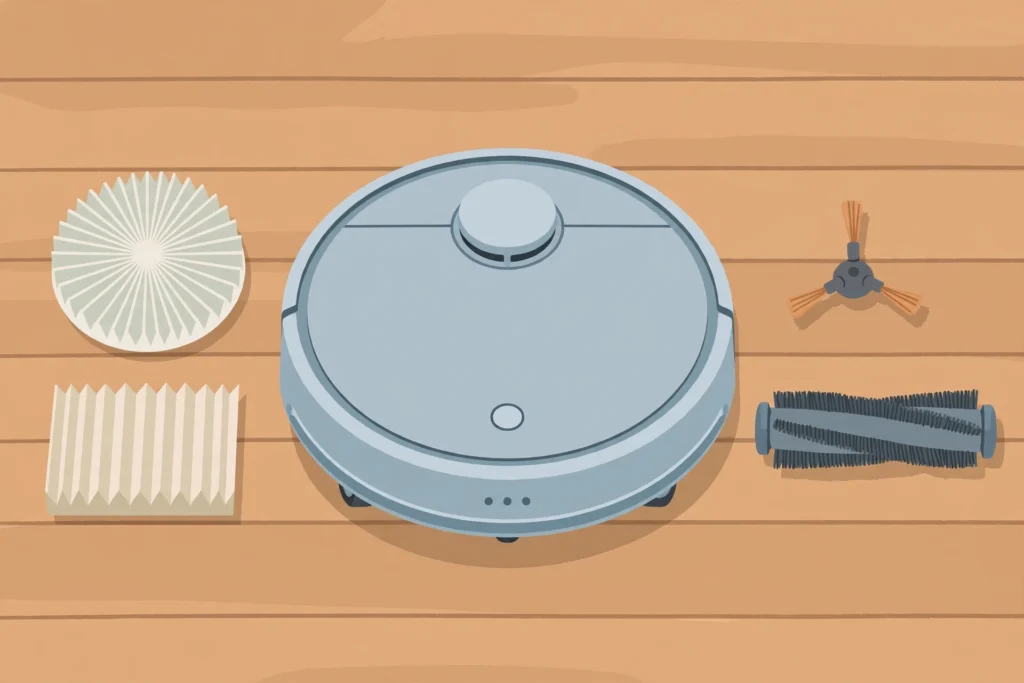
One rule decides whether a replacement part fits your robot vacuum: match the exact model number, not the name on the box. Two robots can share a name and take different filters, brushes, or dust bags, and a listing that names your series but not your exact model has not confirmed anything. This guide is […]

Three checks decide whether a small home appliance fits your home: the space it will actually work in, the voltage and frequency on its rating plate, and the plug and circuit it will run on. Skip any one of them and the appliance can arrive too tall for the shelf, rated for a different mains […]

Five accessory categories decide a travel creator kit: support, audio, light, power, and storage. Everything else is optional. The rule for packing is simple: every accessory you pack should solve a problem you will actually hit on your trip. A flexible tripod that steadies a shot on a rock earns its space; a second lens […]
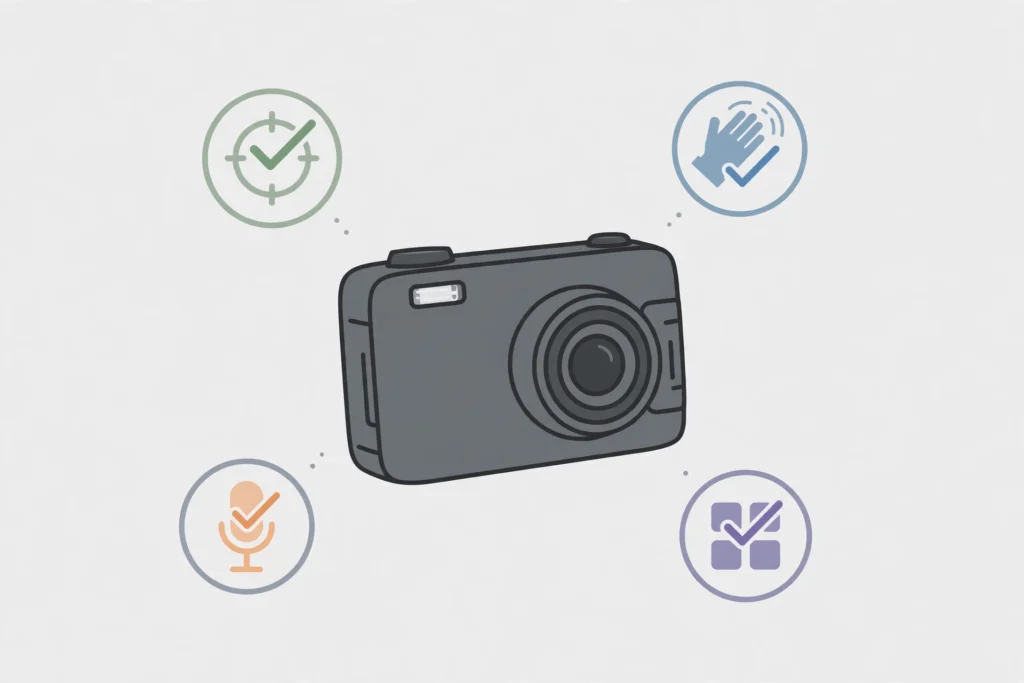
Four checks decide a camera listing: the resolution, the autofocus, the stabilization, and the audio. In that order. Resolution tells you how much detail the camera records. Autofocus decides whether your subject stays sharp while you move. Stabilization decides whether walking footage is watchable. Audio decides whether anyone can understand you. A listing that states […]