

Will a Crossbody Bag Fit a 500 ml Water Bottle?
Yes, if the bag has enough usable interior space and the bottle can pass through the opening. Measure your bottle with the cap on, then compare its height and widest point with the bag’s interior height, width, depth and opening. A 500 ml bottle has no fixed dimensions. The 21 × 7 cm (8.3 × 2.8 in) bottle in HushTug’s guide is one example. For that bottle, roughly 24–25 cm of usable height and about 8 cm of depth are starting points for upright carry; the opening, closure and material can change the fit.
In this guide:
- Measure your bottle first
- Upright carry: the height check
- Sideways carry: the width check
- The mouth is the gate
- Depth: the number that stops a 7 cm bottle
- What the examples show
- Fit checklist
- FAQ
- Sources
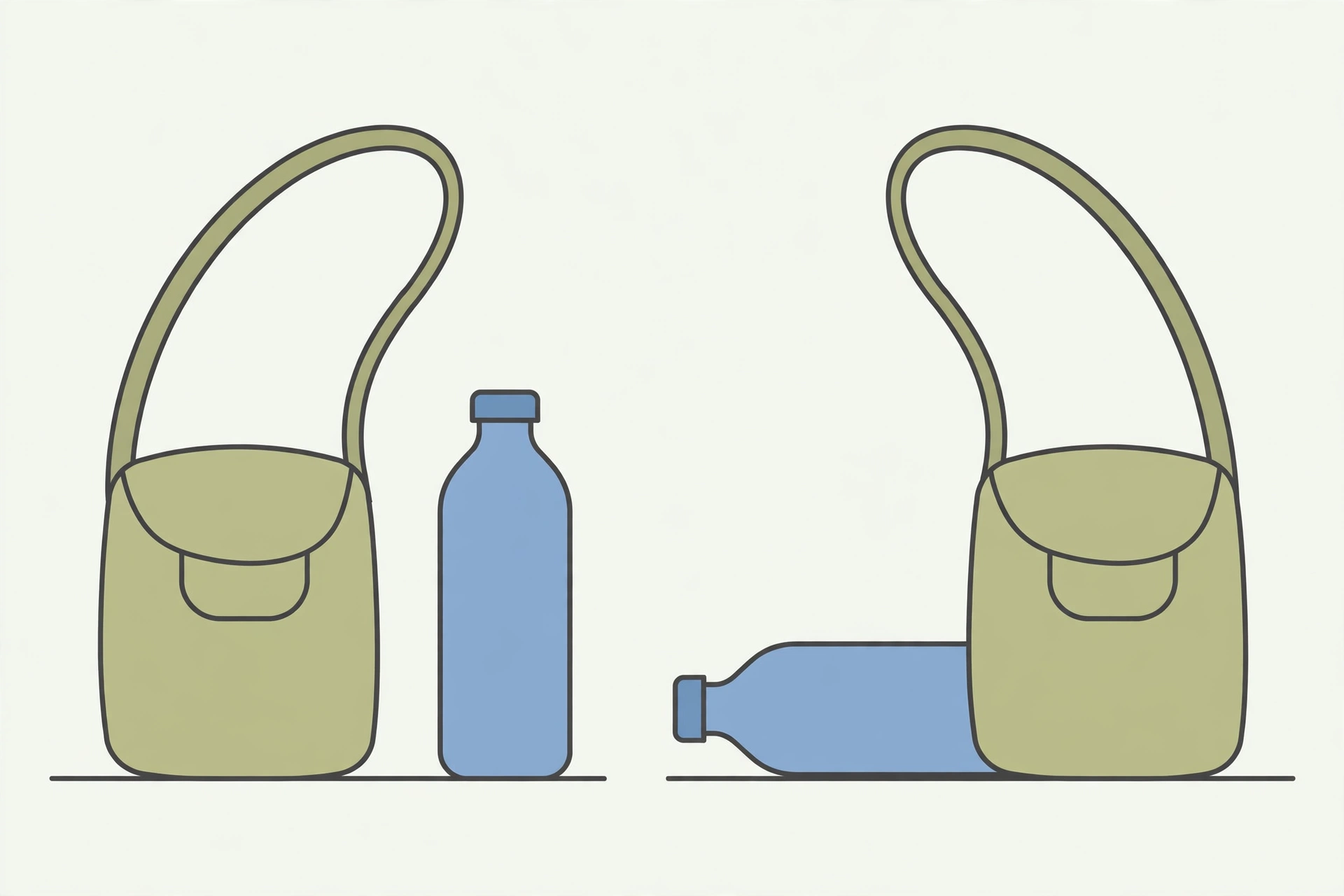
Measure your bottle first
Measure the full height with the cap on and the width at the widest point, including the cap if it protrudes. HushTug uses a 21 × 7 cm bottle as its example. Barking Bags describes a compact 500 ml bottle of about 19 × 7.5 cm. Both have the same capacity, but the shorter bottle is wider.
Use the measurements of the bottle you plan to carry. If you have yet to buy it, check the bottle maker’s dimensions and allow room for the closure.
Upright carry: the height check
Upright carry can reduce the chance of a leak, but the seal depends on the cap. Allow room above the bottle for the bag to close. HushTug’s guide suggests about 25 cm for its 21 cm bottle example. Wildfool describes leaving roughly 3 cm above the tallest item in a drawstring bucket bag. These examples are starting points; measure the usable interior and closure on the actual bag.
If the bag cannot close over your bottle upright, check whether sideways or diagonal carry works with the actual opening and dimensions.
Confirm whether the listed measurements are internal or external. If they are external only, ask the seller for the usable interior dimensions and the fully open zipper or drawstring measurement. Linings, seams and pocket dividers vary by bag.
Sideways carry: the width check
Sideways carry trades height for width. The bottle lies on its side, so the bag needs interior width of at least the bottle’s height — 21 cm in the HushTug example — and depth of at least the bottle’s diameter, 7 cm. It also needs a closure that holds the bottle when the bag tips: a zipper that runs the full width, or a drawstring that cinches tight. HushTug’s own shoulder bag, at 22.5 by 27 by 8.5 cm, is listed as storing a 500 ml bottle both vertically and horizontally, according to the maker.
Sideways carry has a weakness worth knowing before you commit to it. An open bucket tips its contents when you bend over, as Wildfool notes — a closure can help hold the bottle in place. A bottle on its side also presses its full length against one side of the bag, so a soft bag will bulge and lose its shape. If the bottle will ride sideways most days, a firmer bag, or one with a structured base, holds up better than a soft one.
The mouth is the gate
The mouth — the opening of the bag — is the number most listings do not publish, and it is the one that stops bottles that fit on paper. Wildfool calls the opening diameter the single most useful number on a bucket bag listing, and notes that most brands do not publish it: a 30 cm opening means you can see and reach everything at once, while below 20 cm you are fishing by feel. The same logic applies to a zippered crossbody: the zipper is the gate, and it is usually shorter than the bag itself.
For a bottle, the mouth must pass the bottle’s diameter and its cap, not just the body. A wide zipper or a drawstring helps; a short zipper on a tall bag can block a bottle that fits the interior on paper. Our crossbody bag size guide makes the same point for phones: a bag wider than the phone can still fail at the opening. If the listing gives no opening measurement, ask the seller for it, or look for a photo of the bag open with something inside for scale.
Depth: the number that stops a 7 cm bottle
Depth is the quiet killer of bottle fit, because it is the dimension shoppers check last. HushTug puts it plainly: since the diameter of a plastic bottle is about 7 cm, it is safer to choose a bag with a depth of 8 cm or more. A bag that is too shallow cannot take the bottle at any angle — no amount of height helps if the bottle cannot get past the walls.
For a rigid bottle about 7 cm wide, an interior depth of about 8 cm gives some clearance. Check the narrowest part of the compartment, as well as any seams or dividers. For a dedicated bottle pocket, measure that pocket separately. Barking Bags gives an example of a pocket designed for a compact bottle around 19 × 7.5 cm.
What the examples show
The table below lists bags whose makers publish dimensions and state whether a 500 ml bottle fits. They are examples with published numbers, not recommendations — the point is to show how the three checks play out on real listings.
| Bag (as listed) | Size (cm) | Bottle fit, as the maker states it |
|---|---|---|
| HushTug leather shoulder bag | 22.5 × 27 × 8.5 | Fits a 500 ml bottle vertically and horizontally |
| Laipan crossbody, 2 L | 20 × 16 × 9 | Lists a 500 ml bottle as fitting — but its own packing list qualifies the bottle as “collapsible or slim” |
| Healthy Back Bag Sling, 3.5 L | 29 × 17 × 12 | Designed to carry a 500 ml water bottle |
| Healthy Back Bag Baglett, 1.5 L | 25 × 14 × 11 | No bottle listed |
| Healthy Back Bag Small, 6 L | 43 × 23 × 15 | Drink bottle listed |
| Barking Bags Original | 32 × 25 × 8 | Side pocket designed around a compact 500 ml bottle (about 19 × 7.5 cm) |
| Wildfool mid-size bucket | About 27 tall, about 30 opening | Bottle upright |
The Laipan row is the one to study, because it shows how a listing can be accurate and misleading at once. The bag is 20 cm wide and 16 cm tall, and it lists a 500 ml bottle as fitting — but its own packing list qualifies the bottle as “collapsible or slim”, and its FAQ says the bag needs to be at least 2 litres and 16 cm tall. A 16 cm-tall bag cannot stand a 21 cm example bottle upright. Check what bottle shape the listing tested before assuming your own will fit. That is not a contradiction to hide; it is the central caution of this guide. Liters and a “fits a bottle” claim do not replace the three measurements.
Notice also what the table does not show. No maker in these examples states a universal minimum bag size, and the numbers disagree by design: HushTug says 25 cm, Wildfool says 24 cm of interior height, Laipan says 16 cm tall with a slim bottle. The answer is the method — measure the bottle, check height, depth and mouth — not a single number.
Fit checklist
Run through the list with the bottle in one hand and the listing in the other. Each check takes a minute, and each one rules something out before the bag arrives.
- Measure the bottle. Height with the cap on, diameter at the widest point of the body. Use the maker’s published bottle dimensions if you cannot measure it.
- Check the upright height. Check that the usable interior clears the actual bottle and the closure can still fasten.
- Check the sideways width. If the bottle will lie on its side, interior width must clear the bottle’s height (21 cm) and depth must clear its diameter (7 cm).
- Check the depth. Measure the narrowest usable depth and allow room around the widest part of the bottle.
- Check the mouth. The opening must pass the bottle and its cap. A wide zipper or a drawstring helps; if the listing gives no opening measurement, ask the seller.
- Check the closure. A zipper or a drawstring that holds the bottle when the bag tips. An open top can spill when you bend over.
- Check the strap. A full bottle adds noticeable weight. HushTug recommends a strap 3 cm or wider, with padding — a thin strap digs in on a long walk.
- Keep wet things separate. Bottles condensate. Internal pockets keep a phone or a book away from the bottle, and a water-resistant treatment helps.
- Try the iPad cross-check. HushTug’s designer puts it this way: if a shoulder bag can fit an iPad, it should have no problem fitting a 500 ml plastic bottle. It is a cross-check, not a measurement — use it after the three numbers, not instead of them.
- Compare the format, not just the size. A sling and a messenger carry the same bottle differently. Our sling vs messenger guide covers the format choice, and our everyday carry guide shows what else travels with the bottle — phone, wallet, keys and earbuds.
FAQ
Will a 2-litre crossbody bag fit a 500 ml bottle?
Not necessarily. Liters measure volume, not shape. A 2-litre bag that is 16 cm tall cannot stand a 21 cm example bottle upright — the Laipan example in this guide lists a bottle as fitting, but only a collapsible or slim one. Check the interior height, depth and mouth against your bottle’s measurements, not the liter figure. Our crossbody bag size guide explains the liter framework in full.
Can I carry the bottle on its side?
Yes, if the bag’s interior width clears the bottle’s height (21 cm in the HushTug example) and its depth clears the diameter (7 cm), and the closure holds the bottle when the bag tips. A drawstring or a full-width zipper works; An open top can spill when you bend over. A bottle on its side also presses its length against one side of the bag, so a firmer bag holds its shape better than a soft one.
What if the bag is deep enough but the zipper is short?
Then the bottle may not get in at all. The mouth is the gate: it must pass the bottle’s diameter and its cap. A bag wider than the bottle can still fail at the opening if the zipper is short. Look for a wide zipper or a drawstring, and if the listing gives no opening measurement, ask the seller before you buy.
Does a side pocket count as fitting?
It counts if the pocket itself fits the bottle. A side pocket built around a compact 500 ml bottle — about 19 by 7.5 cm, as Barking Bags builds theirs — holds that bottle, but a pocket sized for a slimmer bottle may not hold a bottle that is 7 cm wide. Measure the pocket the same way as the main compartment: height, depth and mouth. A side pocket also keeps condensation away from the main compartment, which is a genuine advantage.
Sources
Related Posts
The Baseus A5 and the Baseus A5 Air look like the same vacuum. They share the same body, the same cyclone system, the same vacuum-compression trick and the same smart blockage alarm. The short answer: the A5 states the higher peak suction — 16,000 Pa against the Air’s 12,000 Pa, a 27.75 Wh battery against […]

You do not need special translation earbuds to hear live translations in your ears. Google Translate’s Live translate works with any pair of headphones — Google’s own words — on Android and on iPhone. The short answer: pair your Bluetooth earbuds, open the Translate app, tap Live translate, and pick a mode. Listening mode plays […]

A replacement filter or brush listing is a claim, not evidence. The listing says “HEPA”, “OEM-quality”, or “lasts twice as long” — and none of those words can be checked from the listing page. This guide compares filters and brushes by evidence you can gather yourself: measure the old part, test the HEPA claim against […]
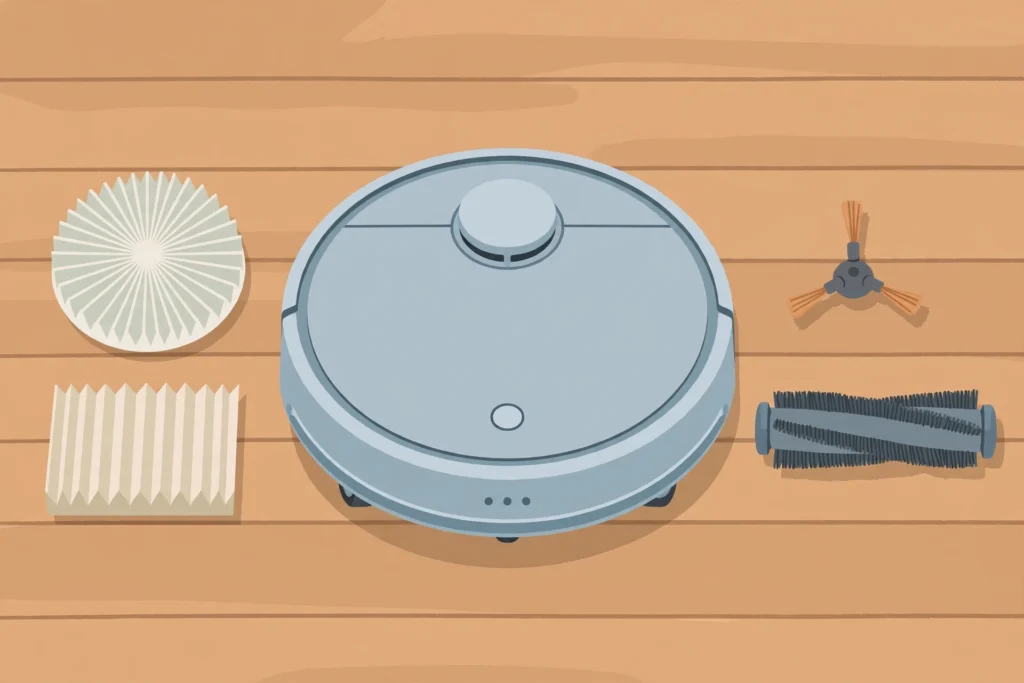
One rule decides whether a replacement part fits your robot vacuum: match the exact model number, not the name on the box. Two robots can share a name and take different filters, brushes, or dust bags, and a listing that names your series but not your exact model has not confirmed anything. This guide is […]

Three checks decide whether a small home appliance fits your home: the space it will actually work in, the voltage and frequency on its rating plate, and the plug and circuit it will run on. Skip any one of them and the appliance can arrive too tall for the shelf, rated for a different mains […]