

Over-Ear vs In-Ear Headphones for Commuting: Which Fits Your Trip?
For commuting, in-ear headphones usually win — and the reason is the commute itself, not the spec sheet. A commute is short, crowded, and noisy, and it asks for portability, a secure fit, and isolation you can carry in a pocket. Over-ear headphones win on sound and long-session comfort, but they are bulky, warm, and hard to pack. The right choice depends on how long your trip is, how noisy it is, and whether you take calls on the way — so this comparison is organised by the commute, not by the driver size.
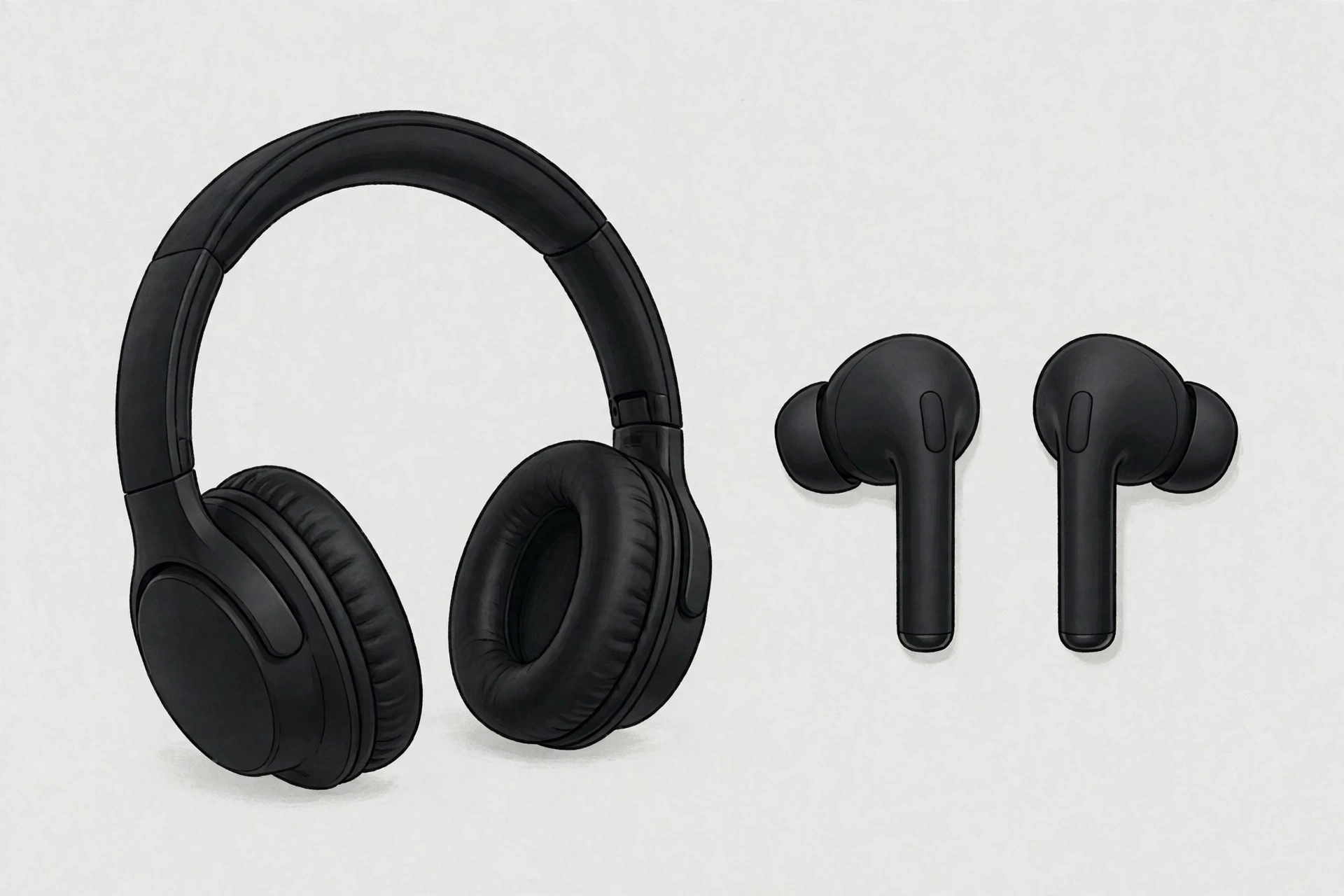
There is no single winner. Over-ear headphones give you a bigger, more natural-sounding listening experience: their larger earcups can hold bigger drivers, which helps produce a wider soundstage and deeper bass. In-ear headphones sit inside the ear canal with silicone or foam tips that create a snug fit; they are small, light, and easy to take anywhere. Both can have strong active noise cancelling. The differences that decide a commute are comfort over the trip length, how much noise each type actually blocks, how they carry, and how safely you can listen at the volume the trip forces on you.
The short answer, by trip
| Your commute | Usually the better pick | Why |
|---|---|---|
| Under 30 minutes, bus or subway | In-ear | Pocketable, secure fit, strong isolation for the size |
| 30–60 minutes, train | Either | Comfort starts to matter; in-ear still wins on carry |
| Over 60 minutes, or you work on the train | Over-ear | Long-session comfort, deeper isolation, bigger sound |
| Walking or cycling part of the way | In-ear, with transparency mode | You need to hear traffic; over-ear cups block too much |
| Calls on the move | In-ear | Microphones sit closer to your mouth |
That table is a starting point, not a verdict. The sections below explain each row, so you can check it against your own trip.
Sound: bigger cups, bigger stage
Over-ear headphones have the sound advantage, and the reason is physical. Large padded earcups completely surround your ears, and the larger drivers inside them produce a wider, three-dimensional soundstage and deeper bass. In-ear headphones can deliver excellent, detailed sound in a much smaller design — good in-ear pairs are not far behind on clarity — but they cannot match the sense of space a large cup gives you. If your commute is your main listening time and music matters most to you, over-ear is the better sound.
Driver size is part of the story, not the whole of it. Most earbuds use dynamic drivers between 6mm and 12mm, and a well-tuned small driver can outperform a poorly tuned large one. Do not buy on driver size alone — the same rule our budget wireless earbuds guide applies to earbuds applies here too.
Noise: the seal does the work, the electronics finish it
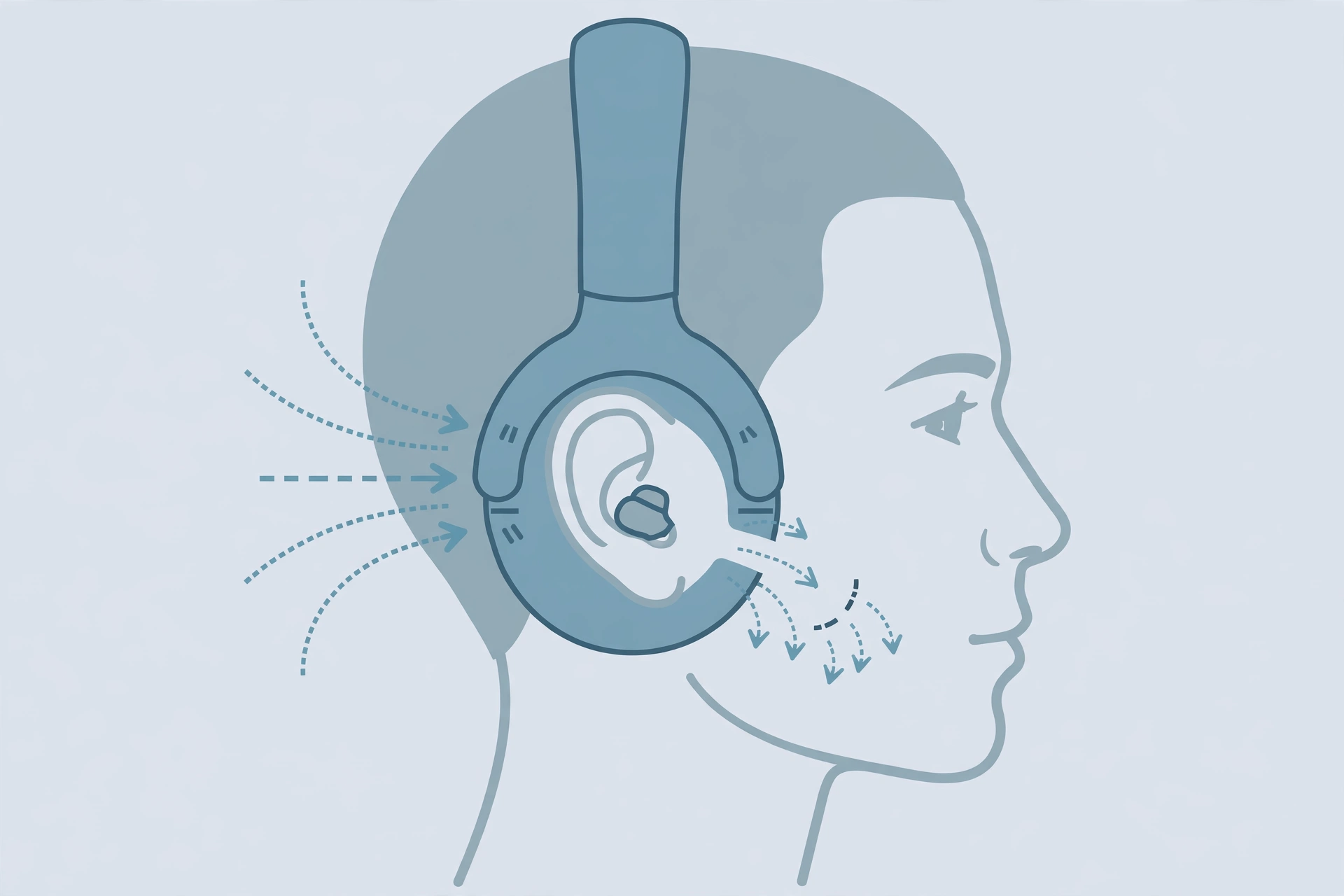
Noise control is where the two types differ most on a commute, and the difference starts before any electronics switch on. For in-ear headphones, the seal is the argument: the tip creates a seal that isolates the ear from ambient air, and that passive isolation does a surprising amount of the work, especially against mid and high frequencies that noise cancelling struggles with. For over-ear headphones, the cup itself blocks sound, and closed-back designs keep sound inside as well as out — open-back headphones, by contrast, neither retain nor block sound, and belong in a quiet room at home, not on transport.
Active noise cancelling then adds to the passive isolation. The best noise-cancelling earbuds reduce ambient noise by roughly 25–30 dB, which is meaningful but not silence — and if you need maximum isolation, over-ear headphones are still the better tool, because they have larger drivers, more space for microphones, and a physical cup that blocks sound.
How is isolation measured? RTINGS tests it with a head-and-torso simulator in a treated room, playing pink noise from speakers around the rig, and records how much outside noise is blocked with the headphones on, with noise cancelling off, and with it on. Its newer tests add real-life scenarios — airplanes, offices, busy streets — plus voice handling and wind, because pink noise alone does not describe a commute. Adaptive noise-cancelling systems also take time to respond to a new sound, so the measurement gives the headphones a head start before recording. When you read an isolation claim, ask whether it was measured this way or just stated on the box.
Comfort: hours, heat, and pressure
Over-ear headphones are more comfortable for long sessions. The padded earcups sit around your ears, and the headband spreads the weight, so nothing presses inside the ear canal. In-ear headphones are lighter but rely entirely on well-fitting ear tips for comfort, and after an hour or two the tip in the canal can ache. On a short commute that does not matter. On a 90-minute train ride it does.
Over-ear has two comfort costs of its own. The cups retain heat around the ears, which makes them unpleasant in summer or during exercise, and they are difficult to carry and weigh on the neck during long sessions despite a good headband. On-ear headphones, the third type, sit in the middle and are usually the worst of both: the pads rest on the ear cartilage, the pressure becomes burdensome over the hours, and their passive isolation stays limited because the pads do not form an airtight seal.
Portability: the pocket test
In-ear headphones win portability outright. They slip into a pocket or a small bag, usually with a charging case that keeps them together and tops them up between trips. Over-ear headphones take up far more room, although some fold down to make packing easier — and even folded, they need a bag, not a pocket. If your commute involves a crowded bus, a bike, or a walk through a station, the pair you can pocket without thinking is the pair you will actually carry.
Battery follows the same split. Over-ear headphones have larger batteries and often plenty of listening between charges. In-ear pairs last a few hours per charge, and the case provides the extra charges — so the total with the case is the number that matters, not the per-charge figure alone.
Hearing safety: the commute sets your volume
The strongest reason to choose carefully is hearing safety, and the commute is what makes it matter. The World Health Organization’s safe-listening guidance says you can safely listen at 80 dB for up to 40 hours a week — but at 90 dB the safe time drops to four hours a week. It advises keeping your device’s volume at no more than 60% of maximum, and staying below an 80 dB average if you use an app to monitor your sound level. It also advises using well-fitted, noise-cancelling headphones precisely to reduce the need to raise the volume in noisy situations. Good isolation makes that guideline easier to follow, since it removes the reflex to turn the sound up to cover the noise of a subway or a shared office.
That is the real test for a commuting pair: does it let you hear your music clearly at a moderate volume on a noisy train? If you have to turn the volume up to cover the engine, the pair is failing you — whichever type it is. A well-sealed in-ear pair or a closed-back over-ear pair both pass that test; a leaky fit or an open-back design does not.
Calls and awareness: two commuting needs
For calls, in-ear usually wins. The microphones sit closer to your mouth, and the seal keeps the train noise out of the call. Over-ear microphones sit further from your mouth and pick up more of the room. If calls are your main use on the move, our guide to wireless earbuds for travel and calls applies the same microphone and fit checks to the travel case.
For awareness, the answer flips by situation. On a train, full isolation is fine. On foot or on a bike, it is not: you need to hear traffic, announcements and the people around you. Good transparency mode lets you hear them without removing the earbuds — test it specifically, by having someone talk to you, and listen for whether their voice sounds natural or processed. Over-ear cups block more by design, which is a disadvantage when you need to stay aware.
A short checklist before you buy
- Time your commute. Under 30 minutes, prioritise portability; over an hour, prioritise long-session comfort.
- Try the pair on a noisy street, not in a quiet shop. If you have to raise the volume to hear, the isolation is not enough.
- Check the seal: for in-ear, try every tip size; for over-ear, check the cups close fully around your ears.
- If you walk or cycle part of the way, test transparency mode before you buy.
- If you take calls, call someone from a busy street and ask them to rate your clarity.
- Do not buy open-back headphones for commuting — they leak sound out and let noise in.
FAQ
Are over-ear headphones better for commuting?
Not usually. They sound better and are more comfortable for long sessions, but they are bulky, warm, and hard to carry. For most commutes — especially under an hour, on a bus or subway — in-ear headphones are the better pick. Over-ear wins when the trip is long enough that comfort matters more than portability.
Do in-ear headphones block more noise than over-ear?
For their size, yes: a good seal blocks a lot of noise passively, and premium in-ear pairs have strong noise cancelling. But the best noise-cancelling earbuds reduce ambient noise by roughly 25–30 dB, while over-ear headphones add a physical cup on top of the electronics — so for maximum isolation, over-ear is still the better tool.
Is it safe to listen at full volume on the train?
No. The WHO’s safe-listening guidance allows 80 dB for up to 40 hours a week, but only four hours a week at 90 dB, and advises keeping volume at no more than 60% of maximum. Well-fitted, noise-cancelling headphones help because they let you listen at a lower volume in noisy places.
What about on-ear headphones?
They are a compromise that usually loses on both sides: smaller than over-ear, less intrusive than in-ear, but weaker for comfort and isolation. The pads rest on the ear cartilage and become burdensome over hours, and they do not seal, so noise gets in and sound leaks out. For commuting, pick one of the other two.
Sources
- World Health Organization — Deafness and hearing loss: Safe listening (80 dB for up to 40 hours a week; 90 dB for four hours a week; volume at no more than 60% of maximum; well-fitted, noise-cancelling headphones)
- RTINGS — Test Bench 1.7 changelog (noise isolation methodology: full-range pink noise, common scenarios, voice handling, ANC wind handling)
- SolderMag — How to Choose True Wireless Earbuds: A No-Nonsense Buyer’s Guide (earbud ANC reduces ambient noise by roughly 25–30 dB; over-ear headphones are the better tool for maximum isolation)
- Currys — Over-ear headphones vs in-ear headphones (soundstage and bass; comfort; portability; noise cancellation; battery; exercise)
- HomeCineSolutions — In-ear, on-ear or over-ear: which type of headphones for which use? (the seal; on-ear cartilage pressure; closed-back vs open-back; over-ear bulk and heat; isolation and safe listening)
LanPicks has not tested the headphones discussed in this guide and names no best model. All figures above come from the sources listed, checked on 22 Nov 2026.
Related Posts

A replacement filter or brush listing is a claim, not evidence. The listing says “HEPA”, “OEM-quality”, or “lasts twice as long” — and none of those words can be checked from the listing page. This guide compares filters and brushes by evidence you can gather yourself: measure the old part, test the HEPA claim against […]

One rule decides whether a replacement part fits your robot vacuum: match the exact model number, not the name on the box. Two robots can share a name and take different filters, brushes, or dust bags, and a listing that names your series but not your exact model has not confirmed anything. This guide is […]

Three checks decide whether a small home appliance fits your home: the space it will actually work in, the voltage and frequency on its rating plate, and the plug and circuit it will run on. Skip any one of them and the appliance can arrive too tall for the shelf, rated for a different mains […]

Five accessory categories decide a travel creator kit: support, audio, light, power, and storage. Everything else is optional. The rule for packing is simple: every accessory you pack should solve a problem you will actually hit on your trip. A flexible tripod that steadies a shot on a rock earns its space; a second lens […]
Four checks decide a camera listing: the resolution, the autofocus, the stabilization, and the audio. In that order. Resolution tells you how much detail the camera records. Autofocus decides whether your subject stays sharp while you move. Stabilization decides whether walking footage is watchable. Audio decides whether anyone can understand you. A listing that states […]